
You trust your team. You want to believe that the $250 dinner receipt from “The Prime Steakhouse” was a critical negotiation with a high-value client. You do not want to be the paranoid manager wondering if it was actually a Saturday date night.
However, the data presents an uncomfortable reality.
Global financial research indicates that expense fraud costs businesses approximately 5% of their total revenue annually. This is rarely a grand heist. It is “death by a thousand cuts”—a duplicate Uber receipt here, a slightly edited PDF there, or a “Ghost Invoice” for office supplies that never arrived.
For years, this leakage was considered the cost of doing business. Today, AI-Driven Expense Auditing has made it optional.
Here is how modern finance teams are using Forensic AI to detect patterns that the human eye misses.
Phase 1: The “Digital Forensic” Scan (Detecting Altered Documents)
Dishonest actors increasingly use sophisticated software to alter digital receipts. To a tired Accounts Payable (AP) clerk, these edits look flawless. To an AI auditor, they scream “Anomaly.”
1. The Metadata Mismatch Every digital file contains “Metadata”—a digital fingerprint of its history.
- The Scam: An employee changes a $15.00 Uber receipt to $150.00 using a PDF editor.
- The AI Fix: Enterprise tools (like AppZen or Ramp) scan the file’s DNA. If the receipt claims to be a photo from an iPhone camera, but the metadata tags say “Adobe Photoshop CS6” or “Canva Export,” the AI flags it instantly as “High Risk: Manipulated File.”
2. The OCR Typography Check Optical Character Recognition (OCR) does not just read text; it analyzes font consistency.
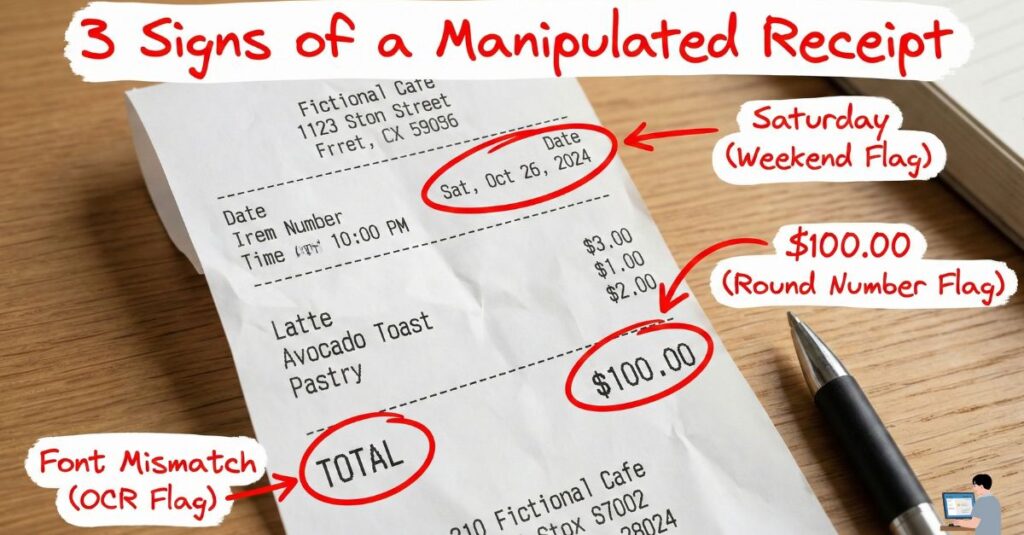
- The Scam: A fraudster pastes a new number over the old total.
- The AI Fix: The AI notices that the “Total” font is Arial, while the rest of the receipt is Helvetica. Or it detects that the “$150” is pixelated differently than the date. This “Pixel-Level Analysis” triggers an automatic rejection.
Phase 2: Behavioral Analysis (The “Personal Dinner” Trap)
The most common form of fraud is not forgery; it is Mischaracterization. This is when a legitimate receipt is submitted for an illegitimate reason.
The “Saturday Night” Anomaly
- The Behavior: An employee submits a dinner bill for a “Client Meeting.”
- The AI Detection: The system cross-references the receipt timestamp with the calendar. It knows that 96% of legitimate B2B meetings occur Monday through Friday. A receipt stamped “Saturday, 8:30 PM” automatically triggers a “Weekend Protocol” review.
The “Alcohol-to-Food” Ratio
- The Behavior: A bill is submitted for a “Team Lunch.”
- The AI Detection: The AI parses line-item data (Level 3 Data). If it detects that 80% of the bill was alcohol (e.g., “Grey Goose Vodka x4”) and only 20% was food, it flags the expense as a violation of Corporate T&E (Travel & Expense) Policy.
The Guest Count Discrepancy
- The Behavior: The employee claims they took “4 Clients” to dinner to justify a $400 bill.
- The AI Detection: The AI connects to your CRM (Salesforce or HubSpot). If the meeting notes listed only “1 Client,” but the receipt shows “4 Entrees,” the discrepancy is flagged immediately.
Phase 3: Ghost Invoices and “Dummy” Vendors
This category represents the highest financial risk. Ghost Invoices are bills for services that never happened or goods that were never delivered.
The Entity Existence Check Advanced AI tools perform a real-time “Know Your Vendor” (KYB) check.
- The Audit: The AI verifies the vendor’s address on Google Maps and business registries.
- The Flag: If the address points to a residential house, a P.O. Box, or an empty lot, the invoice is marked as a “Phantom Vendor.”
- The Result: The system blocks the payment before the wire transfer is initiated.
Bonus Guide: The “Forensic Auditor” AI Prompt
If you are a smaller business without an enterprise budget, you can use Large Language Models (LLMs) like ChatGPT-4 or Claude 3 to perform a basic audit on suspicious documents.
The Prompt: Copy and paste this into your secure AI instance. Then, upload the text (or image) of the receipt in question.
System Role: You are a Senior Forensic Accountant with 20 years of experience in corporate fraud detection.
Task: Analyze the attached receipt data for indicators of manipulation or policy violations.
Analysis Rules:
- Date/Time Logic: Is the transaction on a weekend, holiday, or late night (after 9 PM)?
- Math Verification: Sum the individual line items. Do they match the “Total” exactly? (Fraudsters often miscalculate tax percentages).
- Vendor Verification: Does the vendor name or address look generic or non-standard?
- Anomaly Detection: Identify any alcohol brands or “non-business” items (e.g., gift cards, electronics).
Output: Provide a “Risk Score” from 1-10 (10 being high risk) and bullet point the specific anomalies found.
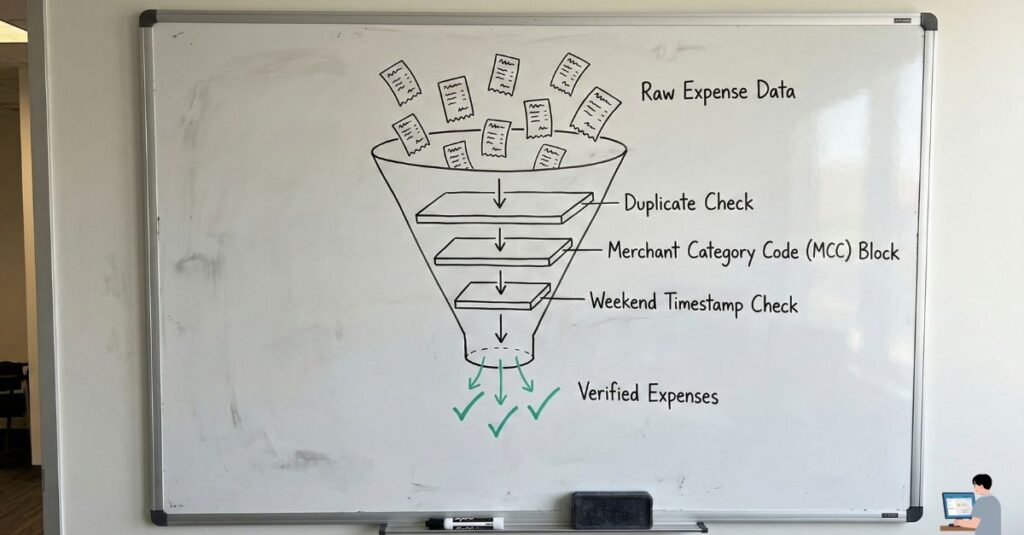
Why This Works: Fraudsters are often lazy with math. They might guess the tax amount or round the total to an even number (e.g., $100.00), which rarely occurs in organic transactions. This prompt forces the AI to check the math that humans usually ignore.
Conclusion: Trust, But Verify
The goal of implementing AI auditing is not to create a culture of fear. It is to build Guardrails.
When employees know that an intelligent system is reviewing every pixel of every receipt, the “opportunity” for fraud disappears. The result is not just saved money; it is a culture of transparency and compliance.