London Underground for Blind and Low Vision Travelers: The System Most Guides Get Wrong
Most accessibility guides to London stop at “guide dogs are welcome.” Here’s what actually gets you across the city — the staff-assist service that needs no booking, the one line where that isn’t true, and the information gap that catches even confident travelers off guard.
Search “London Underground accessibility” and almost every result talks about wheelchairs, step-free stations, and lifts. If you’re blind or have low vision, none of that is really your problem — the Tube’s actual barrier isn’t stairs, it’s information. Knowing where you are, which train just arrived, and whether anything has changed without you being able to see a departure board.
London solves this in a way that genuinely works, once you know how it’s built. It isn’t perfect, and one part of the network breaks the pattern in a way that trips up first-time visitors. This guide covers both.
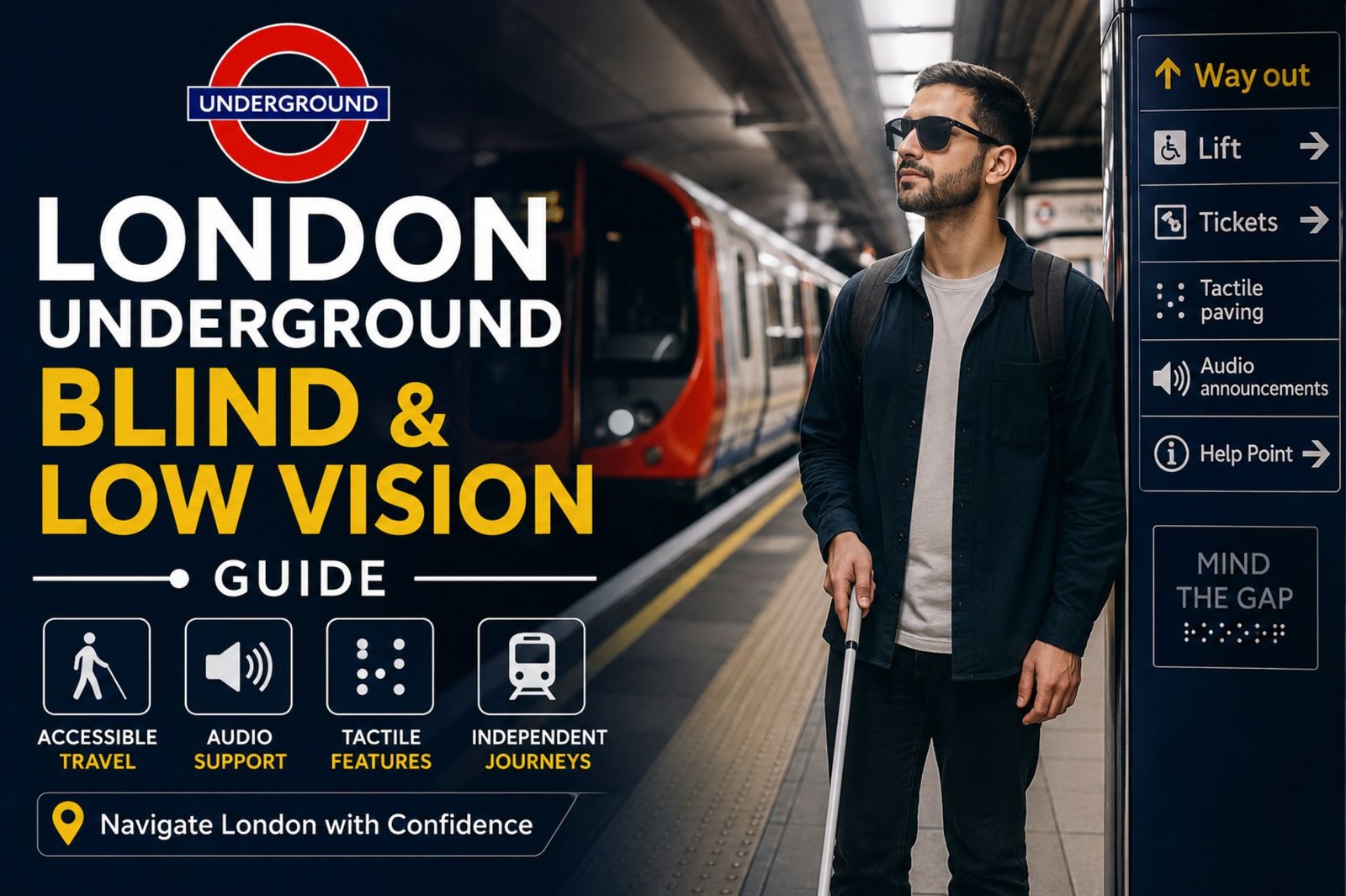
The Tube is genuinely usable independently — not mainly because of infrastructure, but because of a free, walk-up staff escort called Turn Up and Go. Guide dogs are welcome everywhere, including on escalators, thanks to joint training between TfL and Guide Dogs UK. The one exception: the DLR is mostly unstaffed, so assistance there has to be booked in advance, not requested on arrival.
01How Turn Up and Go Actually Works
This is the part first-time visitors don’t expect: you don’t need an app, a booking reference, or a phone call. You just show up and ask.
A ticket office, the gate line, or a platform supervisor — any staff member on duty can start the process.
No form, no ID check. Staff simply need to know where you’re headed to plan the route with you.
Staff are trained in proper sighted-guide technique — offering an elbow to walk beside you, not steering you from behind. You lead the pace.
On busier interchanges, staff can pass a message ahead so someone is aware you’re arriving, though this isn’t guaranteed at every station.
TfL and Guide Dogs UK jointly developed training so assistance dogs can ride escalators safely. You don’t need to detour to a lift unless you’d rather.
Turn Up and Go only works if a staff member is actually there. Smaller outer-zone stations reduce staffing late at night and very early in the morning. If you’re travelling outside normal hours, check the station’s staffed hours on the TfL website before you leave, or call ahead — don’t assume every station is staffed around the clock.
02The Detail Most Guides Skip: The DLR Isn’t the Tube
Most articles describe “TfL” as one accessible network and leave it there. In practice, the Docklands Light Railway runs on a different model entirely. Most DLR stations are unstaffed — Passenger Service Agents ride the trains rather than stand at every platform.
That means if any part of your journey touches the DLR — Canary Wharf, Greenwich, London City Airport, Stratford International — physical assistance there has to be booked in advance, by phone or online, rather than requested on the spot the way it works on the Tube.
If your route mixes lines, this is the one leg worth planning the day before rather than assuming Turn Up and Go will simply carry over.
03Where the Information Gap Really Bites
The basics are covered well. Trains announce the next stop on board, platforms announce arrivals, and accessible ticket machines have audio prompts. That part of the system genuinely works.
What’s inconsistent is real-time disruption information. Engineering works, platform changes, and last-minute closures are still communicated mainly through visual departure boards and posters at the station — not always through an announcement. A London Assembly investigation into travelling with a sensory impairment flagged exactly this: formats built for sighted passengers don’t automatically carry over to blind and low vision passengers.
The practical fix is simple but easy to forget: don’t wait for an announcement to volunteer a problem. Ask staff directly — “is anything disrupted on this line today?” — when you request Turn Up and Go, and check TfL’s live status page with a screen reader before you leave home.
What Real Travelers Are Saying
Recurring patterns across blind and low vision travel blogs and community forums — shared experience, not individual endorsements.
Travelers repeatedly describe staff showing up reliably once asked, a contrast to systems elsewhere that require advance booking just to move through a station.
Several travelers single out that staff offer an arm rather than grabbing or pushing — a small detail that repeatedly comes up as the difference between feeling escorted and feeling handled.
First-time visitors often assume they’ll need lifts everywhere with a guide dog, then are surprised the joint TfL and Guide Dogs UK training means their dog can ride escalators normally.
04Frequently Asked Questions
Is the London Underground accessible for blind and low vision travelers?
Do I need to book Tube assistance in advance?
Can I bring my guide dog on the Underground?
What happens if I arrive at a station with no staff?
Is the DLR different from the Tube for assistance?
Sources

2 thoughts on “London Underground Guide for Blind and Low-Vision Travellers”