You poured money into Facebook Ads. You optimized your landing page. Finally, a notification pings: “New Lead: John Smith.”
You feel good. You finish your coffee, answer a few emails, and 30 minutes later, you call John. He doesn’t pick up. You leave a voicemail. He never calls back.
You just lost money.
We see this problem every day. Business owners ask, “Why am I not closing more deals?” They blame the economy. They blame “bad leads.”
But the data tells a different story. The problem isn’t lead quality. The problem is your stopwatch.
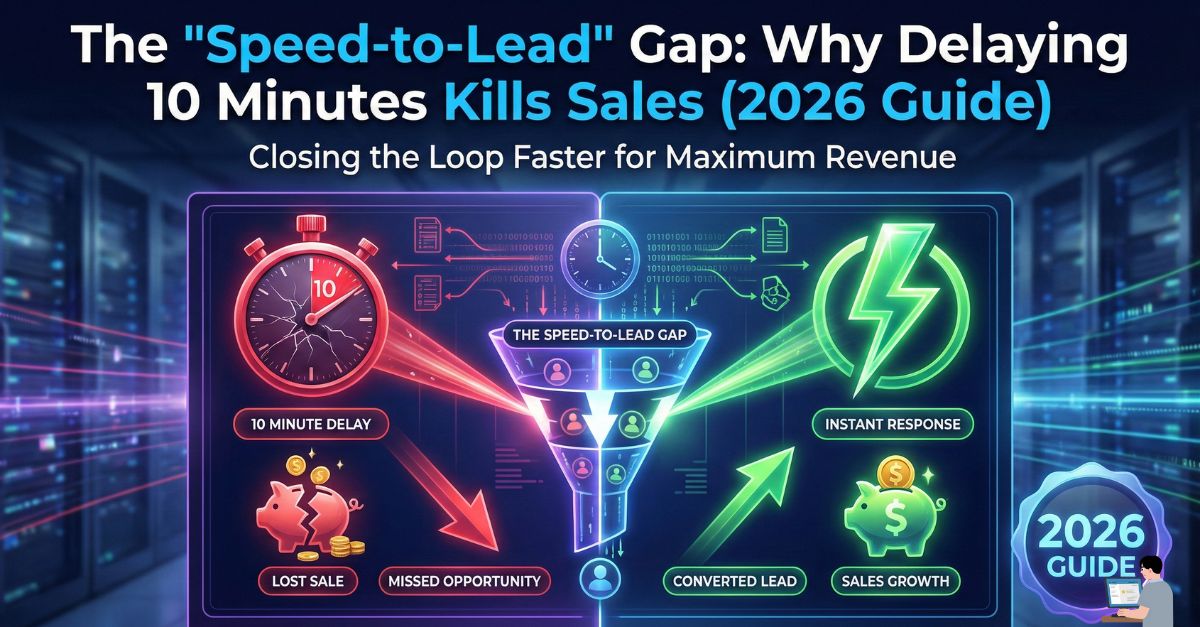
In this guide, we are closing the ‘Speed-to-Lead’ Gap. We will analyze why waiting just 10 minutes can drop your conversion rate by 400%, and how to fix it using the new rules of Sales Automation.
Phase 1: The “Death Zone” (The Math of Delay)

In the old days of sales, the “15-Minute Rule” was the gold standard. If you responded within a quarter of an hour, you were fast.
In 2026, 15 minutes is an eternity. According to data from Harvard Business Review and InsideSales:
- The 5-Minute Cliff: The odds of qualifying a lead drop by 80% if you wait just 5 minutes versus 10 minutes.
- The First Responder Win: 50% of all sales go to the vendor that responds first. Not the best vendor—the fastest one.
The Psychology of “Now”: When a customer fills out a form, they are holding their phone. They are thinking about their pain point right now.
- If you call in 2 minutes, you are a helpful solution.
- If you call in 30 minutes, you are an annoying interruption. They have already moved on to watching TikTok or walking the dog.
Phase 2: Decoding the “Rules” of High-Performance Sales
To fix Low Sales Performance, you need to understand the benchmarks successful teams use. Let’s break down the jargon you see on Reddit and LinkedIn.
1. The 3-3-3 Rule (Persistence Strategy)
Most sales reps give up after one unanswered call. The 3-3-3 Framework solves this:
- 3 Days: Call/Email the lead once a day for the first 3 days.
- 3 Weeks: If no answer, nurture them once a week for 3 weeks (sharing value, not asking for sales).
- 3 Months: If still cold, touch base once a month for 3 months.
2. The 10-3-1 Ratio (The Funnel Reality)
This rule sets expectations for Retail and B2B alike. For every 10 leads you generate:
- 3 will be qualified conversations.
- 1 will become a customer. The Lesson: If you want 10 sales, you don’t need 10 leads; you need 100. If your ratios are lower than this, you likely have a “Speed Issue,” not a “Skill Issue.”
3. The 70/30 Rule (Active Listening)
The Problem: Sales reps talk too much. The Fix: The prospect should talk 70% of the time. You should talk 30% of the time. You cannot solve their problem if you don’t hear it.
Phase 3: The Diagnosis (Why Are Your Sales Low?)
If you are a Sales Manager writing an explanation letter for low performance, or a founder analyzing a bad month, look for these three hidden killers:
1. The “Manual” Bottleneck
The Issue: You rely on humans to notice a lead email and dial the number manually. The Result: Humans get distracted. “I’ll call them after lunch” is the sentence that kills revenue.
2. The “Availability” Blindspot
The Issue: In Retail or E-commerce, if a customer asks a question on Instagram DM and you don’t reply instantly, they bounce to Amazon. The Fix: You need Chatbot Automation to handle inquiries 24/7.
3. The “Follow-Up” Fatigue
The Issue: A lead says “not now.” The sales rep marks them as “Lost” in the CRM. The Fix: That lead isn’t lost; they are just not ready. They need Automated Nurturing, not deletion.
Phase 4: The Solution (Automating “Speed-to-Lead”)
You cannot hire humans fast enough to beat the 5-minute clock 24/7. You need AI Automation.
The “Instant Response” Workflow: Instead of waiting for a human, set up a CRM Automation Flow (using tools like HubSpot, Salesforce, or HighLevel):
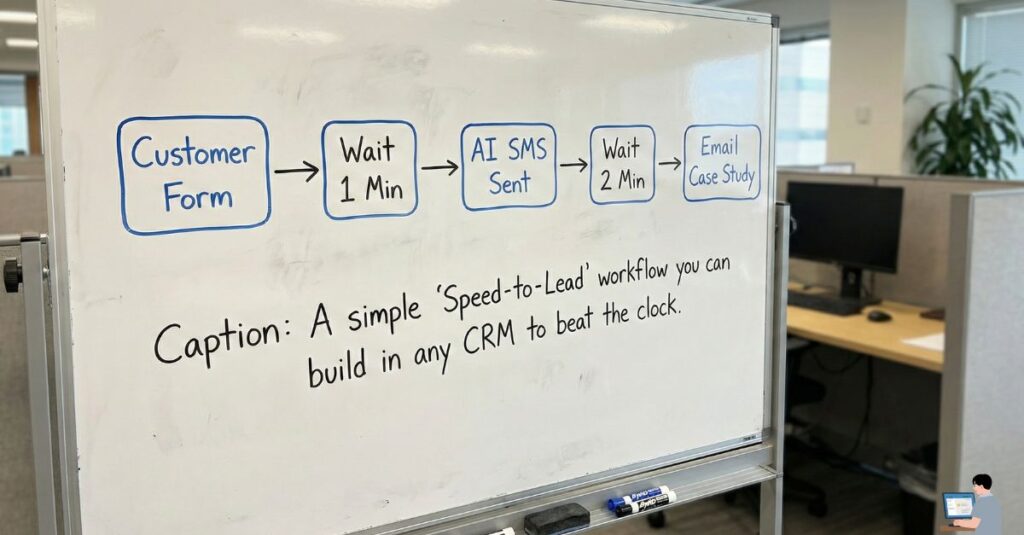
- Minute 0 (The Trigger): Customer submits a form on your site.
- Minute 1 (The SMS): AI sends a personalized text: “Hi [Name], saw you asked about [Product]. Do you have 2 mins for a quick chat?”
- Minute 2 (The Email): AI sends a relevant Case Study to build trust.
- Minute 5 (The Call): If they reply “Yes” to the text, the software dials your sales phone and connects you instantly.
Why this works:
- You hit the 5-minute window every single time, even at 2 AM.
- You filter out “tire kickers” (they won’t reply to the SMS).
- Your human team only talks to people who want to talk.
Bonus Phase: Train ChatGPT to Write Your Scripts (Copy & Paste)
You don’t need to hire a copywriter to fix your follow-up emails. Use these prompts to train your AI.
Prompt 1: The “Cold Lead” Reviver
Use this to wake up leads who haven’t replied in 2 weeks.
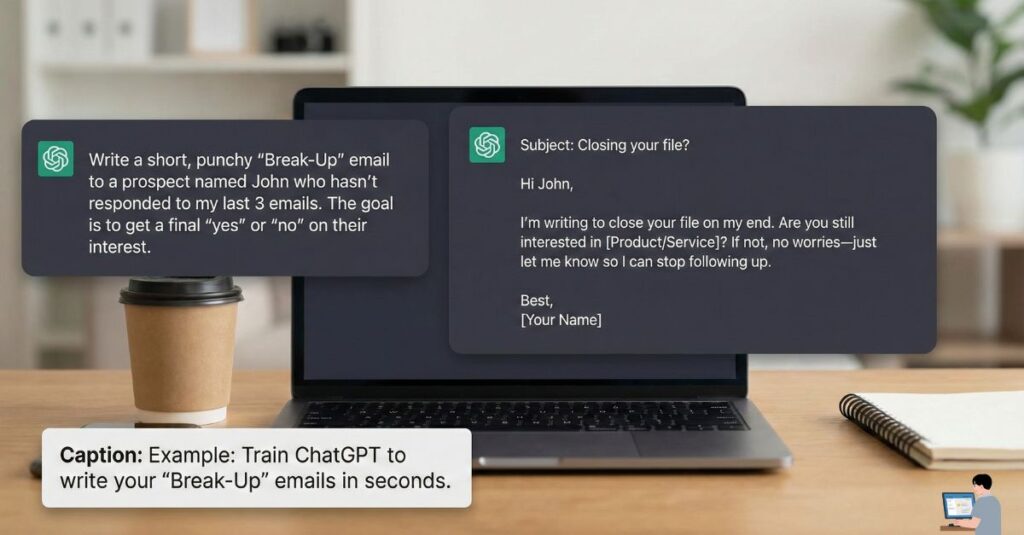
Role: Act as a Senior Sales Copywriter. Task: Write a “Break-Up” email to a lead named John who hasn’t replied to my last 3 emails. Context: I sell [Insert Product]. Goal: Use humor or “radical candor” to get a response. Ask if he has given up on [Solving the Problem] or if he is just busy. Keep it under 100 words.
Prompt 2: The “Objection Handler”
Use this when a client says “It’s too expensive.”
Role: Act as a Negotiation Coach. Task: Give me 3 responses to the objection: “Your price is too high.” Strategy:
- One response focusing on ROI (Value).
- One response offering a “Down-sell” or payment plan.
- One response asking “Compared to what?” (Clarification).
Conclusion: Stop Explaining, Start Automating
When asked “What to say when sales are down?”, don’t make excuses about the market. Look at your response times.
The difference between a failing business and a scaling business is often just 10 minutes.
- The 3-3-3 Rule ensures you don’t give up.
- The 70/30 Rule ensures you listen.
- But Speed-to-Lead ensures you actually get into the conversation in the first place.
Don’t let your leads go cold. Close the gap.