It starts with a Slack message from your biggest potential customer. “Hey, we’d love to move forward with the $50k contract. Just send over your SOC 2 Type II report, and we can sign.”
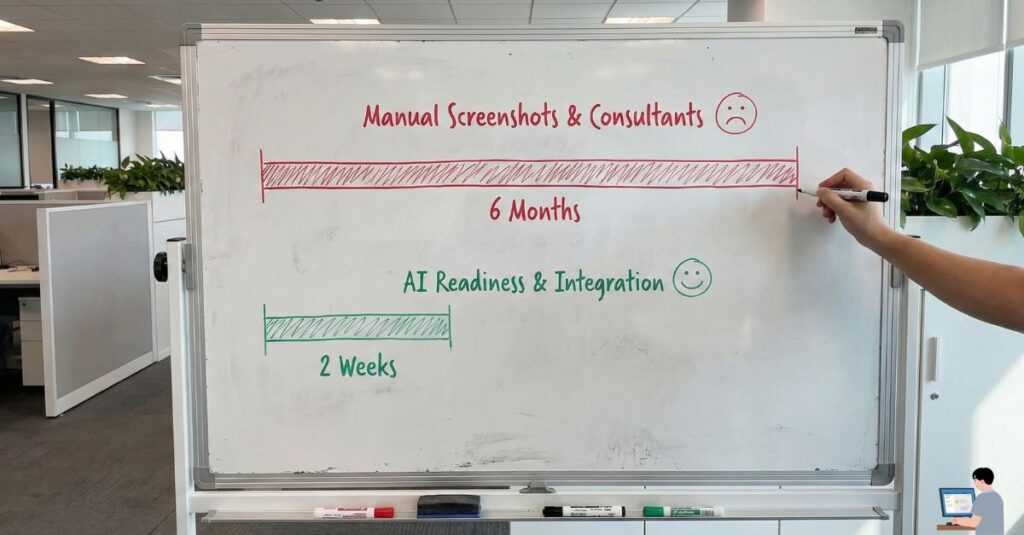
Your heart sinks. You don’t have a SOC 2 report. You don’t even have a formal security policy. You know what comes next: 6 months of “Audit Hell.”
- Taking 500 screenshots of laptop settings.
- Nagging your developers to turn on 2-Factor Authentication.
- Spending $50,000 on consultants who charge by the hour.
You feel the deal slipping away. You feel the panic of “Audit Fatigue” before you’ve even started.
But what if you could skip the manual labor? What if you could connect an AI to your AWS and Slack, and have it do the work for you while you sleep?
The answer is SOC 2 Autopilot. In this guide, we will show you how Automated Compliance Platforms (like Vanta, Drata, and Scytale) are turning a 6-month nightmare into a 2-week “set it and forget it” process.
1. The Basics: What Exactly is SOC 2?
Before we automate it, let’s define it. SOC 2 (System and Organization Controls 2) isn’t a “Certificate” you hang on the wall like a diploma; it is an Attestation Report. An independent auditor (CPA) looks at your company’s infrastructure and says, “Yes, they are safe to do business with.”
To get it, you must meet the 5 Trust Services Criteria (TSC):
- Security (Mandatory): Is your system protected against unauthorized access? (e.g., Firewalls, MFA, Endpoint Protection).
- Availability: Is your system up and running? (e.g., Backups, Disaster Recovery plans).
- Processing Integrity: Does your system do what it promises without error?
- Confidentiality: Is restricted data (like business plans) protected?
- Privacy: Is personal data (PII) collected and used only with permission?
Pro Tip: Most early-stage startups only need to audit for “Security” (and sometimes “Confidentiality”) for their first report. Don’t overcomplicate it by trying to do all five at once.
SOC 1 vs. SOC 2 vs. ISO 27001
Founders often get confused by the alphabet soup of compliance. Here is the quick breakdown:
- SOC 1: For companies that affect a client’s financial reporting (e.g., Payroll software, Payment Processors).
- SOC 2: For Tech/SaaS companies hosting data (e.g., Cloud storage, CRM, Marketing tools). This is the gold standard in North America.
- ISO 27001: The Global standard (popular in Europe/Asia). While SOC 2 is about how you implement controls, ISO is about having a Management System for security.
2. The “Autopilot” Revolution: How AI Replaces Screenshots
In the old days (circa 2020), an auditor would ask: “Show me proof that John was offboarded correctly on March 12th.” You would have to dig through Slack logs and emails to find a screenshot. Today, Agentic AI does this instantly.
1. Automated Evidence Collection
Instead of taking screenshots, you install a read-only “Agent” on your employees’ laptops and connect the AI to your cloud infrastructure (AWS/GCP/Azure).
- The AI Check: The AI scans your cloud settings every hour.
- The Result: If an employee turns off MFA or leaves an S3 bucket public, the AI flags it instantly: “Alert: Compliance Violation Detected. Remediation Required.”
- The Value: The evidence is collected 24/7. When the auditor arrives, you simply grant them access to the platform. No panic. No digging.
2. Policy Generation (No More Expensive Lawyers)
You need 20+ policy documents to pass an audit (Access Control Policy, Incident Response Plan, etc.).
- The Old Way: Pay a consultant $5,000+ to write them from scratch.
- The AI Way: The software generates them in 10 seconds based on your actual settings. You read them, click “Approve,” and you’re done.
3. The Tool Battle: Vanta vs. Drata vs. Scytale
Which “Robot Auditor” should you hire? The market is crowded, but based on user feedback from G2 and Reddit, here is the breakdown of the top contenders.
1. Vanta (The Market Leader)
- Best For: Fast-growing startups who want it done yesterday.
- Pricing: Starts around $7,500 – $15,000/year (depending on company size).
- Pros: Huge network of auditors who know the software intimately; excellent automation for standard tech stacks.
2. Drata (The Automation King)
- Best For: Tech-heavy teams who love deep integration and granularity.
- Pricing: Competitive with Vanta, often starting at $7,500/year.
- Pros: Incredible “Continuous Monitoring” dashboard. It feels like a developer tool, not just a compliance checklist.
3. Scytale (The Hands-On Hero)
- Best For: Companies that want “Software + Humans.”
- Pricing: Custom, but generally very competitive for smaller startups.
- Pros: Known for having great “Compliance Experts” who guide you through the process, rather than leaving you alone with the software.
Crucial Note: The tool is NOT the audit. You still have to pay an independent auditor (CPA firm) separately to review the data the tool collects.
- Total Cost = Tool Subscription + Auditor Fee.
Most companies hide their SOC 2 report in a PDF. This is a wasted opportunity. Modern AI compliance tools allow you to publish a live “Trust Center”.
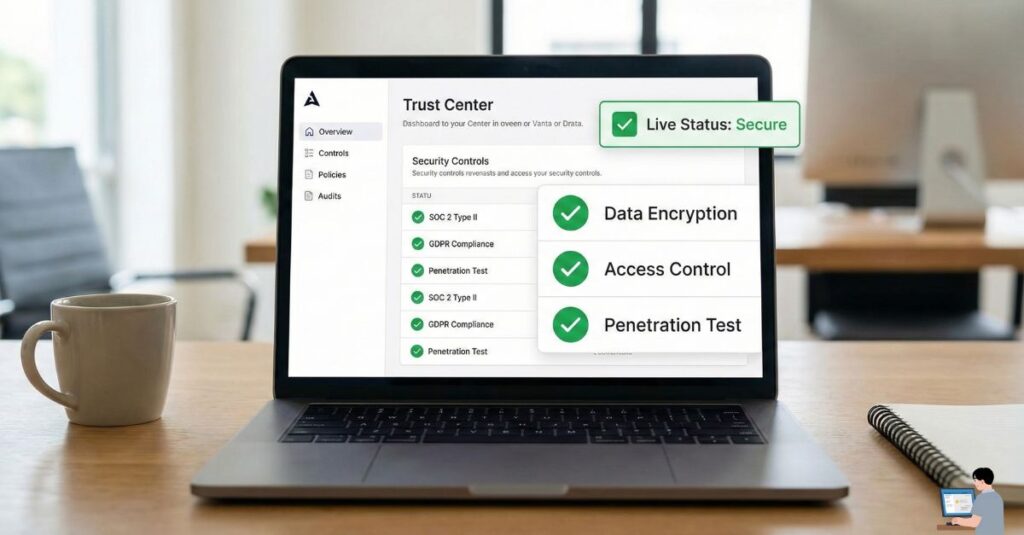
The Strategy: Instead of waiting for a prospect to ask for security docs, put a link in your website footer: “Security & Trust.” When they click it, they see a live, AI-verified dashboard showing:
- “MFA is enabled for 100% of employees.”
- “Last Pen Test: Passed.”
- “Data Encryption: Active.”
The Result: You don’t just pass the audit; you use your security posture to shorten the sales cycle and build instant credibility.
FAQ: Your Panic Button Questions Answered
Q: Does AI automate the audit instantly?
A: “Instantly” refers to the Gap Analysis. The moment you connect Vanta or Drata to AWS, it immediately tells you your “Pass/Fail” score (e.g., “You are 40% compliant”). However, the actual SOC 2 Type II observation period requires 3-6 months of monitoring to prove you stay secure over time.
Q: What is the difference between Type I and Type II?
A:
- Type I: A snapshot in time. “On January 1st, our systems were safe.” (Faster, cheaper, good for early deals).
- Type II: A movie. “From January to June, we were safe every single day.” (This is what Enterprise clients demand).
Q: How much does a SOC 2 certification really cost?
A: You should budget $20,000 – $40,000 for your first year.
- $10k – $15k for the AI Compliance Software.
- $15k – $25k for the Auditor (CPA Firm).
- $0 for “Stress” (if you use AI correctly).
Q: Can I use Supabase or Salesforce to pass SOC 2?
A: Yes. These are called “Sub-processors.”
- Good News: Supabase is already SOC 2 Type II compliant. You “inherit” the security of the physical database layer.
- Bad News: You are still responsible for your data inside it (e.g., Who has the password to your Supabase project? Is that password rotated?). The AI tool helps you track this user-level responsibility.
Conclusion: Compliance is a Feature, Not a Bug
When you ask, “What is a security audit?”, it sounds like a punishment. But in the AI era, it is a Competitive Advantage.
If you have a SOC 2 badge on your website, and your competitor doesn’t, you win the Enterprise deal. It’s that simple. AI has democratized trust. It used to cost $100k and require a full-time Compliance Officer. Now, it runs on Autopilot.
Don’t fear the audit. Automate the busy work. Close the big deal.
Your security posture is no longer a stack of paper; it’s a living, breathing digital shield.