
It is the ultimate digital gut punch.
You spend days researching, writing, and formatting a high-quality article. You optimize the layout, carefully place your ad units, and finally hit “Publish.”
A week later, you search your target keyword to check your progress. But your article isn’t at the top.
A spam website you have never heard of is ranking above you. They are using your exact words, your images, and stealing the ad impressions and traffic that rightfully belong to you.
I know exactly how frustrating this is. It is not just annoying; it is a direct attack on your livelihood. When you work tirelessly to drive legitimate traffic to an approved website, automated content thieves act as parasites on your profits.
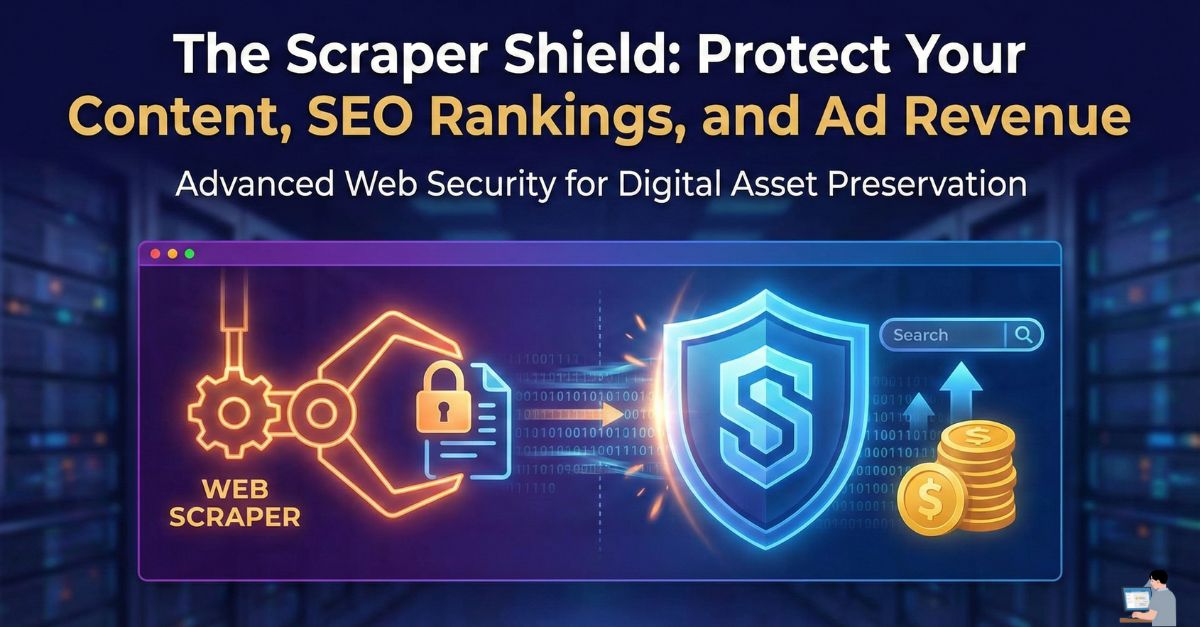
Take a deep breath. You are not powerless here. In this guide, we are going to talk heart-to-heart about how to build an AI-powered “Scraper Shield” to lock down your digital real estate once and for all.
The Syndicate: How Scrapers Steal Your Rankings
To stop a thief, you first have to understand their tools.
In the past, content theft meant someone manually copying and pasting your text. Today, thieves use malicious crawler bots and automated software to rip your entire website’s database in milliseconds.
The second your article goes live, their bot grabs it. They often use AI to spin a few words and immediately publish it across a network of spam sites.
The Shift from SEO to GEO

This threat is growing faster because of the shift from traditional SEO to Generative Engine Optimization (GEO).
Massive data brokers are deploying armies of bots to scrape the internet and train AI models. They extract your expertise without compensating you. Your traffic drops, but your server costs remain high because these bots are constantly draining your bandwidth.
Why Does the Thief Outrank You?
You might be wondering: Why would Google rank the thief higher than my original work?
It usually comes down to Domain Authority. If a massive, aged spam network with millions of backlinks scrapes your brand-new article, search engine algorithms can get temporarily confused.
The algorithm sees two identical pieces of content and might mistakenly award the ranking to the site with the stronger historical authority. You cannot achieve your true ranking potential if your content is constantly being cannibalized.
The E-E-A-T Crisis: Why Duplication Kills Trust
Google evaluates content using the E-E-A-T framework: Experience, Expertise, Authoritativeness, and Trustworthiness.
Of these four pillars, Trustworthiness is the absolute core.
If your highly researched article suddenly exists on fifty different shady websites, your specific brand’s authority is diluted. Protecting your content isn’t just about pride; it is a mandatory technical SEO requirement to preserve your site’s trust score.
The Scraper Shield: How to Block Bots Instantly
You cannot fight automated bots with manual effort. You must fight AI with AI.
In professional cybersecurity, the goal is ensuring your content remains exclusively yours. Here is your AI-powered defense strategy to protect your ad revenue:
1. Behavioral Bot Management Software (The AI Bouncer)

Old firewalls tried to block specific IP addresses, but thieves easily bypass this using rotating VPNs. Modern cloud security solutions look at behavior instead.
- Human Behavior: A human moves the mouse, hesitates before clicking, and takes minutes to read an article.
- Bot Behavior: A bot hits a URL, downloads the text instantly, and immediately requests fifty more pages.
Advanced security tools detect this non-human speed. They instantly serve an invisible challenge that blocks the bot before your page even loads, protecting your server resources.
2. Dynamic Rate Limiting
You need to configure your server to restrict how many pages a single user can view per minute.
If an IP address tries to load sixty articles in sixty seconds, your firewall should automatically issue a temporary ban. This simple step completely breaks the scraper’s automation loop.
3. The “Honey Pot” Trap
Create hidden, invisible links in your website’s code. Humans will never see them, but bots will inevitably click them while scanning your site.
If an IP address clicks your Honey Pot, your system immediately flags them as a malicious scraper and permanently blacklists them.
🎁 Exclusive Publisher Bonuses: AdSense-Safe Protection
Because I want to see your website thrive, here are two extra, completely safe strategies you can implement right now to protect your assets:
- Bonus 1: The Canonical Tag Defense: Always include a self-referencing
rel="canonical"tag in the<head>of your HTML. If a lazy scraper copies your raw source code, they will accidentally copy this tag too. This secretly tells search engines that your website is the original source, forcing the duplicate site to pass all SEO credit back to you. - Bonus 2: Internal Linking Nets: Weave internal links naturally throughout your text, linking back to your other articles. When scrapers steal your text, they often leave the links intact. This means their stolen article will physically point readers (and search engine crawlers) right back to your domain.
The DMCA Counter-Attack
What happens if your content was already stolen before you set up your shield? You launch a legal counter-attack using managed DMCA takedown services.
A DMCA takedown is a legally binding request demanding the removal of stolen copyrighted work.
- Find the Host: Use a “WhoIs” lookup tool to find out which company provides the website hosting for the thief.
- Submit the Form: Go to the host’s “Abuse” page and submit the exact URLs of your original work and the stolen work.
- The Google Takedown: Submit a DMCA request directly through the Google Search Console Copyright Removal Tool. If approved, Google will completely de-index the thief’s URL, destroying their stolen traffic overnight.
(Note: Never file a false DMCA claim against a competitor. It is illegal and harms your own site’s standing.)
Guard Your Profit
Your website is your business. Every single article you write is an asset designed to generate long-term traffic and ad revenue.
You would never leave the front door of a physical store wide open at night. Do not leave your digital doors open.
Acknowledge the threat. Install a behavioral shield. Strike back at thieves. Your rankings, your trust score, and your revenue belong to you—it is time to lock them down.