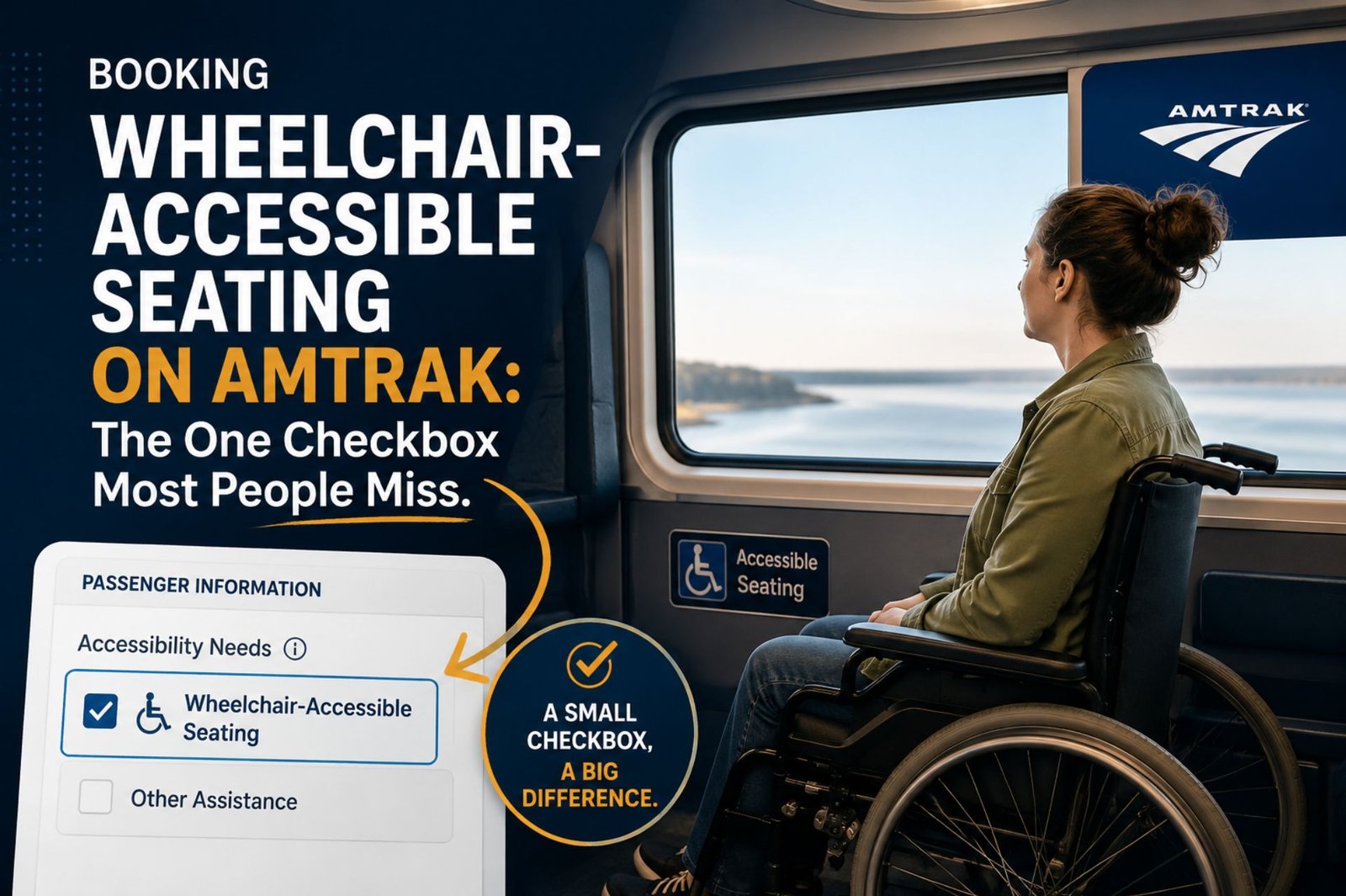
Booking Wheelchair-Accessible Seating on Amtrak: The One Checkbox Most People Miss
One passenger missed a single checkbox and was later quoted nearly double the fare to fix it. The booking flow works — but only if you catch this one step.
Amtrak’s accessible booking system genuinely works well. That’s not the usual story in this space, and it’s worth saying plainly.
But the whole system depends on one small checkbox during booking — easy to miss, and expensive to fix after the fact.
One documented case involved a passenger who missed it, got assigned a standard seat, and was later told fixing it would mean canceling and rebooking at a fare that had since risen to nearly double the original price. Amtrak ultimately made it right, but only after the passenger escalated the issue directly. That’s a fixable problem — as long as you know to look for it before you book, not after.
When booking on Amtrak.com, check “Passenger with disability or assistance needed” before selecting seats — it’s easy to miss. Accessible seating costs the same as standard seating. Wheelchair spaces are limited per train, so book early, and arrive 30–45 minutes ahead if you need boarding assistance.
01Why Train Travel Is Genuinely Underrated Here
Compared to flying, Amtrak has real structural advantages for a wheelchair user: no gate-checking your device, no separate cargo hold, and an accessible restroom that’s actually reachable mid-journey.
The tradeoff is that the system relies more on you catching the right steps during booking, since there’s less staff-side redundancy than at a major airport.
Accessible seating never costs more
If you’re ever quoted a higher price to switch to an accessible seat, that’s a booking error, not policy. Amtrak has confirmed accessible seats are priced identically to standard ones.
02How to Actually Book It, Step by Step
Enter your route and dates as usual
Start the booking exactly like any other Amtrak reservation — departure station, destination, and travel dates.
Check “Passenger with disability or assistance needed”
This is the step that gets missed. It’s a small checkbox, easy to skip past — but it’s what unlocks the accessible seating questionnaire.
Answer the assistance questionnaire
You’ll be asked whether you need a station wheelchair, whether you travel with your own device, and whether you’ll stay seated in it or transfer to an accessible seat.
Confirm service animal and station assistance details
Following windows cover service animals and whether you’ll need help at the station itself, not just onboard.
Select your train and complete booking
Your accessible seating choice is applied automatically from here on reservable trains — no extra step needed once the questionnaire is done.
03Wheelchair Space Specifications
| Spec | Amtrak Requirement |
|---|---|
| Maximum width (occupied) | 27.5 inches |
| Maximum length (occupied) | 48 inches |
| Minimum ground clearance | 2 inches |
| Maximum weight (occupied) | 600 lbs |
| Device types accepted | Manual and battery-powered |
If your device exceeds these dimensions, it’s still worth calling ahead — Amtrak notes some routes and equipment can accommodate larger devices depending on the specific train.
04Choosing Your Seating Style
Tap each one to see what it actually means.
Accessible Seating Options
Available across Coach, Business, and First Class cars.
Stay in Your Wheelchair
Designated tie-down space, typically near the accessible restroom. If your device isn’t identified as collapsible, you’ll remain seated in it for the journey, with brakes applied while the train is moving.
Transfer to an Accessible Seat
Extra-room “transfer seats” designed to make moving from a wheelchair into the seat easier, with room nearby to store a folded chair. A good fit if you use a collapsible device and prefer a standard seat for comfort.
Accessible Bedroom
Available on long-distance First Class routes — a private room with ample wheelchair space, an in-room restroom, and meals included. Book at least 14 days ahead, since these are limited and first-come, first-served.
05At the Station
- Arrive 30–45 minutes early for standard boarding assistance, longer at larger or unfamiliar stations.
- Check in with a staff member once you arrive, even if assistance is already noted on your reservation.
- Courtesy wheelchairs are available at most staffed stations if you need one just to get to the platform.
- Not every station is level-boarding. Some smaller or historic stations may require a ramp or mobile lift — worth confirming ahead if you’re traveling through an unfamiliar route.
06What Real Travelers Are Saying
Experienced Amtrak riders tend to converge on a few of the same hard-earned habits.
Themes From the Accessible Rail Travel Community
Common patterns reported across accessible-travel blogs and rail traveler communities — shared experience, not individual endorsements.
Travelers repeatedly recommend calling the Access Desk to confirm accessible seating actually applied, rather than trusting the online confirmation alone.
Routes requiring a connection are consistently flagged as the trickiest part of rail travel, since assistance availability can vary station to station.
Since staff assist with boarding but not personal care, experienced riders mention traveling with a companion as genuinely helpful on longer routes.
07Frequently Asked Questions
No. Accessible seating is priced the same as standard seating. Passengers who book an accessible bedroom may also receive a discount, but the accessible seat itself should never cost more.
Accessible seating can typically be requested at booking with no strict advance window, but spaces are limited per train, so booking early improves availability. Accessible bedrooms and group requests are best made at least 14 days ahead.
Generally up to 27.5 inches wide and 48 inches long when occupied, with at least 2 inches of ground clearance, and a maximum occupied weight of 600 pounds.
At least 30 to 45 minutes before departure, and up to an hour early at larger or unfamiliar stations, to give staff time to prepare ramps or lifts.
A note on accuracy: station accessibility, equipment, and booking tools can change. Always confirm current details with Amtrak’s Access Desk (1-800-USA-RAIL, option 3) before a trip, especially one involving a connection or an unfamiliar station.

3 thoughts on “Booking Wheelchair-Accessible Seating on Amtrak: The One Checkbox Most People Miss.”