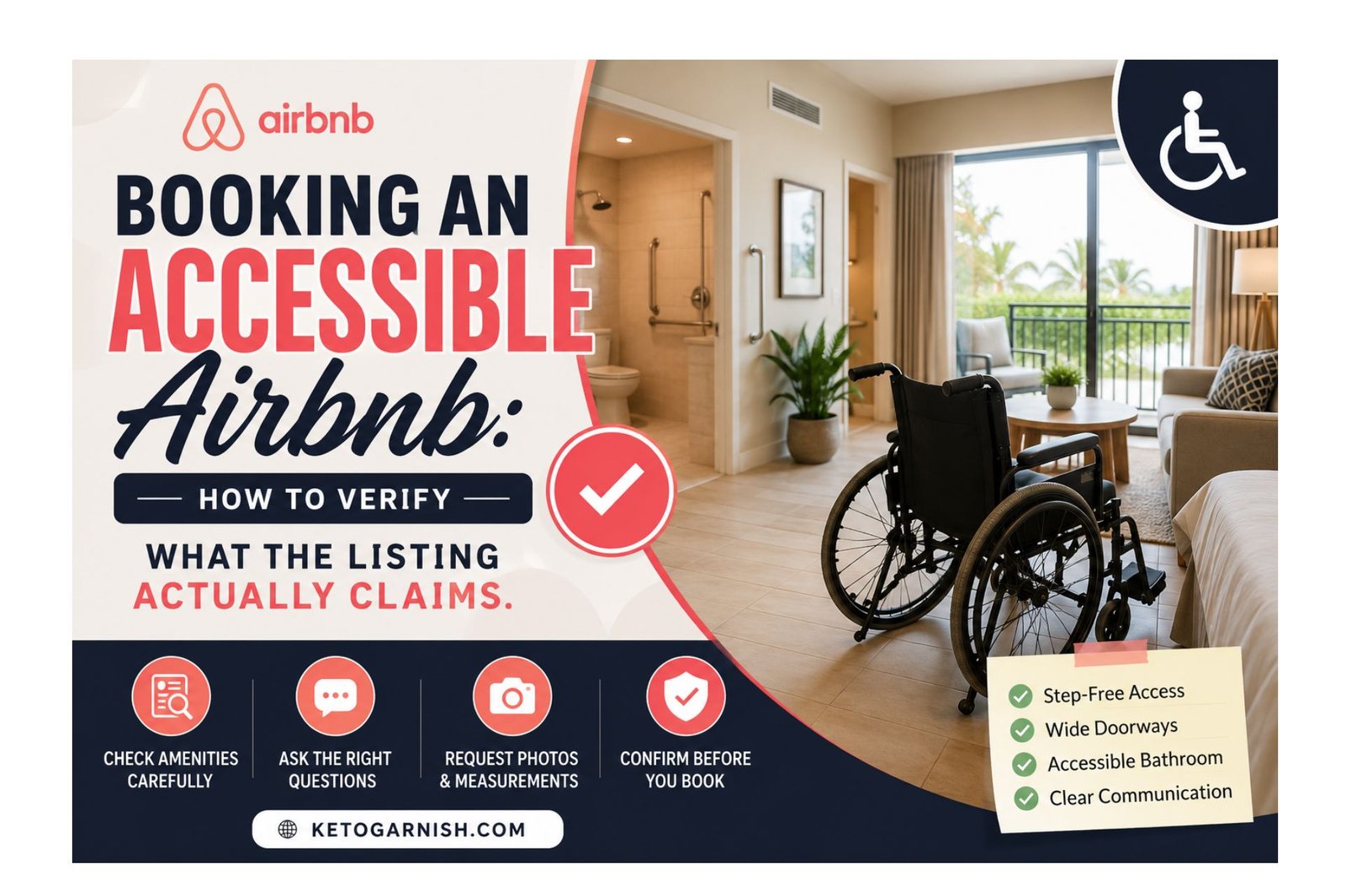
Booking an Accessible Airbnb: How to Verify What the Listing Actually Claims
A checkbox on a filter isn’t a promise. Here’s how to turn “wheelchair accessible” into something you can actually count on before you arrive.
There’s a particular kind of anger that comes from arriving somewhere after a long travel day and discovering the “step-free entrance” the listing promised is actually one small step, described generously.
It happens more than it should, and it’s rarely malicious. It’s usually just a host who didn’t fully understand what “accessible” means to the person filling out that checkbox.
The fix isn’t avoiding vacation rentals. It’s understanding exactly how much a filter can and can’t tell you — and doing the one extra step that closes the gap.
Airbnb’s accessibility features are self-reported by hosts and only checked for photo accuracy, not verified in person. The “Adapted” category has stricter published criteria. Either way, message the host directly before booking and get specific measurements confirmed in writing.
01Why the Filter Isn’t the Whole Answer
Airbnb genuinely has invested in this — there are over 20 specific accessibility filters now, far more precise than the old single “wheelchair accessible” checkbox.
But every one of those filters starts as something a host typed in and photographed. Airbnb’s review process checks that the photo matches the claimed feature — it doesn’t send someone out to measure a doorway or test whether a grab bar is actually load-bearing.
That’s not a flaw unique to Airbnb. It’s the nature of any platform built on self-reported listings at scale. Knowing that going in is what lets you close the gap yourself.
A checkbox is a starting point, not a guarantee
Treat every accessibility filter as “this host believes this is true,” not “this has been independently confirmed.” The message you send afterward is what turns belief into confidence.
02What “Adapted” Actually Means
Beyond individual filters, Airbnb has a separate Adapted category for listings that meet a specific, published bar: step-free access to an entrance, at least one bedroom, and a bathroom with real modifications like grab bars or a shower seat.
It’s a genuinely more curated tier than a single filter — but it’s still based on host-submitted photos, not a certified inspection. Treat it as a stronger starting signal, not a finish line.
03Assumption vs. Reality
“Wheelchair accessible” on the filter means it works for any wheelchair.
It means the host believes it fits their understanding of accessible. A doorway that’s fine for a narrow manual chair may be too tight for a larger power chair.
A host can decline to rent to you once they learn about your disability.
Airbnb’s nondiscrimination policy prohibits refusing guests, charging extra, or applying different rules based on disability or a service animal.
04The Message That Actually Gets Answers
Vague questions get vague answers. Specific, measurable questions get specific, useful ones.
“Hi! I use a power wheelchair, roughly 26 inches wide. Could you confirm the exact width of the entrance doorway and bathroom doorway, and whether the shower is a true roll-in or has a step or curb?”
“Also, is the accessible entrance the same one shown in the listing photos, and is it currently in working order?”
05Your Pre-Booking Checklist
Before You Book
06What Real Travelers Are Saying
Frequent accessible-rental bookers tend to describe the same habit as the thing that changed everything.
Themes From the Accessible Travel Community
Common patterns reported across accessible-travel blogs and traveler communities — shared experience, not individual endorsements.
Experienced travelers describe asking for exact inches rather than accepting words like “spacious” or “accessible,” since those terms mean different things to different hosts.
Confirming details through Airbnb’s own messaging system, rather than a phone call, is repeatedly mentioned as what protects a guest if a listing doesn’t match on arrival.
Travelers consistently use the Adapted category to narrow their search first, then still confirm specifics directly with the host before booking.
07Frequently Asked Questions
Accessibility features are self-reported by hosts and reviewed by Airbnb for photo accuracy, but not independently inspected in person. Confirming specific details directly with the host remains the most reliable way to avoid surprises.
It highlights listings confirmed to have step-free access to an entrance, at least one accessible bedroom, and a bathroom with modifications such as grab bars or a shower seat, based on host-submitted photos reviewed by Airbnb.
No. Airbnb’s nondiscrimination policy prohibits hosts from refusing guests, charging extra fees, or applying different rules based on disability or the presence of a service animal.
Yes. Messaging to confirm specific measurements and working order of accessible features, and keeping the confirmation in writing, is strongly recommended in case the listing doesn’t match on arrival.
A note on accuracy: accessibility features are set by individual hosts and can change between when a listing is reviewed and when you stay. Always confirm current, specific details directly with the host before booking, and keep that confirmation on the platform.

4 thoughts on “Booking an Accessible Airbnb: How to Verify What the Listing Actually Claims.”