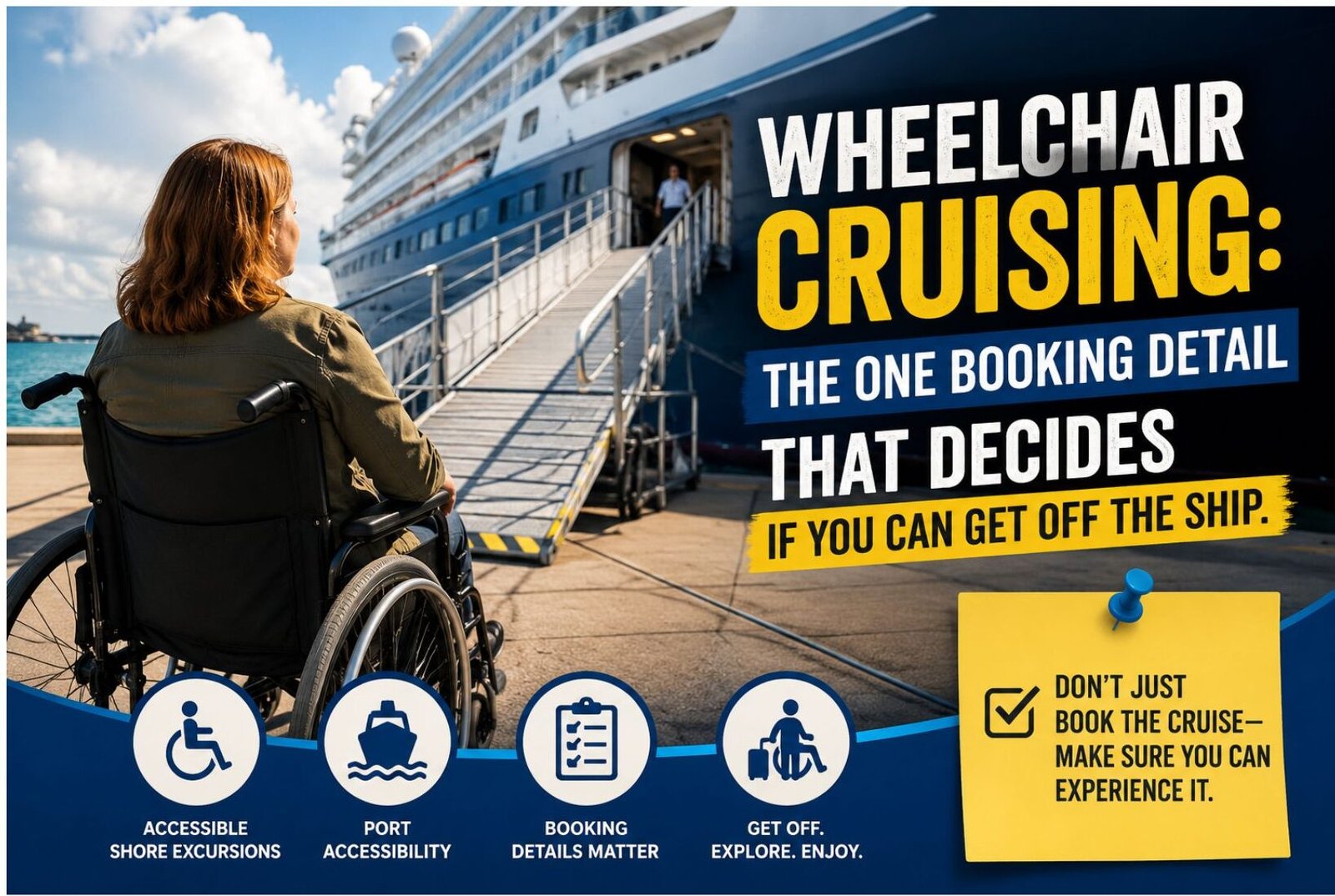
Wheelchair Cruising: The One Booking Detail That Decides If You Can Get Off the Ship
You can book the most accessible cabin on the most accessible ship in the fleet and still spend a port day staring at the coastline from the deck. Here’s the detail nobody puts front and center.
Cruise lines have gotten genuinely good at accessibility — wide cabin doorways, roll-in showers, pool lifts, elevators with Braille controls. That part isn’t the problem anymore.
The problem is a detail that rarely shows up in the marketing photos: how you actually get from the ship to the shore.
Most people don’t think about this until they’re already sailing, standing at the gangway, watching everyone else board a small boat toward a port they were genuinely excited to see.
At tender ports, the ship anchors offshore and passengers transfer by small boat — and crew often can’t safely lift a power wheelchair weighing close to 200 pounds onto one. Check whether your itinerary includes tender ports before booking, not after. Accessible cabin doorways run 32–36 inches on newer ships, versus 22–24 inches standard.
01The Detail That Gets Buried in the Fine Print
A cruise itinerary lists ports of call the same way regardless of how you’ll actually reach them. Nice, uniform text — city name, arrival time, departure time. Whether the ship docks directly at a pier or anchors offshore isn’t usually the headline.
That difference is everything if you use a power wheelchair. Docked ports mean rolling straight down a gangway. Tender ports mean transferring into a small boat that moves with the water, often via a boarding process that simply isn’t built for heavier mobility equipment.
It’s not a lack of willingness. It’s physics.
Crew members generally want to help, but a 200-pound power wheelchair on a moving boat, in open water, isn’t something that can be lifted safely by a couple of people. This isn’t a policy gap — it’s a genuine physical constraint.
02How to Actually Check This Before You Book
- Look at the full itinerary, not just the port names. Cruise line documentation usually notes docked versus tendered status, but it’s often buried in a deck plan or excursion page, not the headline itinerary summary.
- Call the accessibility desk directly. Every major line has one — this is the fastest way to get a real answer instead of guessing from marketing copy.
- Ask what happens on tender days specifically. Some lines can still get manual wheelchair users ashore with assistance, even at tender ports — power chairs are the harder case, not always an absolute no.
- Consider a folding power chair if you’re shopping for new equipment. Lighter, foldable models expand which ports are realistically reachable, even if they’re not a fix for every itinerary.
03How Major Lines Compare
Tap each one to see what sets it apart.
Cruise Line Accessibility Comparison
Based on published fleet accessibility information as of 2026.
Royal Caribbean & Celebrity
Among the widest accessible doorways in the industry (32–36 inches) on newer Oasis and Icon-class ships, 20–30+ accessible staterooms per ship, and designated wheelchair viewing areas in entertainment venues with clear sightlines.
Princess Cruises
Regal Princess offers 38 accessible staterooms and dedicated wheelchair assistance for embarkation and debarkation — though shore access can still depend heavily on local port conditions.
Norwegian Cruise Line
Norwegian Bliss includes 42 accessible staterooms, accessible ground transportation coordination at U.S. ports, and sign language interpretation available with 90 days’ advance notice.
Holland America
Koningsdam offers 27 fully accessible staterooms plus 13 ambulatory-accessible cabins, along with screen-reader software and large-print or Braille menus for low vision guests.
04Your Pre-Booking Checklist
Before You Book a Cruise
05What Real Cruisers Are Saying
Experienced wheelchair cruisers tend to repeat the same core lesson to first-timers.
Themes From the Accessible Cruising Community
Common patterns reported across accessible-travel blogs and cruise communities — shared experience, not individual endorsements.
Experienced cruisers consistently describe checking tender port status before comparing cabin categories or pricing, since it can rule an itinerary out entirely.
Cruisers repeatedly mention that agents focused specifically on accessible cruising catch details a general booking site misses.
Many describe deliberately choosing itineraries weighted toward docked ports, treating tender days as optional relaxation rather than something to fight for.
06Frequently Asked Questions
A tender port is a destination where the ship anchors offshore rather than docking at a pier, requiring passengers to transfer to land using small boats. This transfer can be significantly harder or impossible for wheelchair users, particularly with heavier power wheelchairs.
Often not safely. Many power wheelchairs weigh close to or over 200 pounds, and crew are generally not able to lift devices that heavy onto a moving tender boat, especially in rough conditions.
The cruise line’s detailed itinerary or deck plan documentation typically specifies docked versus tendered ports. Calling the accessibility desk directly to confirm is recommended, since this detail isn’t always obvious in marketing materials.
Accessible cabin doorways commonly run 32 to 36 inches on newer ships, compared to roughly 22 to 24 inches on standard cabins.
A note on accuracy: tender port status, accessible cabin specs, and onboard equipment vary by ship, itinerary, and season. Always confirm current details directly with the cruise line’s accessibility desk before booking, especially for itineraries with multiple stops.

1 thought on “The One Booking Detail That Decides If You Can Get Off the Ship”