
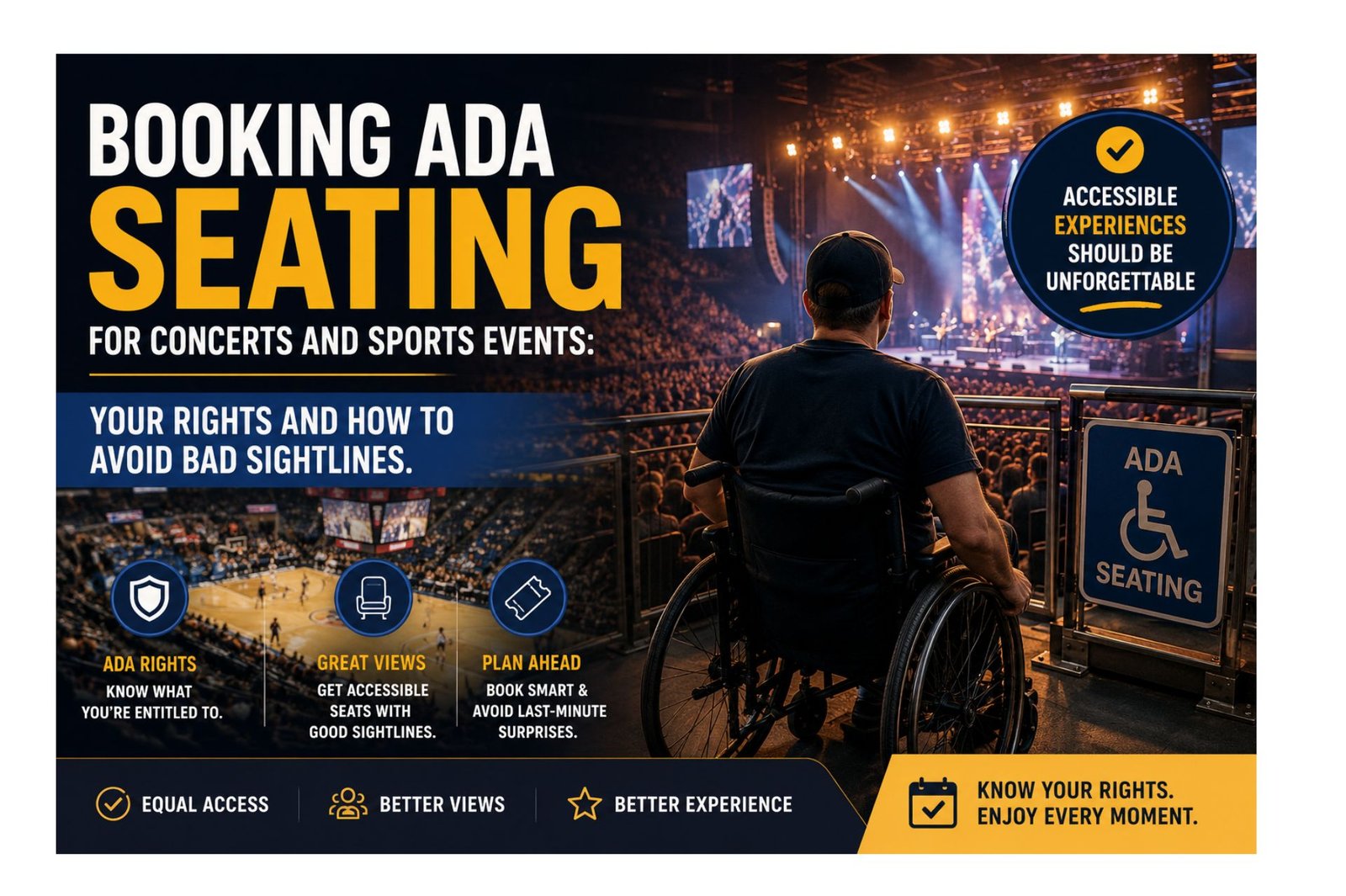
Booking ADA Seating for Concerts and Sports Events: Your Rights and How to Avoid Bad Sightlines
Accessible seating isn’t supposed to mean a worse seat. Here’s what the law actually requires, and what to do the moment reality doesn’t match it.
You booked the show months in advance. You picked accessible seating specifically so the day would go smoothly.
Then you arrive and the “accessible” seat is tucked behind a sound booth, or facing a support beam, or somehow further from the stage than seats a third of the price.
This happens more than it should, and it’s not something you’re supposed to just accept. There’s a real legal standard behind accessible seating, and knowing it changes the conversation the moment something doesn’t match.
ADA accessible seating must offer sightlines comparable to nearby standard seats, not a leftover view. It must be spread throughout the venue — not one corner — and include an adjacent companion seat. If your seat doesn’t match, go straight to an usher or guest services and describe the specific problem.
01Why This Keeps Happening
Accessible seating sounds simple on paper. In practice, it runs into ticketing systems, temporary event configurations, and staff who don’t always know the rules as well as they should.
This isn’t hypothetical friction. In 2019, the National Federation of the Blind and individual plaintiffs sued the NFL and multiple team venues over accessible seating configurations, companion seating shortages, and poor sightlines for wheelchair users — a case that resulted in a consent decree requiring real remediation across stadiums. Separate complaints followed against NBA arenas in 2021 over accessible routes to newly renovated premium areas.
The pattern across these cases is consistent: the standard exists, but enforcement depends partly on people knowing their rights and pushing back when the standard isn’t met.
“Comparable” is the legal word that matters
Accessible seating doesn’t have to be the best seat in the house. It has to offer a sightline genuinely comparable to nearby standard seating — not simply a view of the event from wherever space was easiest to carve out.
02Who Actually Qualifies
Accessible seating eligibility is broader than most people assume — it’s not only for wheelchair users.
Mobility devices
Wheelchairs, scooters, walkers, canes, crutches, and prosthetic devices all qualify.
Chronic conditions
Arthritis, neurological or orthopedic conditions that severely limit walking also qualify.
Respiratory & cardiac
Conditions that may require portable oxygen or involve significant functional limitations qualify as well.
Deaf, hard of hearing, blind, low vision
These guests qualify for seating with relevant features, like sightlines to an interpreter or proximity to assistive listening systems.
03How to Actually Book It
- Buy through the same channels as any ticket — accessible seats must be sold online, by phone, and at the box office, not hidden behind a separate, harder-to-find process.
- Ask specifically about sightlines when booking by phone, especially for a temporary event configuration like a concert stage setup that differs from the venue’s usual layout.
- Request additional adjoining seats if you’re attending with a larger group beyond one companion — many venues can accommodate this on request.
- Never pay more for accessible seating than the equivalent standard ticket price.
04What To Say If the Seat Doesn’t Match
“This accessible seat doesn’t match what was described — the sightline is blocked by [specific obstruction], and I’d like this resolved.”
“If you’re not able to fix this, I’d like to speak with a manager or guest services supervisor.”
05What Real Fans Are Saying
People who attend events regularly with accessibility needs tend to describe the same handful of hard-earned habits.
Themes From the Accessible Event Community
Common patterns reported across accessibility advocacy resources and frequent event-goers — shared experience, not individual endorsements.
Frequent concertgoers describe calling the venue directly before buying, since temporary stage setups can shift where accessible seating actually ends up relative to the show.
Fans consistently report that raising a seating problem immediately, before the event starts, gets resolved far more often than waiting and complaining afterward.
Saving email or chat confirmations of what was promised makes it noticeably easier to resolve a discrepancy in person, several attendees note.
06Frequently Asked Questions
Eligibility extends well beyond wheelchair users, including people who use a brace, cane, crutch, or powered mobility aid, those with arthritis or neurological conditions limiting walking, respiratory or cardiac conditions, and deaf, hard of hearing, blind, or low vision guests.
Yes. Under the ADA, wheelchair-accessible seating must provide sightlines comparable to nearby standard seating, not simply a view from a leftover or obstructed spot.
Yes. Every wheelchair-accessible space requires at least one adjacent companion seat, and larger parties can often request additional adjoining seating.
Find an usher or guest services representative immediately and describe the specific problem. If the first staff member can’t resolve it, ask for a manager or guest services supervisor.
A note on accuracy: seating configurations, especially for concerts and temporary event setups, can vary significantly by venue and by show. Always confirm specific sightline and seating details directly with the venue before booking, particularly for non-standard event layouts.

1 thought on “Booking ADA Seating for Concerts and Sports Events: Your Rights and How to Avoid Bad Sightlines.”