
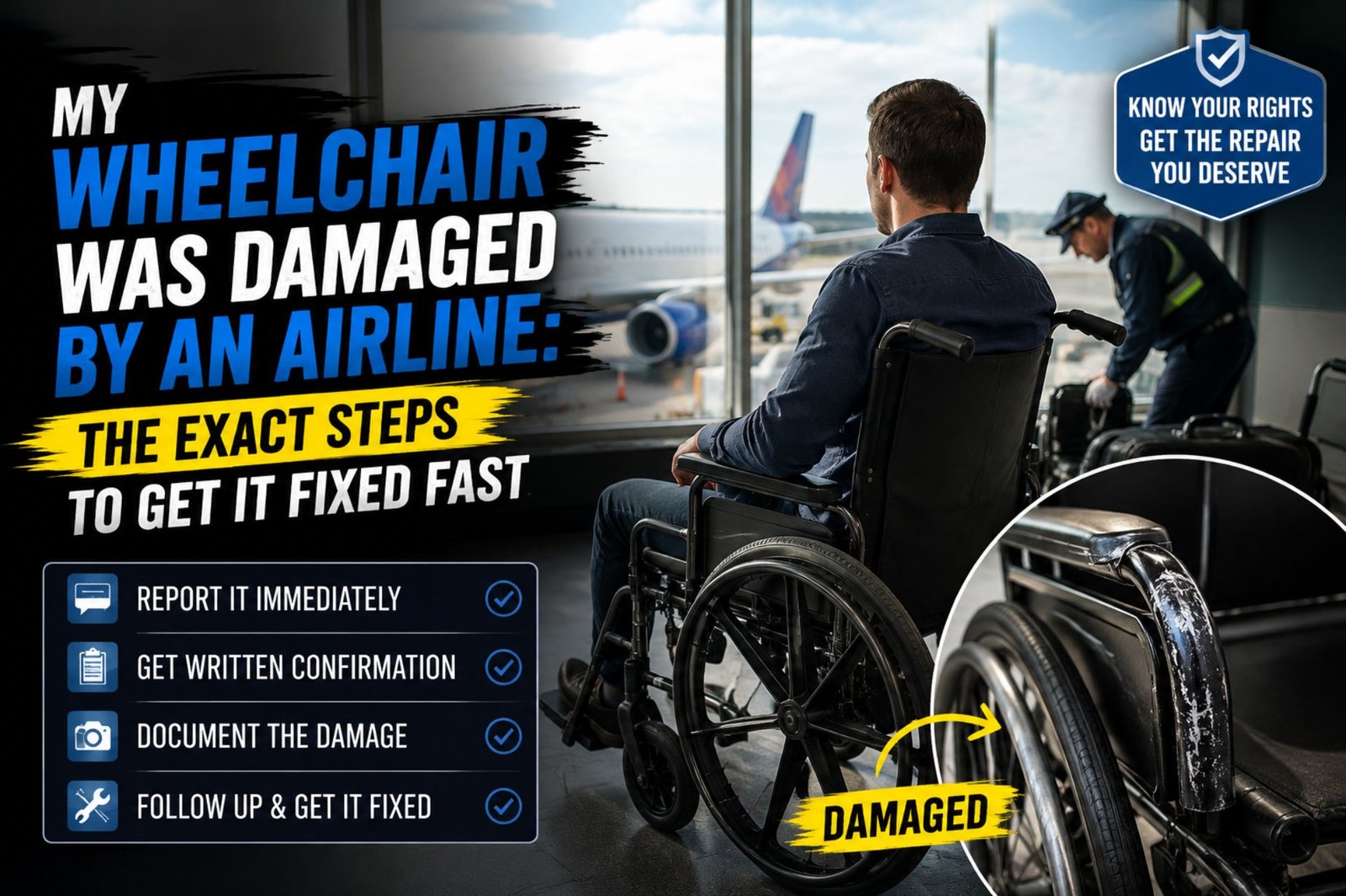
My Wheelchair Was Damaged by an Airline: The Exact Steps to Get It Fixed Fast
This is the guide for the moment right after you see the damage — before you’re sure what to do, before anyone’s explained your actual rights.
There’s a very particular gut-drop moment: watching your wheelchair come up the jet bridge or the baggage carousel and seeing that something’s wrong before you even reach it.
Maybe it’s the joystick hanging loose. Maybe a wheel won’t lock. Whatever it is, your mobility just became someone else’s mistake to fix, and you’re standing in an airport figuring out what happens next.
Ms. Wheelchair America 2026, Latavia Sturdivant, went through exactly this after a recent flight — her customized power chair arrived with the joystick detached and the frame cracked. Delta apologized publicly and committed to covering repairs. That outcome wasn’t automatic. It came from someone who knew to push, document, and escalate. This guide is built to give you that same footing, right from the moment you spot the damage.
The airline owes you 100% of repair or replacement cost, no cap, plus a loaner for the entire repair period. Report damage immediately at the airport, file a written complaint within 45 days, and escalate to the DOT within 180 days if the airline stalls.
01Your Rights, In Plain English
The Air Carrier Access Act puts full liability on the airline for a damaged mobility device — not partial, not capped at some standard baggage limit. Full repair or replacement cost, up to the device’s original purchase price.
That protection exists because Congress recognized a wheelchair isn’t luggage. It’s not something you can simply do without for a few weeks while a claim processes.
The loaner has to actually work for your life
Airlines must provide a loaner while repairs happen, but “a loaner” and “a loaner you can actually use” aren’t automatically the same thing. If it can’t handle your daily terrain or needs, that’s worth raising directly, not quietly tolerating.
02What To Do, In Order
Report it before you leave the airport
File a damage report at the gate or baggage office immediately. This creates the timestamped record that anchors everything after it.
Ask for the airline’s Complaint Resolution Official
Every airline is required to make a CRO available by phone or in person. Ask any staff member to connect you — this is a specific, required role, not a general customer service line.
Document everything, in photos and in writing
Photograph the damage before it’s moved or touched further. Get names, times, and a copy of whatever report was filed.
Request a loaner and state your repair preference
Ask directly for a comparable loaner, and let them know if you’d prefer your own trusted repair vendor over a third-party contractor — you’re entitled to make that choice.
File a written complaint within 45 days
Use the airline’s official complaint channel, and put the amount you’re requesting in writing — this creates a paper trail that matters if things stall.
Escalate to the DOT if needed, within 180 days
If the airline isn’t responding or resolving the issue, file a separate complaint with the DOT’s Aviation Consumer Protection Division.
03What To Say to the Complaint Resolution Official
“My mobility device was damaged on this flight. Under the Air Carrier Access Act, the airline is responsible for the full repair or replacement cost, and I need a loaner device while repairs are completed.”
“I’d like this documented today, and I’ll be filing a written complaint within 45 days if it isn’t resolved.”
04What Real Travelers Are Saying
People who’ve been through this before tend to repeat the same hard-earned lessons.
Themes From the Wheelchair Travel Community
Common patterns reported across accessible-travel advocacy resources and traveler accounts — shared experience, not individual endorsements.
Travelers repeatedly emphasize photographing damage and filing a report before leaving the airport, since delayed reports are consistently harder to resolve.
Putting the specific dollar amount and request in writing is described repeatedly as creating real accountability that a phone conversation alone doesn’t.
Travelers whose airline complaints stalled describe the DOT escalation as the step that finally moved things forward, even when it felt like an extra hurdle at a hard moment.
05Frequently Asked Questions
Yes. Under the Air Carrier Access Act, U.S. airlines are responsible for 100% of the repair or replacement cost, up to the original purchase price, with no liability cap based on cost.
A written complaint should be filed with the airline within 45 days of the incident. A separate complaint can also be filed with the DOT’s Aviation Consumer Protection Division within 180 days.
Airlines must provide a loaner while repairs are completed, but it should be reasonably comparable and safely usable. If it isn’t functional for your needs, raise that directly with the Complaint Resolution Official.
Yes. If you prefer your regular, trusted vendor over a third-party contractor selected by the airline, the airline is still required to cover the cost.
A note on accuracy: this guide covers general rights and process under U.S. federal law as of 2026; specific circumstances and international travel may involve different rules. This isn’t legal advice — for a claim that stalls significantly, consulting a disability rights attorney is a reasonable next step.

4 thoughts on “My Wheelchair Was Damaged by an Airline: The Exact Steps to Get It Fixed Fast”