
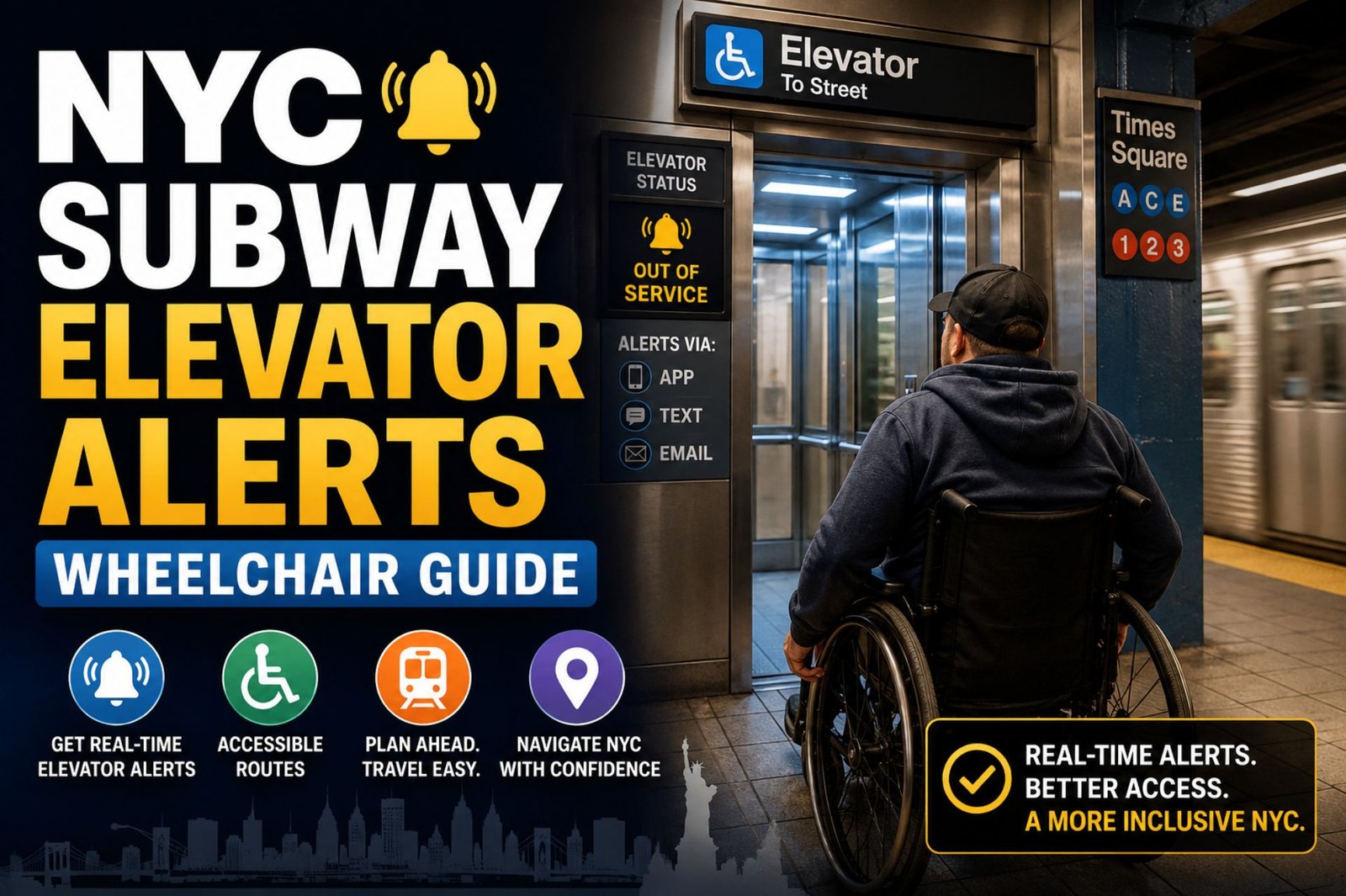
Nyc subway elevator alerts wheelchair guide

NYC Subway Wheelchair Access: The Elevator Alert Trick Most Riders Never Set Up
City Access Transit & Mobility

Roughly seven out of ten subway stations still aren’t step-free, and even the accessible ones fail without warning. The riders who never get stranded aren’t luckier — they’re using one free tool almost nobody signs up for.

9 min read Updated July 2026 New York City

You’ve done everything right. You checked the map, confirmed the station has an elevator, and planned your route around it. Then you get to the mezzanine and the elevator is dark, with a handwritten sign taped over the call button. No app told you. No announcement warned you. You’re just stuck, thirty feet above or below the platform you need.

This happens to wheelchair users on the New York City subway more often than the MTA’s marketing would suggest. It isn’t because the system is hopeless — it’s because most riders are checking the wrong information at the wrong time, and nobody explains the actual sequence that keeps you moving instead of stranded.

That’s the gap this guide closes. This isn’t a “top accessible stations” list. It’s a working method — what to set up before you leave, what the outage data actually means, and the one habit that turns a broken elevator from a crisis into a five-minute reroute.

Key Takeaway

New York’s subway elevators fail often enough that treating “the station has an elevator” as your accessibility plan will eventually leave you stranded. The fix isn’t avoiding the subway — it’s building a two-layer check into every trip: a live status check right before you leave, and a pre-picked backup station in case the first one fails.

01 How the Alert System Actually Works

The MTA runs a free elevator and escalator outage alert service, but almost nobody who isn’t a regular subway rider knows it exists — and fewer still know how to use it well enough to trust it. Here’s the sequence that actually works, in order.

1
Sign up for elevator alerts by station, not by borough At mta.info, you can register for free email or text alerts tied to specific stations on your regular route — not the whole system. This is the difference between useful signal and noise you’ll eventually mute.
2
Check the live outage list minutes before you leave, not the night before Outages start and clear throughout the day. Riders who check once in the morning and trust it all day are the ones who get surprised. A last-minute check takes under a minute.
3
Note whether the elevator is “ADA” or third-party managed Some station elevators are owned and maintained by outside building developers rather than the MTA. These are marked differently in outage data, and their repair timelines tend to be far less predictable — worth knowing before you count on one for a tight connection.
4
Confirm the elevator actually reaches the platform, not just the mezzanine A station can have a working elevator and still not be usable end-to-end. At a handful of stations, the elevator only bridges street to mezzanine, and there’s no step-free path from there to the train. Always check the full station accessibility notes, not just “elevator: yes.”
5
Pick a backup station before you need one Every regular route should have a second accessible station you know how to reach on wheels if the first one fails mid-trip. Deciding this in the moment, underground, with no signal, is the worst possible time.
! Recent city reporting has found dozens of subway elevators out of service systemwide at any given time, and riders have long complained that in-station alerts lag behind reality. Treat any single data source as a strong hint, not a guarantee — and always have a second plan.

02 What the Numbers Actually Mean for a Trip

These figures won’t shift day to day, but they explain why a single accessibility check isn’t enough — and why building in a buffer matters more here than in almost any other transit system in the country.

~30%
of subway stations are fully ADA accessible
1 in 10
system elevators out of service on a typical day
2
layers of checking that actually prevent stranding

Best times to travel if your route depends on a single elevator

Planned elevator replacements — as opposed to sudden breakdowns — are usually scheduled and posted in advance, which means early trips are slightly safer than trips planned the same morning an outage begins.

Lower Risk Window
Weekday mornings
Higher Risk Window
Late evenings & weekends

Overnight and weekend maintenance windows are when scheduled outages most often land, so a station that was fully accessible on your Tuesday commute can be a different story on a Saturday afternoon. Always re-check, even for a route you’ve done before.

03 The One Navigation Trap Worth Knowing

Most trip-planning apps mark a station as “accessible” if it has an elevator anywhere in it. They don’t always distinguish between an elevator that gets you street-to-platform and one that only gets you street-to-mezzanine.

That gap catches even experienced riders, because it only shows up when you’re already at the station and the second half of the journey — mezzanine to platform — turns out to have no step-free option at all. Before relying on a station for a wheelchair transfer, check the full accessibility notes for that specific station, not just the accessibility icon on the map.

04 What Real Riders Are Saying

Wheelchair users who ride regularly describe a consistent pattern: the system is workable, but only with active management, not passive trust.

Themes From the Accessible Transit Community

R
Real-time checks beat scheduled trust Riders who check status right before leaving report far fewer surprises than those who rely on a status they saw earlier in the day, since outages start and clear unpredictably.
B
A backup route isn’t optional, it’s routine Frequent riders consistently mention keeping a second accessible station in mind for every regular trip, treating it as a standard part of planning rather than an emergency measure.
M
Transfer stations carry the highest stakes Because major transfer points concentrate multiple lines, an elevator outage there tends to disrupt a much longer stretch of someone’s trip than an outage at a smaller local stop.

05 Frequently Asked Questions

Is the NYC subway realistically usable for a full-time wheelchair user?
Yes, for most trips, if you build in the two-layer check described above. It requires more active planning than a system like the ones in Tokyo or Barcelona, but with a pre-checked route and a backup station, most regular riders manage it daily.
What should I do if an elevator fails while I’m already in the station?
Look for MTA staff at the station booth — they can usually direct you to the nearest working accessible route or arrange assistance. It’s also worth reporting the outage on the spot through the station-specific outage form, which helps push the repair along for the next rider.
Are all subway elevators maintained by the MTA?
No. Some are owned and maintained by outside building developers rather than the MTA, and these can have less predictable repair timelines. It’s worth knowing which type serves your regular station.
Is there a backup transit option if the subway isn’t workable for a trip?
Access-A-Ride, the city’s paratransit service, exists as an alternative for people whose disabilities make fixed-route transit genuinely difficult, though it typically requires advance booking rather than being a spontaneous option.
A note on accuracy: Elevator outages change hour to hour. Always confirm current status directly through the MTA’s own accessibility page or 511 before relying on any third-party source, including this guide, for a specific trip.

A
About Alex

This author documents real-world accessibility conditions in major transit systems, drawing on official data sources and firsthand accounts from riders who navigate these systems daily.

About Alex

This author bio section can be dynamically pulled by enabling its Dynamic data option in the right toolbar, selecting author meta as the content source, add description into the Author meta field.

Leave a Comment