9 min read · Updated for 2026 · City Access
Europe’s trains can be the most accessible way to cross the continent — when assistance is booked properly. Here is how it works, country by country.
For many wheelchair travelers, European trains beat flying on every measure that matters. You stay with your chair the whole way. Stations sit in city centers, not on the outskirts. And nobody gate-checks your mobility.
The catch: step-free access and boarding assistance vary enormously between countries, operators, and even stations. The system works well when you book assistance in advance and know the local rules — and it can fail badly when you do not. This guide covers your rights, how assistance booking works, the country differences that matter, and what to do when assistance does not show up.
Fast Answer
Book assistance 24–48 hours ahead (the exact window varies by country), confirm the day before, and arrive 30–60 minutes early. Under EU rules, assistance at staffed stations is free — and staff must help even without a booking, though pre-booking is far more reliable.
1. Your Rights: the Rules Underneath It All
Across the European Union, rail passenger rights regulation gives passengers with disabilities and reduced mobility a clear set of entitlements: free assistance getting on and off trains at staffed stations, accessible travel information, and compensation if mobility equipment is lost or damaged on the railway’s watch.
The United Kingdom runs its own equivalent system, regulated by the Office of Rail and Road, with the same core promise: assistance is free, and operators must make reasonable efforts to help even if you turn up without booking. This guide is general information about published passenger rights, not legal advice — and rules do change, so verify the details with your operator before you travel.
2. How Assistance Booking Actually Works
The process is similar across operators. You book assistance through the train company’s assistance service — usually an online form or a dedicated phone line — separately from buying your ticket. Have this information ready:
- Date, time, and train number for each leg of your journey.
- Chair type (manual or power), plus exact dimensions and weight — ramps and lifts have limits, and wrong numbers are the most common cause of boarding failures.
- Whether you transfer to a seat or stay in your chair.
- Whether you are traveling alone or with a companion.
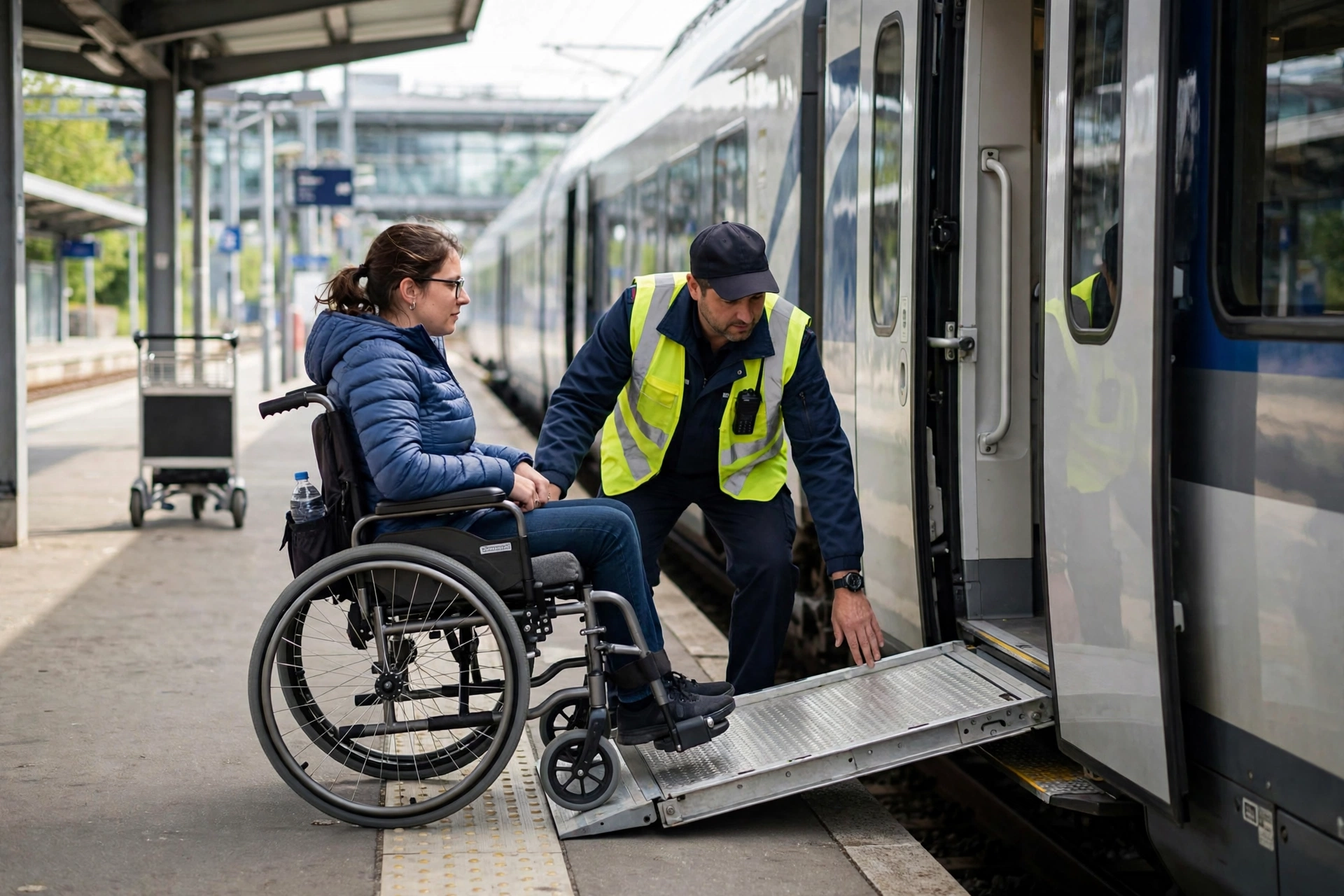
On the day, you meet staff at the station’s assistance or meeting point (find its location in advance — they are not always obvious). Staff bring a ramp, help you board, and arrange for staff to meet you at your arrival station. For connections, assistance must be booked for each leg, including the change.
- 2 hours — Minimum advance booking for the UK’s Passenger Assist service
- 24 hours — Typical advance booking for France, Italy, and Germany
- 30–60 min — How early to arrive at the station before departure
3. Country by Country: What Changes
The headline differences that affect your planning:
- United Kingdom — Passenger Assist: book as little as 2 hours before travel, and many stations support turn-up-and-go assistance without any booking. The most flexible system in Europe.
- France — SNCF Assist’enGare: book at least 24 hours ahead. Covers TGV, Intercités, and TER services at staffed stations.
- Germany — DB mobility service: book by the evening before travel (generally by 8pm the day before). Staff meet you with a portable ramp or lift.
- Spain — Renfe Atendo: request at least 12 hours ahead. On high-speed AVE services, many trains have dedicated wheelchair spaces with tie-downs.
- Italy — Trenitalia Sale Blu: book 24 hours ahead through the station-based Sale Blu assistance lounges.
Cross-border journeys add a wrinkle: you may need to book assistance with each operator separately. When booking an international ticket, ask who handles assistance on each leg — and get each confirmation in writing.
Sample Script
“I’d like to book boarding assistance for [train number] on [date] from [station] to [station]. I use a [manual/power] wheelchair, [width] by [length] centimeters, weighing [weight] kilograms, and I [transfer to a seat / stay in my chair].”
“Can you confirm the booking reference and where the assistance meeting point is at [station]?”
4. Finding Step-Free Routes and Stations
Assistance gets you on the train; step-free station design determines whether the rest of the journey works. Before you travel:
- Check each station on the operator’s website for step-free access, working lifts, and accessible toilets — including your interchange stations.
- Allow generous interchange times — 30 minutes minimum. Accessible routes through large stations are longer, lifts are slower, and a delayed inbound train compresses everything.
- Watch for one-direction step-free access: some stations are step-free in one direction only. Check the direction you are actually traveling.
- Download the operator’s app: live departure boards, platform numbers, and disruption alerts beat station announcement boards when you cannot easily reposition.
5. When Assistance Fails: Your Backup Plan
It happens: the ramp is not there, the staff member is not there, or a delay breaks your connection. Here is the order of operations:
- Find staff or a help point immediately: go to the assistance point, the information desk, or a station help point. You have the right to assistance even without a prior booking — say so, calmly and clearly.
- Document everything: note times, names, and what was promised versus what happened. Photos of the inaccessible situation help later.
- Complain to the operator first: file a written complaint with the train company, referencing your booking reference and what failed. Keep it factual and specific.
- Escalate to the national enforcement body: if the operator’s response is inadequate, each country has a designated body for rail passenger rights complaints. Name it in your follow-up — it signals you know the system.
6. Frequently Asked Questions
Do I have to book assistance in advance?
Legally, no — your right to assistance does not depend on booking. Practically, yes: pre-booked assistance is far more reliable, and some countries’ systems are built around advance notice (24 hours in France and Italy, for example).
Is boarding assistance free?
Yes. Under EU rules and the UK’s equivalent system, assistance for passengers with disabilities at staffed stations is provided free of charge. Never pay anyone for it.
What if my train is delayed and I miss my assistance slot?
Speak to station staff or the conductor as soon as the delay is clear — operators are expected to rearrange assistance for your revised connection. This is another reason to build generous interchange times into your plan.
Can I take a power wheelchair on European trains?
Generally yes, within size and weight limits that vary by operator and train type. Give your exact dimensions and weight when booking assistance so the operator can confirm your chair fits their ramps, lifts, and wheelchair spaces.
A note on accuracy: assistance services, booking windows, and passenger-rights rules change over time and vary by operator. This guide is general information, not legal advice — always verify the current arrangements with your train operator before you travel.
Sources
Related guides
Keep planning with these:
