
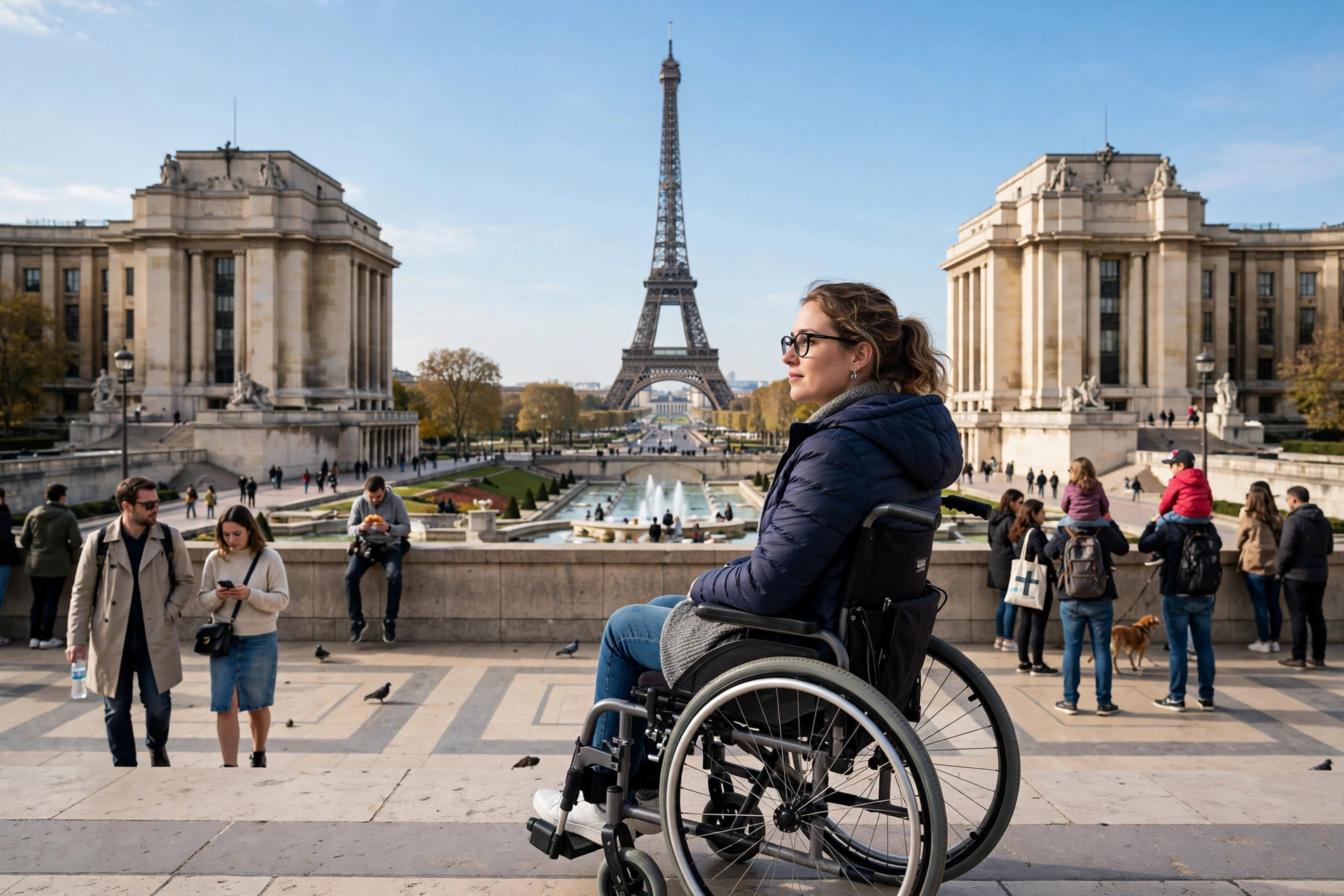
Paris has a reputation problem among wheelchair travellers, and some of it is earned. This is a two-thousand-year-old city built long before anyone thought about step-free access, and its famous Metro is one of the least accessible underground systems in Europe. But the reputation misses the other half of the story: every bus in Paris kneels and deploys a ramp, the tramways are fully step-free, and the Eiffel Tower and the Louvre have put genuine thought into welcoming wheelchair users. Paris wheelchair access is not effortless, but it is workable once you know which systems to trust and which to skip.
The Step-Free Metro and RER Reality
Let’s start with the hard truth: the Paris Metro is mostly off-limits if you cannot do stairs. Of the sixteen Metro lines, only Line 14 — the newest, fully automated line running from Saint-Denis in the north to Orly Airport in the south — is completely step-free, with lifts at every station and level boarding onto the trains. On the other fifteen lines, the overwhelming majority of stations have no lifts at all, and many involve long staircases, corridors, and transfers that are simply not navigable in a wheelchair.
Do not write off rail entirely, though. RER Line A, the east-west backbone serving La Défense, Charles de Gaulle–Étoile, Auber near the Opéra, and Gare de Lyon, offers step-free access at most central Paris stations. Lines B, C, and D are patchier — check before you commit. The tramways are all fully accessible with low floors and level boarding, and they are genuinely useful: the T3a and T3b loop around the edges of the city, linking Metro and RER stations along the way.
The practical rule is to plan rail journeys station by station, not line by line. Use the RATP app or the Île-de-France Mobilités website to check lift status before you set out — lifts break down, and a single out-of-service lift can strand you mid-journey. When the Metro cannot serve you, the bus usually can.
The Accessible Bus Network: Your Best Friend in Paris
If the Metro is the weak point of Paris wheelchair access, the bus network is its quiet superpower. Every bus in Paris is low-floor, every bus carries a deployable ramp, and every bus has a dedicated wheelchair space with tip-up seats. Drivers are trained to kneel the bus and deploy the ramp — position yourself visibly at the stop and signal clearly as the bus approaches.
Buses also go where visitors actually want to go. Dozens of lines crisscross the centre, and several follow gloriously scenic routes: line 69 runs from the Eiffel Tower quarter past the Louvre and through the Marais, while line 72 follows the Seine. Riding the bus doubles as sightseeing, and at street level you never have to solve the last-mile problem of escaping a deep underground station.
A few practical notes. Board through the middle or rear doors, where the ramp is located. During rush hour a packed bus may not be able to take you — travelling outside peak times makes everything easier. The night buses (Noctilien) are accessible too. Keep the RATP app handy for real-time arrivals, so you spend less time waiting at the kerb.

The Eiffel Tower and the Louvre: What Access Actually Looks Like
The two attractions everyone asks about are also the two that handle access best.
At the Eiffel Tower, wheelchair users get priority access — you do not queue in the standard line. Book the priority-access ticket online in advance for a chosen date and time slot; you will enter via the pillar equipped with lifts. Elevators serve the first and second floors, and the summit is reachable by lift with a change of elevator at the second floor. The first floor has level pathways and a glass-floor section; staff will route you around the pinch points on the second floor. One honest caveat: on very busy days the lifts get crowded, so morning slots are calmer.
At the Louvre, use the main Pyramid entrance — it is step-free, with lifts down to the main hall. Inside, lifts connect the Denon, Sully, and Richelieu wings, and accessible toilets are on several levels. Manual wheelchairs can be borrowed free from the information desk (bring ID) — useful if you would rather save your own chair for the streets. Grab the museum’s accessibility map showing step-free routes. Note the Pyramid courtyard is cobbled, so the approach can be bumpy; the underground entrance through the Carrousel du Louvre is smoother.
One tip that pays off across the city: many major museums and monuments offer reduced or free admission for disabled visitors plus a companion. Bring documentation of your disability — a disability card or parking permit from home is usually accepted.
Cobblestones, Hills, and Streets to Plan Around
Paris rewards travellers who know where the ground fights back. The headline challenge is Montmartre: the climb to Sacré-Cœur is steep and cobbled, exhausting in a manual chair and demanding in a power chair — plan your route and keep your battery charged. The courtyard around the Louvre’s Pyramid is paved with rough cobbles, and parts of Le Marais and the Latin Quarter mix cobblestones with narrow pavements.
The good news is that the grand boulevards — the Champs-Élysées, Boulevard Saint-Germain, Rue de Rivoli — are wide, smooth, and mostly level. The quays along both banks of the Seine offer long, flat, paved promenades that are a genuine pleasure to roll along. When choosing where to stay, the 7th arrondissement near the Eiffel Tower and the 1st near the Louvre are flat and central; Montmartre and the eastern arrondissements are prettier to look at than to push through.
Accessible Taxis and Airport Transfers
For door-to-door travel, G7 Horizon is the name to know: G7’s wheelchair-accessible taxi fleet with ramp-equipped vehicles. Book through the G7 app and select a Horizon vehicle — booking ahead is strongly advised, especially for airport runs, as the accessible fleet is smaller than the standard one.
From Charles de Gaulle Airport, the RER B stations at the airport are step-free, and the RoissyBus into Opéra is low-floor and accessible. From Orly, Metro Line 14 now runs directly to the airport with full step-free access — the easiest accessible airport transfer Paris has ever had. If you would rather take a taxi, official fixed fares apply between the airports and central Paris; confirm the fare and that a Horizon vehicle is on its way when you book.
A Few Practical Details Worth Knowing
Accessible public toilets take planning: the self-cleaning sanisette units across the city include wheelchair-accessible models, mapped on the Paris city website. Restaurants are hit and miss — many have a step at the entrance, so check photos online or call ahead. Most large museums, department stores, and shopping centres are fully accessible. And save your bus routes and lift statuses offline: deep Metro stations and thick-walled old buildings are brutal on mobile signals.
Paris Wheelchair Access FAQ
Is the Paris Metro wheelchair accessible?
Only Line 14 is fully step-free, with lifts at every station. The other fifteen lines are largely inaccessible — most stations have no lifts. For step-free rail travel, use Line 14, accessible RER stations (especially Line A), the fully accessible tramways, and above all the 100% low-floor bus network.
Can wheelchair users go up the Eiffel Tower?
Yes. Wheelchair users get priority access and skip the standard queue — book the priority-access ticket online in advance. Lifts serve the first and second floors, and the summit is reachable by lift with a change of elevator at the second floor. Mornings are the quietest time to visit.
Are Paris buses really all accessible?
Yes. The entire Paris bus fleet is low-floor with deployable ramps and dedicated wheelchair spaces, and drivers are trained to deploy the ramp on request. Board through the middle or rear doors, and travel outside rush hour when buses are less crowded.
What is the hardest part of Paris for wheelchair users?
The combination of a largely inaccessible Metro and old street surfaces — cobblestones around the major landmarks and the steep Montmartre hill. The fix is a bus-first strategy: plan bus routes between sights, stay in the flat central arrondissements, and check lift statuses before relying on any rail station.
Related guides
- Compare notes with our London wheelchair access guide, another historic city with an old underground system.
- See how Tokyo approaches step-free transit — and why the staff matter as much as the elevators.
- Learn how to research any city’s accessibility before you book, so you arrive with a plan.

1 thought on “Paris Wheelchair Access Guide: Navigating the City of Light”