
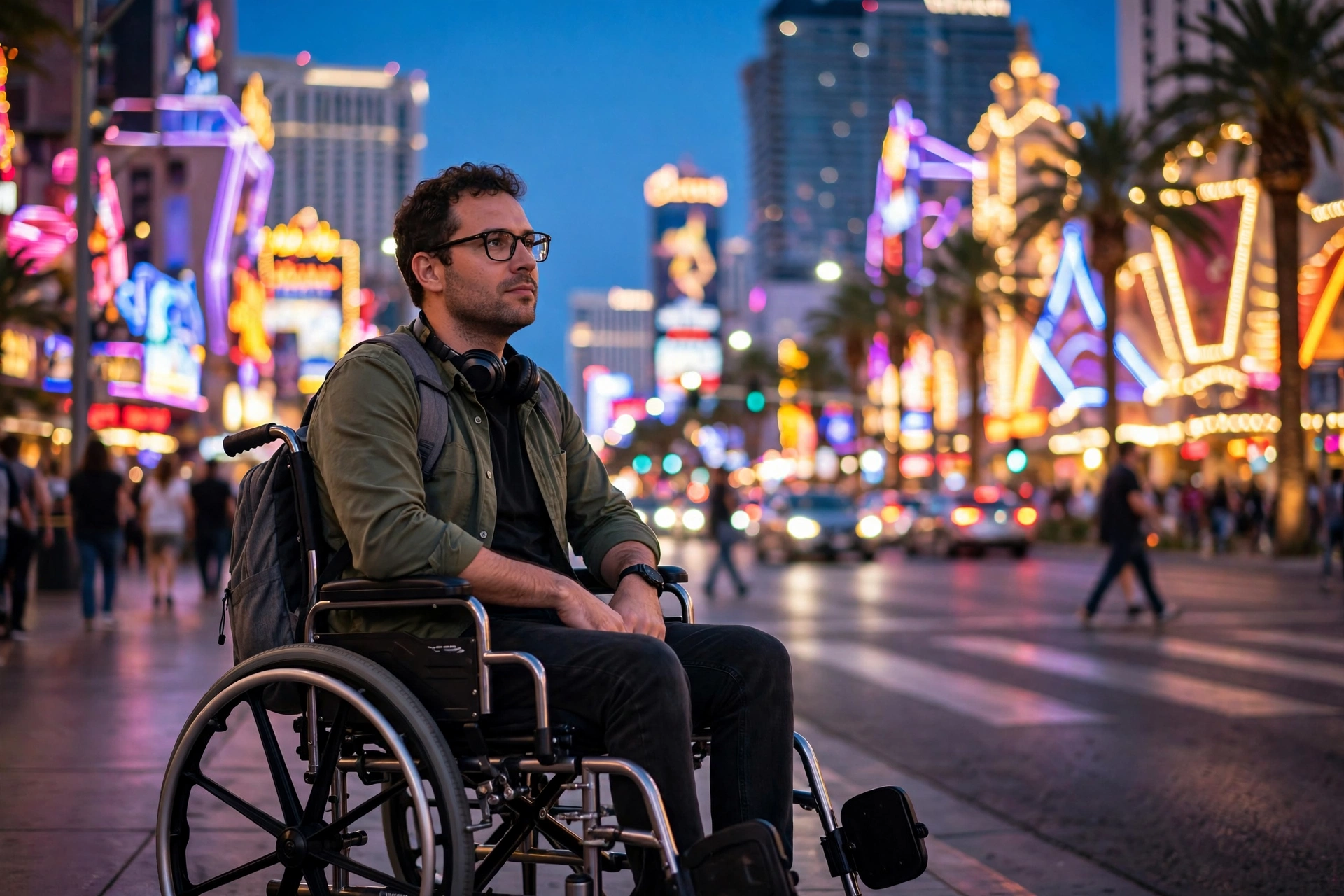
Las Vegas wheelchair access is better than most visitors expect. The city sells a fantasy of total freedom: roll up to the tables at 2am, catch a world-class show, cool off in a rooftop pool. For wheelchair users, much of that fantasy is genuinely within reach — the Strip is one of the flattest, most step-free entertainment districts in the United States, and the big resorts were built or renovated under the ADA.
The honest version: Vegas is also enormous, brutally hot in summer, and crowded in ways that turn short distances into expeditions. This guide covers the step-free reality of Las Vegas wheelchair access — how to actually move along the Strip, what to demand from your hotel room, how casino floors and showrooms really work, and the practical tips that separate a great trip from an exhausting one.
Getting around the Strip without steps
Las Vegas Boulevard runs about four miles from the Sahara to Mandalay Bay, and the main sidewalk is wide, level, and generally well kept, with curb cuts at the crossings. But “crossings” need an explanation, because on the Strip you rarely cross at street level.
Pedestrian bridges and their elevators
At most major intersections you cross via pedestrian bridges rather than crosswalks. Every bridge has elevators as well as escalators and stairs — this is the step-free network of the Strip, and it works well when it works.
The catch is reliability and crowds. Bridge elevators are small and slow, and at peak times you may wait through several cycles. Occasionally one is out of service, forcing a long detour to the next bridge. Build buffer time into every crossing, and ask hotel security about outages — they usually know the status and the best alternate route. Several bridges connect directly into casino upper levels, doubling as step-free shortcuts between properties.
The Deuce bus
The Deuce is the double-decker bus running the length of the Strip around the clock. Every bus is wheelchair accessible with a ramp or lift and priority spaces, and a day pass costs a fraction of a single rideshare trip.
Use it to skip the long, hot stretches between resort clusters — the roll from the Bellagio area to the STRAT is far longer than it looks. Buses get packed late at night and on weekends, so allow an extra 15 to 20 minutes when timing matters.
The Las Vegas Monorail
The Monorail runs along the east side of the Strip from MGM Grand to the Sahara, and every station is step-free with elevators. It is fast and air-conditioned — a genuine relief in summer. The limitation is geography: it serves the east side only, and some stations sit a long way back from the casino floors they serve. Check a station map before relying on it.

Accessible hotel rooms: what to book and what to verify
Every large Strip resort has accessible rooms — the law requires it, and at Vegas scale that means real inventory. But “accessible room” covers a wide range, and the difference between a good one and a bad one can decide your trip.
- If you need a roll-in shower, say so explicitly when booking. Many “accessible” rooms have a bathtub with grab bars instead — fine for some travelers, unusable for others. Ask directly: “Does this room have a roll-in shower or a bathtub?”
- Call the hotel after booking online to confirm bed height, doorway widths, and toilet height — and request a room near the elevator bank. A room at the far end of a tower can add serious distance to every outing.
- Ask for the details that matter to you: shower bench, handheld showerhead, visual alarms, lowered peephole. Hotels can often arrange these with advance notice.
- Request a refrigerator for medication when you book — most resorts waive the fee for medical needs with advance notice.
- If you use a power chair or scooter, ask about charging: where the outlets are and whether they are reachable from the bed area.
If your assigned room does not match what was promised, go back to the front desk right away. With thousands of rooms, they can usually move you — but only if you speak up early.
Casino floors in a wheelchair
Here is a pleasant surprise: casino floors are almost entirely flat and step-free, designed for slow-moving foot traffic, which works in your favor. Aisles between slot machines get tight on weekend nights, but mornings and afternoons are calm and easy to navigate.
Many modern slot machines are reachable from a seated position, and staff will help you find machines at a comfortable height. For table games, ask the pit boss about accessible seating before you buy in.
The real casino-floor challenge is sensory, not architectural: it is loud, crowded late at night, and Nevada casinos still allow smoking on the gaming floor. If smoke is an issue, mornings are noticeably better, and some properties have non-smoking gaming areas — ask at check-in.
In Las Vegas, three things decide a wheelchair traveler’s trip: the right room, a transport plan, and honest expectations about distance.
Shows and theater seating: how to book accessible seats
Vegas showrooms are covered by ADA seating rules, and the big theaters handle this well. The booking process is where trips go wrong.
- Book through the venue’s own box office whenever possible, not a third-party reseller. State exactly what you need: a wheelchair space (you stay in your chair) or a transfer seat (aisle seat with a movable arm), plus companion seats.
- Book early. Accessible seating is limited and the best locations sell first — for popular residencies, weeks or months ahead.
- Ask about sightlines: a wheelchair space at the very back of a raked theater is compliant but can be a poor view. Ask the box office which sections they recommend.
- Arrive early on show night. Ushers will guide you to your seats, and it is far easier before the pre-show crowd fills the aisles.
- For older or smaller venues off the main Strip, call ahead and ask about step-free entry and accessible restrooms, not just seating.
If you cannot find accessible seats online, calling the box office directly almost always works better than third-party sites.
Pool access
Most major Strip resorts have at least one pool with a lift — but that does not tell you which pool, whether it is working, or whether it is the one you want. Call the concierge before you go and ask which pools have lifts and what hours they are staffed. Pool decks are slippery when wet and often a long roll from the tower elevators, so scout the route in daylight first.

Honest practical tips: heat, distances, and energy
This is the section that matters most. Vegas is genuinely accessible and genuinely exhausting, often on the same day.
- Respect the heat. Summer highs regularly pass 40°C (104°F), and the Strip offers little shade. Do outdoor stretches early morning or after sunset, duck into air-conditioned casinos midday, and carry more water than you think you need.
- Distances lie. The resorts are so large that the roll from your room to the Strip can take 15 minutes before your outing has even started. Budget your energy like money.
- Use indoor connections. Many resorts link up through indoor walkways and free step-free trams, such as the Excalibur–Luxor–Mandalay Bay line. Learn your hotel’s connections on day one.
- Charge everything overnight and carry a backup battery for your phone — you will use it for maps, rideshares, and tickets all day.
- Time it right. Weekdays beat weekends for crowds, and mornings beat nights for almost everything: calmer casinos, emptier bridges, cooler air.
Frequently asked questions
Largely yes. Sidewalks are wide and level with curb cuts, and pedestrian bridges have elevators. The real challenges are distances, heat, crowds, and the occasional out-of-service elevator — not steps.
Yes. Casino floors are flat and step-free, with reachable slots, accessible table-game seating options, and lowered service counters. Aisles get tight at peak times; mornings are easiest.
Book through the venue’s box office, specify a wheelchair space or transfer seat plus companion seats, book early, and arrive early on the night. Calling the box office beats third-party sites.
Yes. All Deuce buses have ramps or lifts and priority spaces, running 24/7 along the Strip. Day passes are inexpensive.
Spring and autumn for milder weather; weekdays and mornings for smaller crowds. Summer is doable but demands a heat plan.
Related guides
Keep planning with our Chicago wheelchair accessibility guide, the London wheelchair access guide, and our guide to booking an accessible airport transfer.

1 thought on “Las Vegas Wheelchair Access Guide: The Strip, Hotels, and Shows”