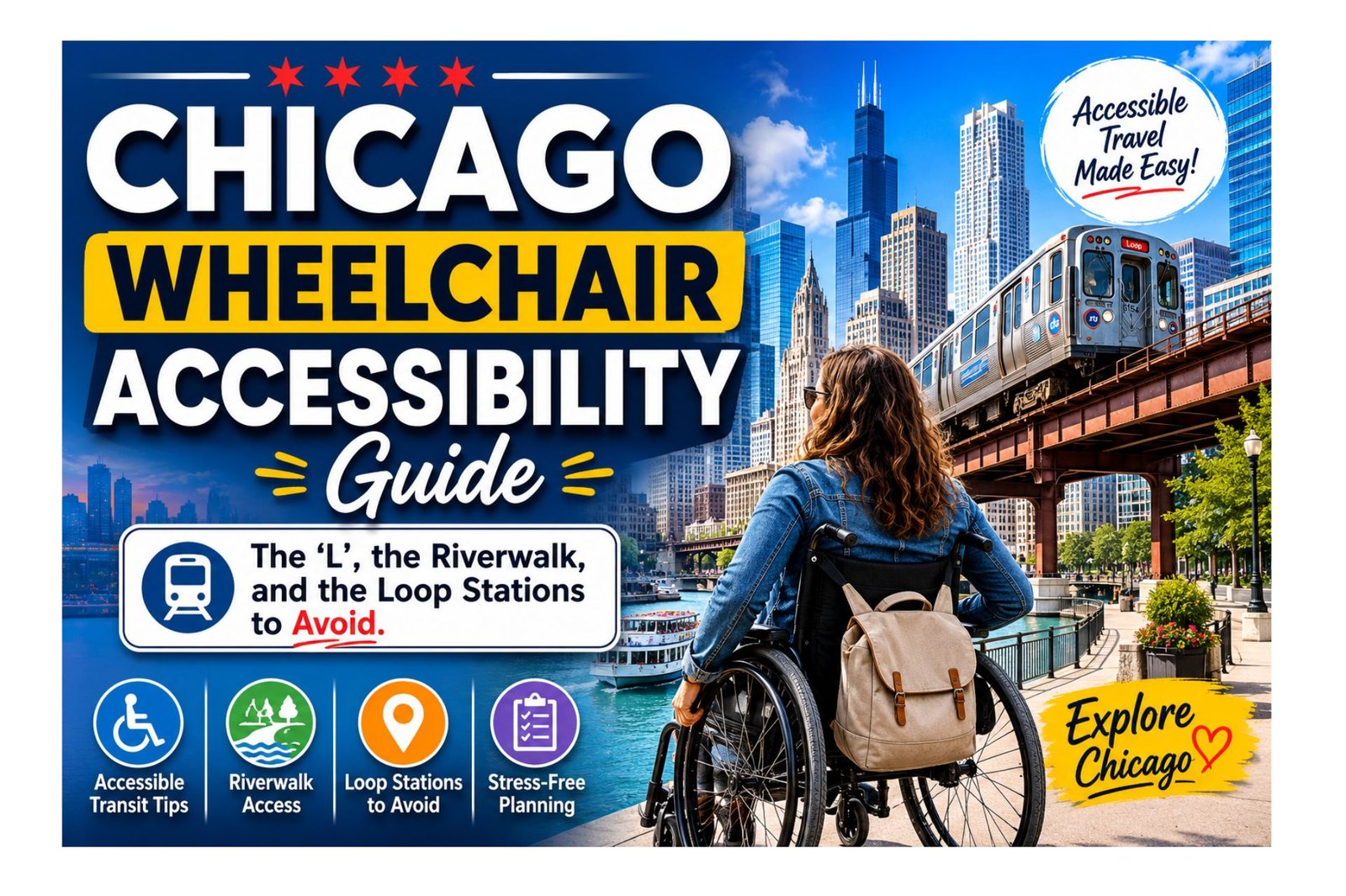
Chicago Wheelchair Accessibility Guide: The ‘L’, the Riverwalk, and the Loop Stations to Avoid
Chicago is more accessible than people expect, with one honest exception: a cluster of century-old stations in the exact neighborhood most visitors head to first.
Chicago doesn’t get talked about the way Rome or Venice does when it comes to accessibility.
Maybe because it doesn’t need the caveats — flat terrain, modern infrastructure, a genuinely accessible bus fleet. It should be one of the easier major cities to navigate in a wheelchair.
Mostly, it is. But there’s one specific, well-documented gap that catches visitors off guard: the very stations at the heart of downtown, the ones every tourist map points to first, are some of the least accessible in the entire system.
Chicago is largely wheelchair accessible — every CTA bus has a ramp, and over 70% of ‘L’ train stations are step-free. The exception is the historic downtown Loop, where several century-old elevated stations still lack elevators. Check the CTA’s live elevator status before relying on any single station.
01Why the Loop Is the Exception, Not the Rule
Chicago’s elevated train system, the ‘L’, is over 130 years old in places. The oldest stations, concentrated in the Loop, were built decades before accessibility was ever part of the design conversation.
Retrofitting a 19th-century elevated structure with an elevator is expensive and slow, which is exactly why the gap has persisted even as the rest of the system modernized around it.
The CTA is actively working through this with its All Stations Accessibility Program, adding elevators station by station — but progress is gradual, and today, a real gap remains right in the neighborhood most visitors want to explore on foot.
Always check live elevator status before you rely on a station
Even accessible stations can have a temporary elevator outage. The CTA publishes real-time elevator status online — checking it before you head out takes thirty seconds and can save an hour.
02Loop Stations Currently Without Elevator Access
This is the exact list worth screenshotting before your trip. Several stations share names across different lines, so double-check the line, not just the stop name.
| Line | Stations Without Elevator Access |
|---|---|
| Brown | LaSalle/Van Buren, Randolph/Wabash, State/Lake |
| Orange | Adams/Wabash, LaSalle/Van Buren, Madison/Wabash, Randolph/Wabash, State/Lake |
| Pink | Adams/Wabash, LaSalle/Van Buren, Madison/Wabash, Randolph/Wabash, State/Lake |
| Purple | Adams/Wabash, LaSalle/Van Buren, Madison/Wabash, Randolph/Wabash, State/Lake |
| Green | Adams/Wabash, Madison/Wabash, Randolph/Wabash, State/Lake |
The pattern is clear once you see it: the shared Loop “Wabash” stations are the consistent gap across nearly every line that runs through downtown. Plan around a nearby accessible station instead — the CTA’s official system map marks each one clearly.
03Getting Around: Your Real Options
Tap each one to see the honest tradeoff.
Chicago Transit Options
Based on CTA, Pace, and city-published accessibility information as of 2026.
The ‘L’ Train
Fast and frequent, with over 70% of stations step-free. Best for longer cross-city trips outside the Loop’s gap zone. Always check live elevator status before you go.
CTA Bus
The most consistently accessible option citywide — every bus has an on-request ramp and a wheelchair securement area. Slower than the ‘L’, but far more forgiving when a specific train station isn’t accessible.
Pace Paratransit
The cheapest door-to-door option at $3.25 per trip, covering anywhere within three-quarters of a mile of a fixed route. Requires advance certification and next-day booking — not a same-day solution.
WAV Taxi / Uber
Best for on-demand trips or avoiding the Loop’s gap entirely. Book through CURB, call 1-888-WAV-CABS, or request a WAV vehicle directly in the Uber app.
04What’s Actually Accessible: The Highlights
The Chicago Riverwalk
A 1.25-mile stretch along the south bank of the river, level the entire way and designed with universal access in mind from the start. One of the most reliably comfortable stretches of the city for a wheelchair user, no exceptions or workarounds needed.
Griffin Museum of Science and Industry
Step-free entry from the underground garage, with elevators serving every floor of the museum.
360 CHICAGO Observation Deck
Uses a dedicated ADA entrance on Delaware Place, separate from the main Michigan Avenue lobby, with ramp access running the full circumference of the observation deck.
Chicago Cultural Center
Free to enter and fully accessible via the Garland Court entrance at Randolph Street, with loaner wheelchairs available at the lobby security desk if needed.
05What Real Travelers Are Saying
Wheelchair users who know Chicago well tend to describe the same workaround, almost word for word.
Themes From the Accessible Travel Community
Common patterns reported across accessible-travel blogs and Chicago residents — shared experience, not individual endorsements.
Frequent visitors describe defaulting to a bus whenever their destination lines up with an inaccessible Loop station, rather than trying to work around the train system.
Locals consistently mention checking the CTA’s live elevator alerts before heading out, treating it the same way others check the weather.
Because it’s flat and fully accessible end to end, the Riverwalk comes up repeatedly as a reliable anchor point for a day’s plans in the city.
06Frequently Asked Questions
More than 70% of CTA ‘L’ stations have a step-free route via elevator or ramp, but several historic stations, especially in the downtown Loop, still lack elevators. The CTA’s All Stations Accessibility Program is working to close this gap over time.
Yes. Every CTA bus has a wheelchair ramp deployed on request at any stop, kneeling capability at the curb, and a designated wheelchair securement area near the front doors.
Pace paratransit costs $3.25 per trip with no trip cap, though riders must be certified in advance and reservations typically need to be made the day before.
You can book by calling 1-888-WAV-CABS, using the CURB app, or requesting a WAV vehicle through the Uber app.
A note on accuracy: elevator status, station accessibility, and transit programs change as the CTA’s improvement plan progresses. Always check the CTA’s live elevator status page before relying on a specific station.

3 thoughts on “Chicago Wheelchair Accessibility Guide: The ‘L’, the Riverwalk, and the Loop Stations to Avoid.”