
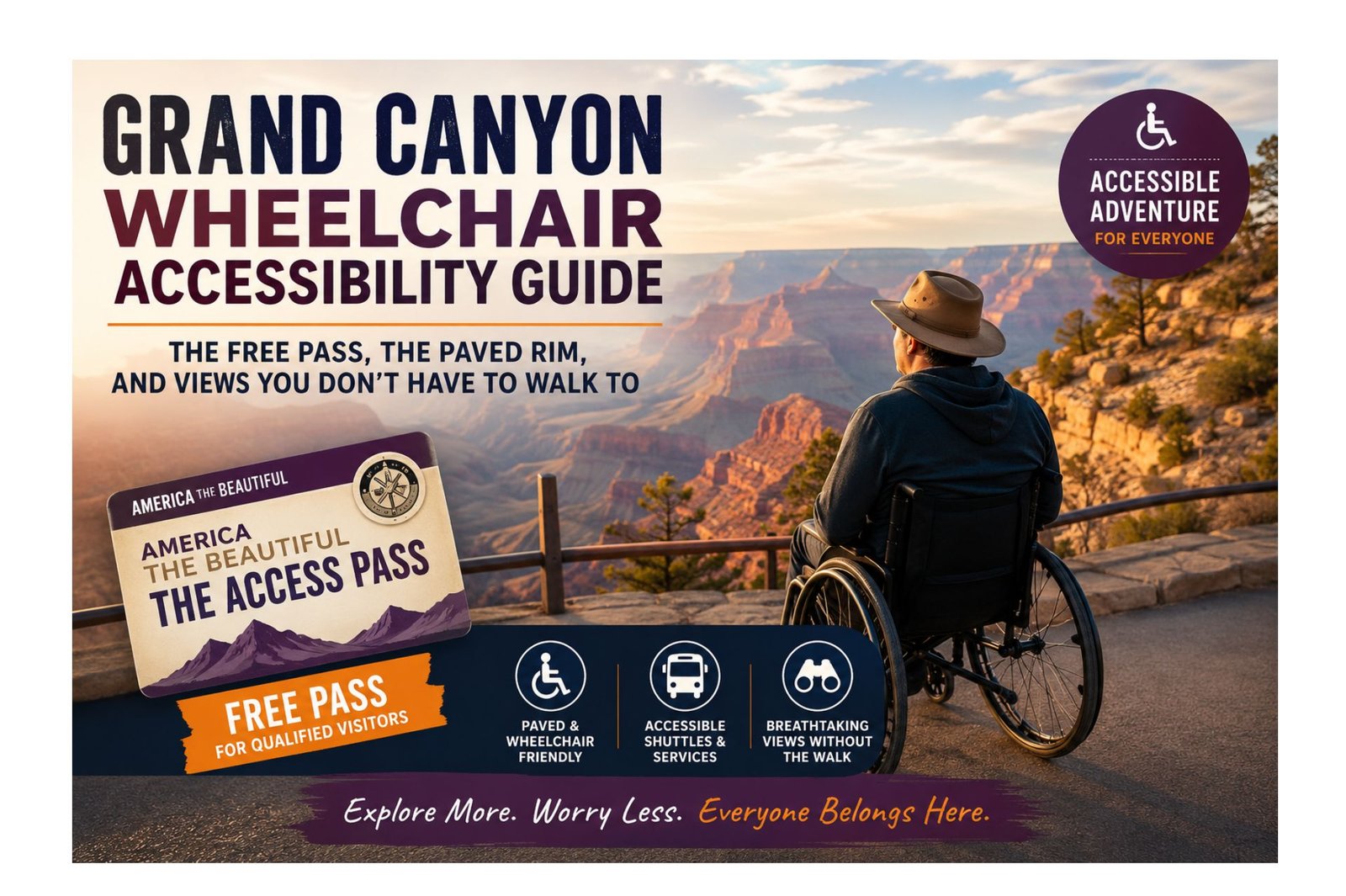
Grand Canyon Wheelchair Accessibility Guide: The Free Pass, the Paved Rim, and Views You Don’t Have to Walk To
You’ve probably assumed the Grand Canyon means miles of dirt trail and steep drop-offs. For the South Rim, that assumption is mostly wrong.
There’s a specific kind of grief in loving the outdoors and assuming a place like the Grand Canyon just isn’t built for you.
Most of what people picture is the part that genuinely isn’t accessible — the trails switchbacking down into the canyon itself, the mule rides, the multi-day backcountry routes.
What gets left out of that picture is the South Rim, which was intentionally built for exactly the opposite experience: paved paths, accessible shuttles, and viewpoints you can reach without leaving pavement, or even your car.
The South Rim is genuinely accessible — a paved Rim Trail, free accessible shuttles, and several “windshield view” points reachable without walking at all. U.S. residents with a permanent disability qualify for a free lifetime Access Pass covering entrance fees. Trails descending into the canyon itself are not wheelchair accessible.
01The One Free Pass Worth Knowing About
Before anything else — this is the detail with the most direct value in this entire guide.
The America the Beautiful Access Pass is a free, lifetime pass for U.S. residents with a permanent disability. It covers entrance fees at Grand Canyon and every other federal recreation site in the country, not just this one trip.
It has to be requested in advance with documentation — not something to figure out at the entrance gate.
The South Rim is the one to visit first
It’s open year-round, has the most developed accessible infrastructure, and is significantly more built-out than the North Rim, which only operates seasonally and offers fewer accessible facilities.
02The Rim Trail: What’s Actually Paved
The Rim Trail runs roughly 13 miles along the South Rim, and the honest answer is that most — not all — of it is paved and wheelchair accessible.
The clearest accessible stretch runs from the Grand Canyon Visitor Center through Mather Point to around the South Kaibab Trailhead — flat, paved, and lined with some of the park’s best-known views. West of Bright Angel Lodge, the trail narrows and climbs, and that section is not considered wheelchair accessible.
You don’t have to walk any of it to see the canyon, though — the free shuttle runs stops along the entire route, so you can hop on whenever the terrain or the day catches up with you.
03Find Your Viewpoint
Tap what matters most to you.
Viewpoint Finder
Based on National Park Service and park-published accessibility information.
Windshield Views — See It From the Car
Moran Point, Lipan Point, and Navajo Point along Desert View Drive all offer views visible directly from a parked vehicle, no walking required. This is the single most underused fact about visiting the canyon with limited mobility.
Short Paved Walk
Mather Point and the stretch of Rim Trail around the Visitor Center are flat, paved, and among the most popular views in the entire park — reachable with minimal distance from parking.
Indoor / Museum Stops
The Yavapai Geology Museum combines accessible indoor exhibits with sweeping canyon views right outside, and the Grand Canyon Visitor Center is fully accessible with restrooms and staff on hand.
North Rim
Smaller and less developed than the South Rim, with several viewpoints along the road to Cape Royal viewable from inside a vehicle. Open seasonally, mid-May through mid-October only.
04Shuttle Bus Specifications
| Detail | Specification |
|---|---|
| Cost | Free, no ticket required |
| Accessible device size | Up to approximately 30 inches wide, 48 inches long |
| Frequency | Every 15–30 minutes depending on route |
| Routes | 4 total, 3 operating year-round |
| Seasonal note | Hermit Road closed to private vehicles March–November; shuttle only |
05What Real Travelers Are Saying
People who visit with limited mobility tend to describe the same pleasant surprise, over and over.
Themes From the Accessible Outdoor Travel Community
Common patterns reported across accessible-travel blogs and mobility-device communities — shared experience, not individual endorsements.
Travelers using power wheelchairs and mobility scooters repeatedly describe being surprised by how much of the South Rim they could see independently, without needing to plan around exclusion.
Frequent visitors describe treating the free shuttle as a tool to conserve energy — riding part of the Rim Trail and walking the rest, rather than committing to the whole distance.
Visiting popular viewpoints like Mather Point at sunrise comes up repeatedly as the way to get a calmer, less crowded experience of the same accessible spot.
06Frequently Asked Questions
The South Rim is considerably accessible, with a paved Rim Trail, accessible shuttle buses, visitor centers, and multiple viewpoints reachable without leaving a vehicle. Trails descending into the canyon itself are not wheelchair accessible.
Yes. The America the Beautiful Access Pass is a free, lifetime pass for U.S. residents with a permanent disability, covering entrance fees at Grand Canyon and other federal recreation sites nationwide.
Yes. All South Rim shuttle buses are wheelchair accessible and free to ride, accommodating standard-sized wheelchairs up to approximately 30 inches wide and 48 inches long.
Yes. Several viewpoints along Desert View Drive, including Moran Point, Lipan Point, and Navajo Point, offer a “windshield view” visible directly from a parked vehicle.
A note on accuracy: trail conditions, shuttle schedules, and seasonal closures change throughout the year. Always check the National Park Service’s official accessibility page before your visit, especially for winter weather or North Rim seasonal dates.

1 thought on “Grand Canyon Wheelchair Accessibility Guide”