
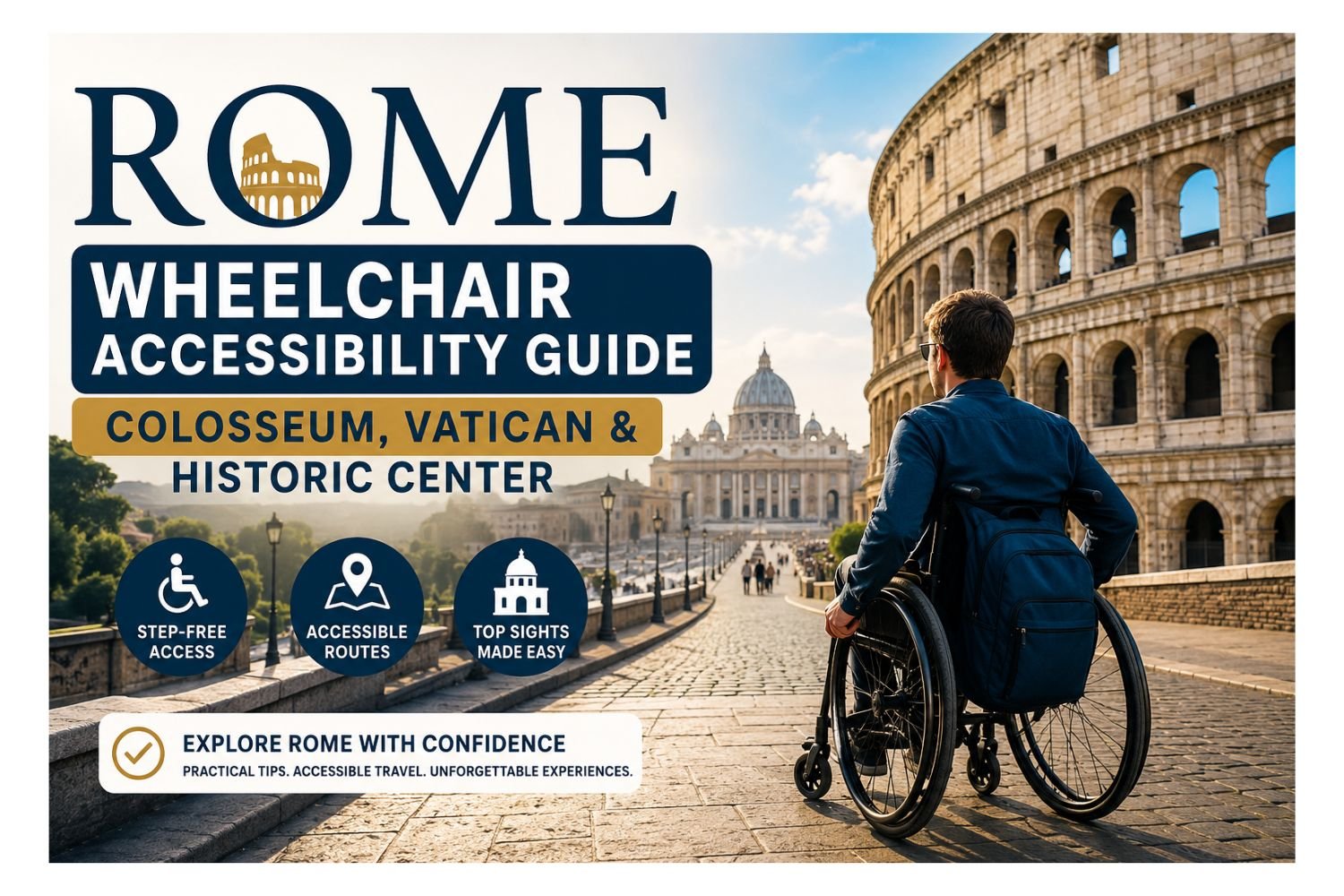
Rome for Wheelchair Users: A Block-by-Block Guide to the Colosseum, Vatican & Historic Center
Rome is one of the most rewarding cities in the world to visit, and one of the most physically demanding to navigate in a wheelchair. This is the version of the guide that actually tells you where the ramps are — not just that “accessibility is available.”
There’s a particular kind of dread that comes with loving a city you’re not sure will love you back. Rome is nearly 3,000 years old in places, built long before anyone designing it thought about wheelchairs, and it shows — in the uneven stone streets, the centuries-old thresholds, the hills that don’t appear on any map until your arms feel them. And yet thousands of wheelchair users visit Rome every year and have the trip of a lifetime. The difference between a trip that wears you down and one that opens the city up is almost entirely about knowing, block by block, what you’re walking into before you get there.
Rome’s major sites are genuinely accessible — the Colosseum, Vatican Museums, and Pantheon all have step-free routes. The real obstacle is the historic center’s cobblestones (sampietrini) and hills between sites, not the sites themselves. Plan routes along wider, flatter streets, and budget more time than you think you’ll need.
01Why Rome Is Genuinely Harder Than It Looks
Rome’s cobblestones — sampietrini, small hand-cut stone blocks laid in the 1700s — are a defining feature of the historic center, and they are rough. They’re uneven, gappy in places, and can be genuinely jarring for a manual or power chair over any real distance. Combine that with a city built across seven hills, and you get a place where the straight-line distance on a map is almost never the honest measure of how hard a route will be.
None of that means Rome is off the table. It means the trip works best when it’s planned around the terrain instead of around the map — choosing routes on modern asphalt where they exist, using accessible transport for the harder stretches, and treating “close by” distances with more caution than you would elsewhere.
The sites are more accessible than the streets between them
This is the single most useful thing to internalize before you plan a Rome itinerary: the destinations are usually fine. It’s the journey between them that needs the planning.
02Site-by-Site: What’s Actually There
The Colosseum
The Colosseum has a dedicated accessible entrance separate from the main visitor queue, with an elevator providing access to the arena-level walkway. Wheelchair users and one companion typically receive free or reduced admission, but the accessible entrance operates on a smaller capacity, so advance booking is strongly recommended rather than assumed.
Vatican Museums & St. Peter’s Basilica
The Vatican Museums offer a wheelchair-accessible route with elevators between floors, and free wheelchair loans are available on request. St. Peter’s Basilica itself is step-free at ground level and one of the more comfortable major sites to visit — though climbing the dome is not wheelchair accessible under any circumstance, since it’s a narrow spiral staircase.
The Pantheon
The Pantheon’s interior is flat and step-free, and the building itself poses no real barrier. The challenge is entirely the approach: the piazza in front is cobblestone, and it’s often crowded, so plan for slower movement rather than a quick pass-through.
Trevi Fountain
You can see and photograph the Trevi Fountain from a step-free vantage point, but the surrounding piazza is small, steeply sloped in sections, and often extremely crowded — which is a bigger practical barrier than the terrain itself. Early morning or late evening visits meaningfully improve maneuvering room.
Roman Forum & Palatine Hill
This is the most honestly difficult major site on this list. The Forum is an active archaeological area with unpaved paths, loose gravel, and genuine elevation change, and large sections are not realistically navigable in a wheelchair. Staff can point out the most passable perimeter routes, and it’s worth calling ahead to ask specifically what’s currently open, since access changes with ongoing excavation work.
03Getting Around: Metro, Buses & Taxis
Rome’s metro (Linea A and B) has accessible stations, but coverage in the historic center is thin, and elevator outages happen without much notice. Many wheelchair travelers find city buses more dependable for short hops, since a growing share of the fleet has low-floor ramp access, and accessible taxis can be booked in advance through the city’s radio taxi service for longer or time-sensitive trips.
Which Way Should I Travel?
Tap a scenario to see the most reliable option.
04What Real Travelers Are Saying
It’s worth being honest that Rome asks more of a wheelchair user than most European capitals, and that’s echoed consistently across the accessible-travel community. The recurring message isn’t “avoid Rome” — it’s “respect Rome’s terrain,” and plan around it rather than hoping it works out.
Themes From the Accessible Travel Community
Common patterns reported across accessible-travel blogs, forums, and advocacy resources — shared experience, not individual endorsements.
Travelers repeatedly note that a slightly longer route on smoother pavement is faster and far less exhausting than a “shortcut” across sampietrini.
Major sites rarely turn wheelchair users away, but accessible-entrance capacity is limited, and travelers who book ahead consistently report smoother arrivals than those who show up unannounced.
Nearly every account of a good day in Rome mentions planning fewer stops than usual and treating rest breaks as part of the itinerary, not an interruption to it.
05Frequently Asked Questions
Rome is manageable but requires real planning. Major sites like the Colosseum and Vatican Museums have dedicated accessible entrances, but the historic center’s cobblestones and hills make many streets genuinely difficult without route planning.
Only a portion of stations have working elevators, and outages happen without much notice. Many travelers find buses and accessible taxis more dependable than the metro for cross-city travel.
Yes. The Colosseum has a dedicated accessible entrance and elevator access to the arena level, and wheelchair users and one companion typically receive free or reduced entry, though advance booking is recommended.
Yes, the Vatican Museums have accessible routes and elevators, and St. Peter’s Basilica is accessible at ground level, though the dome climb is not wheelchair accessible.
A note on accuracy: accessibility features, elevator status, and entrance procedures can change without much public notice, especially at archaeological sites with ongoing work. Confirm current conditions directly with each site before your visit.

2 thoughts on “Rome Wheelchair Accessibility Guide: Colosseum, Vatican & Historic Center”