
8 min read · Updated for 2026 · Booking Logistics
The open road is one of the most accessible ways to travel — when the vehicle fits and the plan holds. Here is how to get both right.
There is a reason road trips are the holiday of choice for so many disabled travelers: no baggage handlers, no aisle chairs, no standing at the carousel wondering whether your wheelchair survived the flight. It is you, your vehicle, and your schedule.
But “just rent a car” is never quite that simple when you need hand controls, a ramp, or a vehicle tall enough for a power chair. Accessible road trips reward planning and punish assumptions. This guide covers the three things that make or break the trip: the vehicle, the controls, and the route.
Fast Answer
Book accessible rental vehicles 2–4 weeks ahead, confirm hand controls in writing 48 hours before pickup, and plan rest stops every 90–120 minutes at locations you have verified — not ones you hope will work.
1. Renting an Accessible Vehicle
You have two broad options: a standard rental car fitted with portable hand controls, or a wheelchair-accessible van with a ramp or lift.
Standard rentals with hand controls. The major rental brands offer portable hand controls at many locations, usually at no extra charge. These are temporary units fitted to the car at pickup, and they work well for drivers who transfer into a standard seat and stow a folding chair in the boot.
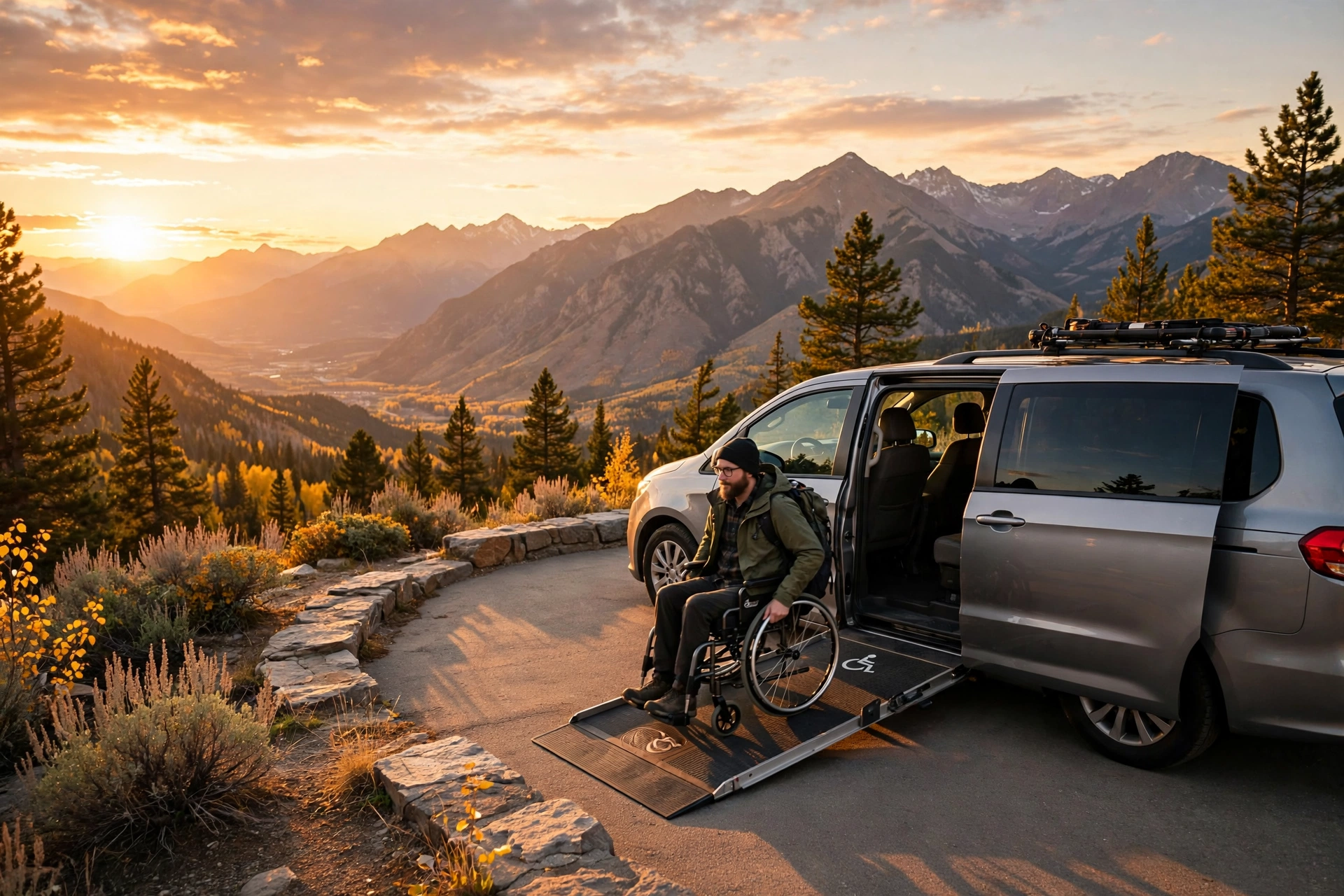
Accessible vans. If you stay in your chair while traveling, or drive from your chair, you need a converted van with a ramp or lift, tie-downs, and enough interior height. These come from specialist accessible-vehicle hire companies rather than high-street rental desks, and availability is much more limited.
Whichever you need, book 2–4 weeks ahead as a minimum — longer in summer and around holidays. Accessible inventory is a small fraction of any fleet, and the specific vehicle you need may have to be moved between locations.
- 2–4 weeks — Minimum lead time for booking an accessible rental vehicle
- 30–60 min — Allow for hand-control fitting and adjustment at pickup
- 48 hours — Before pickup, reconfirm hand controls in writing
2. Hand Controls: How They Work and How to Book Them
Portable hand controls translate foot-pedal inputs to your hands. The most common type is push-pull: push the lever forward to brake, pull it toward you to accelerate. Some drivers prefer a spinner knob on the steering wheel for one-handed steering. Controls also come in left-hand and right-hand versions, so specify which you need.
If you have never driven with them, a short familiarization session in the rental car park is worth the time — braking distances and pedal feel differ from what your feet expect.
How to book: call the pickup location directly, not just the central reservations line. Central booking systems often cannot see which locations actually have hand-control units on the shelf. Get the name of the person who confirmed, and follow up in writing — email counts — 48 hours before pickup.

Sample Script
“I am collecting a rental on [date] and I need portable hand controls fitted. Can you confirm this location has them available, which type they are, and who will do the fitting when I arrive?”
“Could you confirm that by email so I have it in writing?”
3. Planning Your Route
A route that works for a non-disabled driver and a route that works for you are different plans. Build yours around three things: rest stops, range, and charging.
Rest stops. Plan to stop every 90–120 minutes, and verify the stops in advance. Motorway service areas vary enormously — an “accessible toilet” on a map does not guarantee a step-free path from the car park, an unlocked accessible cubicle, or space that fits a power chair. When it matters, call ahead.
Range. In rural areas, fuel stations can be 50 miles or more apart, and not every station is step-free from pump to shop. Keep the tank above a quarter, and know where the next two fuel stops are — not just the next one.
Charging. Power chair users should travel with their charger and know the vehicle’s 12V outlet capacity before relying on it. Overnight charging at hotels is the reliable backbone of any multi-day trip — which means confirming an accessible room with a power socket near the bed, not just any room.
- Map your stops before you leave: mark every planned stop on your route with its accessible facilities verified — not assumed. One unverified stop is where trips unravel.
- Build in buffer time: everything takes longer: transfers, equipment checks, finding the accessible entrance the satnav did not know about. A four-hour drive planned as six hours is a relaxed trip; planned as four, it is a stressful one.
- Save offline maps: signal drops in exactly the rural stretches where you most need your map. Download offline maps for the whole route before departure.
4. The Packing List That Matters Most
Beyond the usual luggage, accessible road trips have a short list of non-negotiables:
- Chair repair kit: puncture repair or a spare inner tube, a multi-tool, and the Allen keys that fit your chair’s bolts.
- Charger and adapters: your chair charger, plus a 12V inverter if you plan to top up from the car.
- Tie-down straps: even in a van with built-in tie-downs, your own straps are a backup worth having.
- Portable threshold ramp: for the one step nobody mentioned at the bed and breakfast.
- Documentation on paper: rental confirmation, hand-control confirmation email, insurance details, and breakdown cover numbers — not just on a phone with 4% battery.
5. Frequently Asked Questions
Can I rent a car with hand controls?
Yes. Major rental brands offer portable hand controls at many locations, usually at no extra charge. Book 2–4 weeks ahead, call the pickup location directly to confirm availability, and reconfirm in writing 48 hours before collection.
Do I need a special licence to drive with hand controls?
It depends on the country. In many places a standard licence covers you if the vehicle is fitted with the adaptations you need, but some jurisdictions require an endorsement or a driving assessment. Check your licensing authority’s rules before you travel rather than assuming.
What if the hand controls are not there when I arrive?
This is why written confirmation matters. With it, the location will usually source a unit from another branch or find you an alternative adapted vehicle. Without it, you are negotiating from scratch. If they cannot provide what was confirmed, ask for a written record of the failure and escalate to the company’s disability assistance team.
Can I take a wheelchair-accessible van across borders?
Often yes, but specialist hire companies may restrict cross-border travel or charge extra. Confirm it in writing before booking, and check that your insurance and breakdown cover extend to every country on your route.
Sources
- MobilityWorks — Wheelchair Accessible Vehicle Rentals
- Wheelchair Travel — Accessible Travel Resources
Related guides
Keep planning with these:

1 thought on “Accessible Road Trips: Rentals, Hand Controls, and Planning”