You’ve arrived at your hotel — only to find the “accessible room” you carefully booked has a bathroom door too narrow for your wheelchair, or a bathtub with high sides where a roll-in shower was promised. If this has happened to you, you’re far from alone — and it isn’t your fault.
Here’s the uncomfortable truth about how to book an accessible hotel room: the label means something different at nearly every property. For one hotel, “accessible” means a genuinely step-free room with a roll-in shower. For another, it means a standard room where someone once bolted a grab bar beside the toilet. The little checkbox on booking sites can’t tell the difference — but the right questions can.
Why “Accessible Room” Means Something Different at Every Hotel
In the United States, the Americans with Disabilities Act (ADA) sets requirements for hotel accessibility — but compliance varies enormously, especially in older buildings. Elsewhere, there may be no single equivalent standard at all.
Even within one hotel, accessible rooms are rarely identical: one might have a roll-in shower, another a bathtub with grab bars, and a third might simply be larger, with a raised toilet. On a booking site, all three sit under the same filter. Never assume — replace assumptions with specifics.
Don’t Trust the Checkbox: Call the Hotel Directly
Third-party booking sites are excellent for comparing prices, but far less reliable at guaranteeing accessibility. When you tick “accessible room” online, you’re sending a request into a system — the site passes a code to the hotel, and you hope someone interprets it the way you would. Too often, nobody does.
Calling the property directly changes everything. You speak to a real person in the actual building you’ll be sleeping in — not a distant call centre. Ask them to describe the specific room and, crucially, to go and look at it: many staff will happily check the shower type or measure a doorway while you’re on the phone.
Call at a quieter time — mid-morning or early afternoon on a weekday — and be specific about your needs rather than relying on the word “accessible” alone. “I use a wheelchair and need a roll-in shower with a seat” gets far better answers than “do you have accessible rooms?” Then call again a few days before arrival to confirm your notes are still there.
The accessible-room checkbox is a starting point, not a guarantee. A ten-minute phone call tells you more than any booking filter ever will.
The Questions to Ask Before You Reserve
Keep this list on your phone — you won’t need every question on every trip, but working through them covers the whole journey, from the car park to the pillow.
Arriving: Parking, Entrances and Lifts
- Is there step-free access from the street and car park to the entrance — no stairs, steep ramps, or heavy manual doors?
- How many accessible parking bays are there, and how close are they to the entrance?
- Are the main entrance doors automatic or power-assisted?
- Is the accessible room on the ground floor, or is there a lift? How large is the lift, and where is it in relation to the accessible rooms?
The Room: Doors, Space and Layout
- What is the clear width of the bedroom and bathroom doors? Many wheelchair users need at least 32 inches (about 81 cm).
- Is there enough clear floor space to turn a wheelchair in the bedroom and bathroom — about a 1.5-metre turning circle?
- How high is the bed, from floor to top of mattress? Very low platform beds can make transfers difficult.
- Is there clear space on both sides of the bed, or only one?
- Is the flooring hard or carpeted? Thick, soft carpet can be hard going for wheels and walkers.

The Bathroom: Where the Details Matter Most
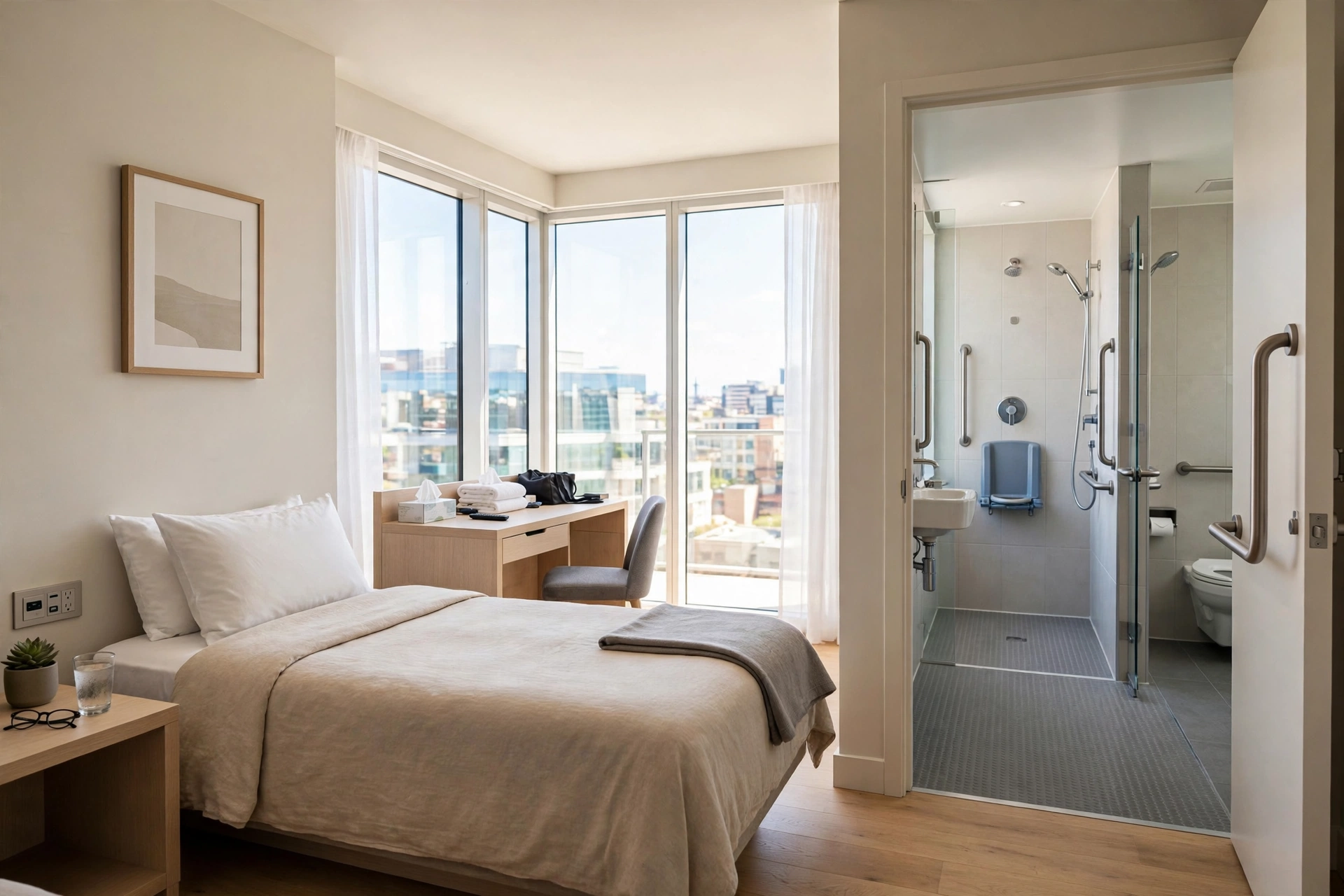
- Is it a roll-in shower, a transfer shower, or a bathtub? A roll-in shower has no kerb, so you can wheel straight in; a transfer shower has a small kerb and a seat; a bathtub has to be climbed into.
- For a roll-in shower: is there a fold-down seat, grab bars, and a handheld showerhead? Does water stay in the shower area or flood the floor?
- For a bathtub: how high are the sides, and is a bath bench or seat available?
- What is the toilet height, and are there grab bars beside and behind it? Around 17 to 19 inches suits many people better.
- Is there knee clearance under the sink, so you can roll underneath it?
The Details People Forget to Ask About
- Is there a working pool lift, and do staff know how to operate it?
- Are the restaurant, breakfast area, and gym step-free?
- Where exactly is the accessible room — near the lift, or at the end of a very long corridor?
- Can a mini-fridge be provided for medication, and is there a charge?
- Are there visual (flashing) fire alarms for guests who are deaf or hard of hearing?
Book Direct With the Hotel When You Can
Once you’ve found a room that genuinely works, book it directly with the hotel rather than through a third-party site. Your requests go straight onto your reservation — with third-party bookings, they can arrive as a generic code, or not at all. Direct booking usually brings friendlier terms too: free cancellation, easier date changes, and loyalty points.
If the price difference on a third-party site is genuinely significant, you can still use it — but call the hotel afterwards with your confirmation number and restate your needs in full. Never assume the booking site passed them on.
Get Your Confirmation in Writing
Once the hotel confirms a room with the features you need, ask for it in writing. An email saying “confirmed: ground-floor accessible room with roll-in shower, shower seat, and grab bars” is worth far more than any verbal promise. Note who you spoke to and the date, and ask them to add the details to your reservation.
Keep the email on your phone, not buried in an inbox. Written confirmation protects you if staff change shifts, the system loses a note, or the room you’re shown doesn’t match what was agreed.

What to Do If the Room Isn’t What You Were Promised
Even with perfect preparation, it can still happen. Here’s what actually works, in order:
- Don’t unpack. Go back to the front desk straight away — it’s much easier to change rooms before you’ve settled in.
- Stay calm and specific: “I confirmed a roll-in shower with a seat in writing; this room has a bathtub.” Show your confirmation and ask for the manager.
- Know what “fixed” looks like: a different accessible room that meets your needs, a move to a sister property at their expense, or a full refund.
- Document everything: take photos, note names, and write down times. Facts win — and an honest, factual review afterwards helps the next traveller more than star ratings ever could.
Frequently Asked Questions
What’s the difference between an “accessible room” and an “ADA room”?
In the US, an ADA room should meet the design standards of the Americans with Disabilities Act — door widths, grab bars, turning space. “Accessible room” is a looser, unregulated term. Outside the US, neither has a single legal meaning, so always ask what the room includes.
Should I book through a hotel website, a third-party site, or by phone?
Use third-party sites to compare prices, but book directly with the hotel — ideally after a phone call confirming the exact room features. Direct bookings put your requests on your reservation, usually include free cancellation, and make problems far easier to fix on arrival.
What exactly is a roll-in shower, and how is it different from a transfer shower?
A roll-in shower has no kerb or lip — the floor is level, so you can wheel straight in — with a fold-down seat, grab bars, and handheld showerhead. A transfer shower has a small kerb and a seat you transfer onto. Always confirm which the hotel means.
How far in advance should I book an accessible hotel room?
As early as you can. Most hotels have only a handful of accessible rooms — sometimes just one or two with a roll-in shower — and they sell out faster than standard rooms. Booking early also gives you first choice of location, such as the ground floor or near the lift.
What should I do if the hotel can’t confirm the specific features I need?
Treat it as a warning sign and look elsewhere. If a hotel can’t tell you the shower type, the door widths, or the bed height, it probably doesn’t understand accessibility well. A property that answers easily is usually the right choice — even if it costs more.
Related Guides
Keep planning with these Clearway Travel guides:
- Sort out travel insurance for travellers with disabilities before you travel — here’s what to look for.
- Considering the seas instead? Read our guide to choosing the right accessible cruise.
- And for the destination itself, learn the process of researching a city’s accessibility before you book.
Sources & verification
Key details in this guide were checked against official sources on 18 October 2026.
- The US Department of Justice’s ADA guide for places of lodging — covers how hotels should serve guests who are blind or have low vision, the official accessibility standard behind this guide’s advice.

2 thoughts on “How to Book an Accessible Hotel Room: Questions to Ask Before You Reserve”