Flying With Sensory Sensitivities: Sensory Rooms, TSA Cares, and Practice Programs That Actually Help
You don’t have to walk into an airport for the first time on the day of your actual flight. There’s a better way to do this.
Airports are a lot, sensory-wise. Fluorescent lights, echoing announcements, crowds moving in every direction, no predictable rhythm to any of it.
For an autistic traveler, or anyone with sensory sensitivities, that’s not a minor annoyance. It can be the difference between a trip that happens and one that doesn’t.
Here’s what a lot of families don’t find out until much later: airports have quietly built an entire support system for exactly this. Sensory rooms. Notification cards. Free rehearsal flights, months before the real one. Most of it is still surprisingly under the radar.
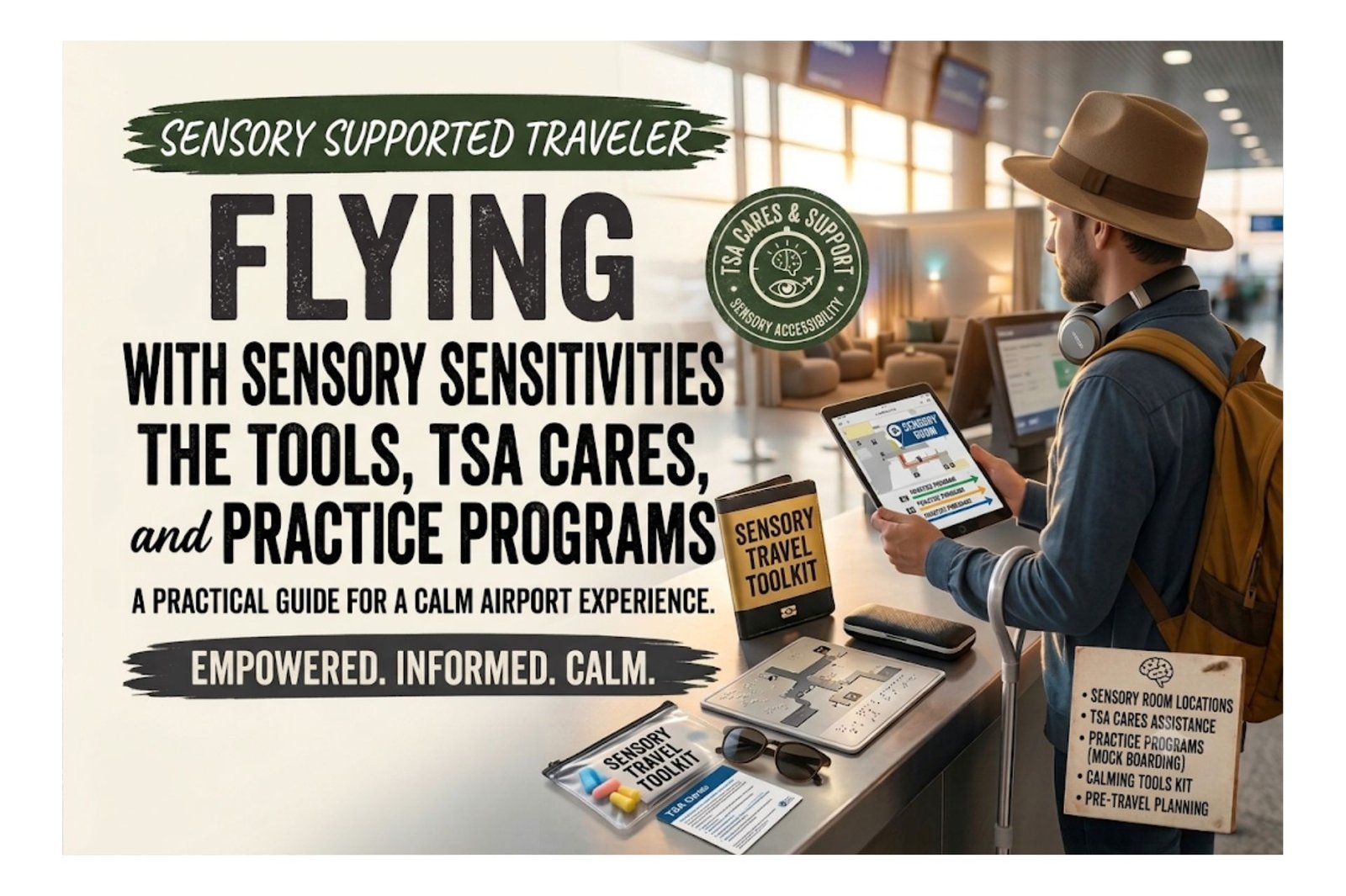
Call TSA Cares 72 hours ahead to arrange checkpoint support. Ask about a TSA notification card to communicate needs without words. Check whether your airport has a sensory room, and look into free practice flight programs like Wings for Autism before booking a real trip.
01Why the First Flight Is the Hardest
Most travel anxiety comes from not knowing what’s coming next.
For a sensory-sensitive traveler, an airport multiplies that uncertainty — new sounds, new smells, a security process nobody explains clearly, all packed into a space with nowhere quiet to retreat to.
The good news is that almost none of this has to be experienced for the first time on the day of a real flight.
You can rehearse the whole thing beforehand
Free programs exist specifically to let you walk through check-in, security, and boarding with zero pressure, months before you actually need to fly.
02The TSA Notification Card
This is a small tool that solves a very specific problem: how do you communicate a need to a security officer, in a loud, fast-moving checkpoint, without a long verbal explanation.
The TSA notification card does exactly that. You hand it over, it explains the situation briefly, and it opens the door to accommodations without requiring a conversation you may not want to have in that moment.
It can be used alongside medical documentation, and it works whether you’re traveling alone or with support.
03Sensory Rooms: Where They Actually Are
Tap an airport to see what it actually offers.
Airport Sensory Room Guide
A sample of U.S. airports with dedicated sensory or calming spaces.
Pittsburgh International — Presley’s Place
A dedicated sensory room built specifically for autistic travelers, with calming lighting and a low-stimulation layout, located pre-security.
Seattle-Tacoma — Sensory Room
Doubles as a meditation and calming space, with soothing textures and acoustic panels to cut down on terminal noise.
San Francisco — Sensory Room + Quiet Airport Program
Includes a mock airplane cabin to practice boarding, alongside a broader program limiting unnecessary announcements terminal-wide.
Minneapolis-St. Paul — Navigating MSP
A mock aircraft cabin near an actual gate lets travelers rehearse boarding in a realistic, low-pressure setting before a real flight.
04Practice Flights: Rehearsing Before the Real Thing
Programs like Wings for Autism and Wings for All let families walk through an entire flight experience — check-in, security, boarding, even sitting on a real aircraft — without ever taking off.
They’re free, they’re run by real airports and airlines, and their entire purpose is removing the fear of the unknown before it has a chance to build.
If one is available near you, it’s worth doing before booking a real trip, not after a difficult one.
05Before You Fly: A Short Checklist
Pre-Flight Prep
06What To Say At Check-In
“I called TSA Cares ahead of time to arrange support for sensory needs — could you confirm what’s on file?”
“We may need a bit more time or a quieter path through security — is a passenger support specialist available?”
07What Real Travelers Are Saying
Advocacy groups and families who’ve done this before tend to circle back to the same handful of lessons.
Themes From the Autism Travel Community
Common patterns reported across autism advocacy resources and traveling families — shared experience, not individual endorsements.
Families consistently report that a practice run through an airport reduces day-of anxiety more than any verbal preparation alone.
Arriving well ahead of boarding is repeatedly described as the single biggest stress-reducer, giving room for breaks without racing a clock.
Advocacy groups consistently encourage restating needs at each stage of the trip rather than assuming staff already know, since information doesn’t always transfer between teams.
08Frequently Asked Questions
It’s a card travelers can show a security officer to quietly communicate a disability, medical condition, or sensory sensitivity without needing to explain it verbally in a crowded checkpoint.
TSA recommends calling at least 72 hours before your flight to arrange additional support for security screening, including checkpoint navigation and sensory or communication accommodations.
They’re free rehearsal programs, often run by airports and airlines, that let autistic travelers walk through check-in, security, and boarding a real or mock aircraft before their actual flight.
A growing number do. Airports including Pittsburgh, Seattle-Tacoma, San Francisco, and others have dedicated sensory or calming rooms with low lighting and reduced noise.
A note on accuracy: sensory room availability, program schedules, and airline accommodations vary by location and change over time. Confirm current details directly with your airport and airline before you fly.

3 thoughts on “Flying With Sensory Sensitivities: Sensory Rooms, TSA Cares, and Practice Programs That Actually Help.”