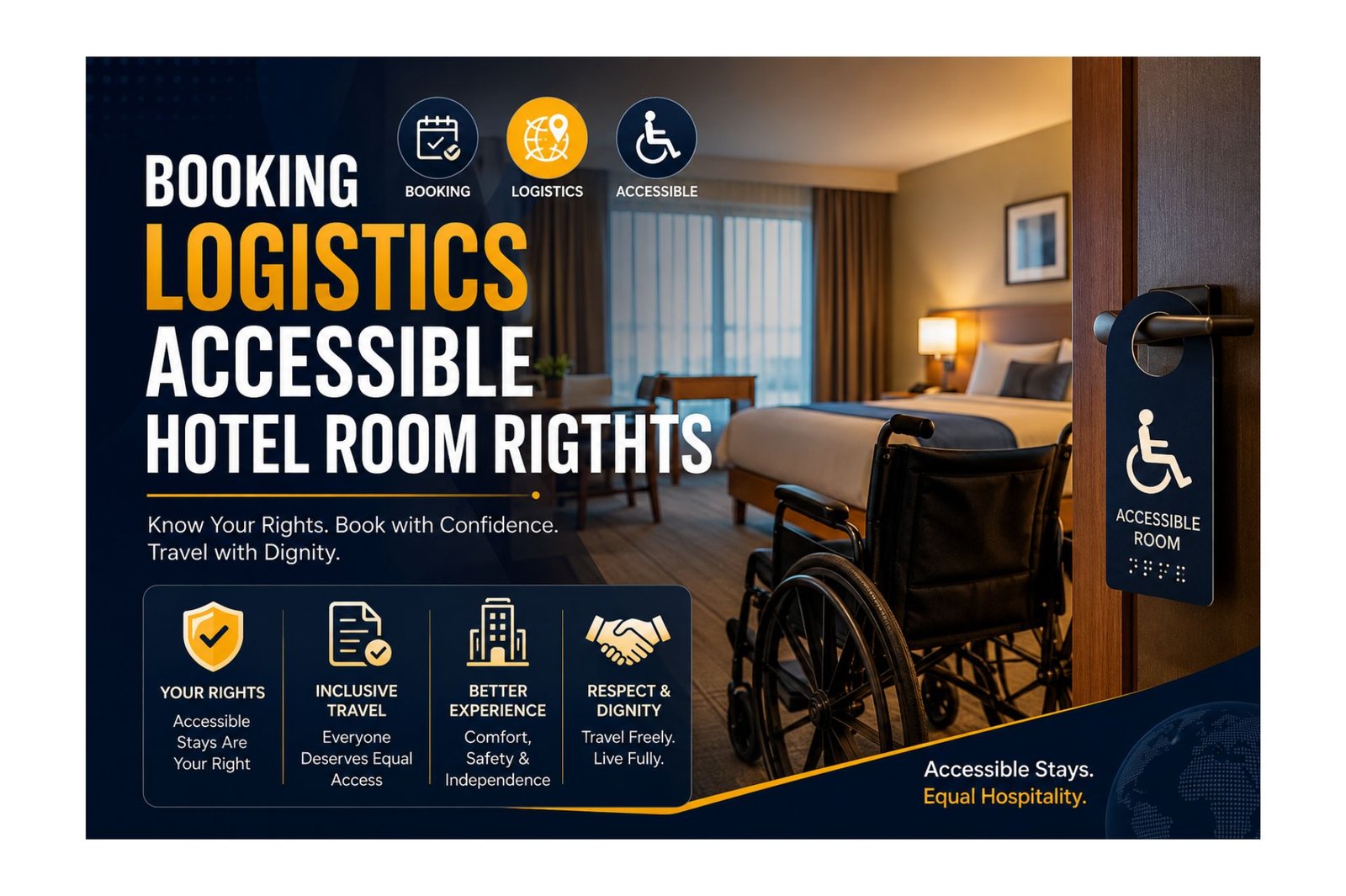
What “Accessible Hotel Room” Actually Means: Your Rights When Booking
The label on a hotel listing rarely tells you what you actually need to know. Here’s what the law says an accessible room has to include — and what it isn’t allowed to charge you for it.
You’ve been here before. A hotel listing says “accessible room available,” and that’s it.
No mention of the shower. No bed height. No idea whether “accessible” means a grab bar was added to a regular room, or whether it was actually built for a wheelchair user.
You end up calling the front desk, hoping whoever answers actually knows the room they’re describing. That shouldn’t be the only way to find out.
Here’s what hotels are legally required to tell you, provide, and never charge extra for — so you’re not booking on faith.
An ADA-accessible room legally requires specific features — a 32-inch doorway, a 60-inch turning radius, and either a roll-in or transfer shower with grab bars. Hotels cannot charge more for these rooms, must hold your reservation, and must be able to describe exact features before you book.
01Why the Label Alone Tells You Nothing
“Accessible room” is a category, not a description. It can mean a fully adapted bathroom with a roll-in shower, or it can mean a standard room with one grab bar added to satisfy a checklist.
The gap between those two things is exactly why so many trips start with an anxious phone call.
The good news: the actual legal requirements are specific and knowable. You don’t have to trust a vague label — you can ask for the details the law says the hotel has to provide.
Hotels are legally required to describe the room, not just label it
Under the ADA, a hotel must be able to tell you the specific accessible features of a room — bed height, shower type, door width — before you book, not after you check in.
02Roll-In vs. Transfer Shower
This is the single most important distinction, and the one most often left out of a listing.
Which Shower Type Do You Need?
Tap each one to see what it actually offers.
Roll-In Shower
No curb or step — a wheelchair rolls directly in. Includes a fold-down seat, grab bars on the wall opposite the seat, and controls positioned within reach of someone seated. Best for wheelchair users who don’t transfer independently.
Transfer Shower
A low curb with a built-in seat right at the entry, designed so a guest can transfer from a wheelchair onto the seat rather than roll all the way in. Often smaller than a roll-in shower. Best for guests who can transfer with some support.
03The Specs a Real Accessible Room Should Meet
| Feature | Requirement |
|---|---|
| Entry doorway | At least 32 inches of clear passage |
| Turning space | 60-inch diameter, clear of furniture |
| Bed height | Commonly cited range: 20–23 inches, floor to mattress top |
| Toilet height | 17–19 inches, with grab bars on rear and side walls |
| Sink clearance | 30×48 inches of clear floor space, knee clearance underneath |
| Outlets | Reachable between 15 and 48 inches from the floor |
04Your Four Legal Rights When Booking
Price parity
An accessible room can’t legally cost more than a standard room of the same type and category.
Room holding
Once reserved, your specific accessible room must be held until all other rooms of that type are sold.
Disclosure
Staff and booking systems must be able to describe the room’s specific accessible features in detail.
Service animals
Hotels must allow service animals in all guest-accessible areas, with no extra “pet fee” charged.
05Questions Worth Asking Before You Book
- “Roll-in or transfer shower?” — never accept “accessible bathroom” as a full answer.
- “What’s the bed height, floor to mattress top?” — get the number, not a description.
- “Is it a true king, or two beds pushed together?” — this changes maneuvering space significantly.
- “Can I see photos of the bathroom and door widths?” — written descriptions alone often miss the detail that matters.
- “Is the accessible room near service areas, or does it have the same view as other rooms?” — you’re entitled to comparable placement, not just comparable price.
06What To Say If the Answers Are Vague
“I need specific details on the accessible room before booking — is the shower roll-in or transfer, and what’s the exact bed height?”
“Under the ADA, hotels are required to describe these features clearly. Could you check with someone who can confirm the specs?”
07What Real Travelers Are Saying
Experienced wheelchair travelers tend to converge on the same lesson: consistency matters more than luxury.
Themes From the Accessible Travel Community
Common patterns reported across accessible-travel blogs and traveler communities — shared experience, not individual endorsements.
Frequent travelers repeatedly note that major chains tend to offer more predictable, consistent accessible-room design than independent hotels, since standards are applied property-wide.
Travelers consistently say that seeing actual photos of grab bar placement and door widths tells them more than any written listing does.
Getting specific accommodations confirmed by email before arrival is repeatedly described as the difference between a smooth check-in and a frustrating one.
08Frequently Asked Questions
A roll-in shower has no curb, allowing a wheelchair to roll directly in, with a fold-down seat and reachable controls. A transfer shower has a low curb with a built-in seat at the entry, for transferring from a wheelchair rather than rolling all the way in.
No. Under the ADA, hotels cannot charge a higher rate for an accessible room than a standard room of the same type and category.
Generally no. Once reserved, hotels are required to hold that specific room until all other rooms of the same type have been sold.
While there’s no single strict federal bed height, accessibility guidance commonly cites 20 to 23 inches from the floor to the top of the mattress as workable for wheelchair transfers.
A note on accuracy: accessibility standards can vary by hotel age, renovation date, and country. Always confirm specific room features directly with the hotel before booking, especially for international stays where local standards may differ from the ADA.

5 thoughts on “Your Accessible Hotel Room Rights: What to Know Before Booking”