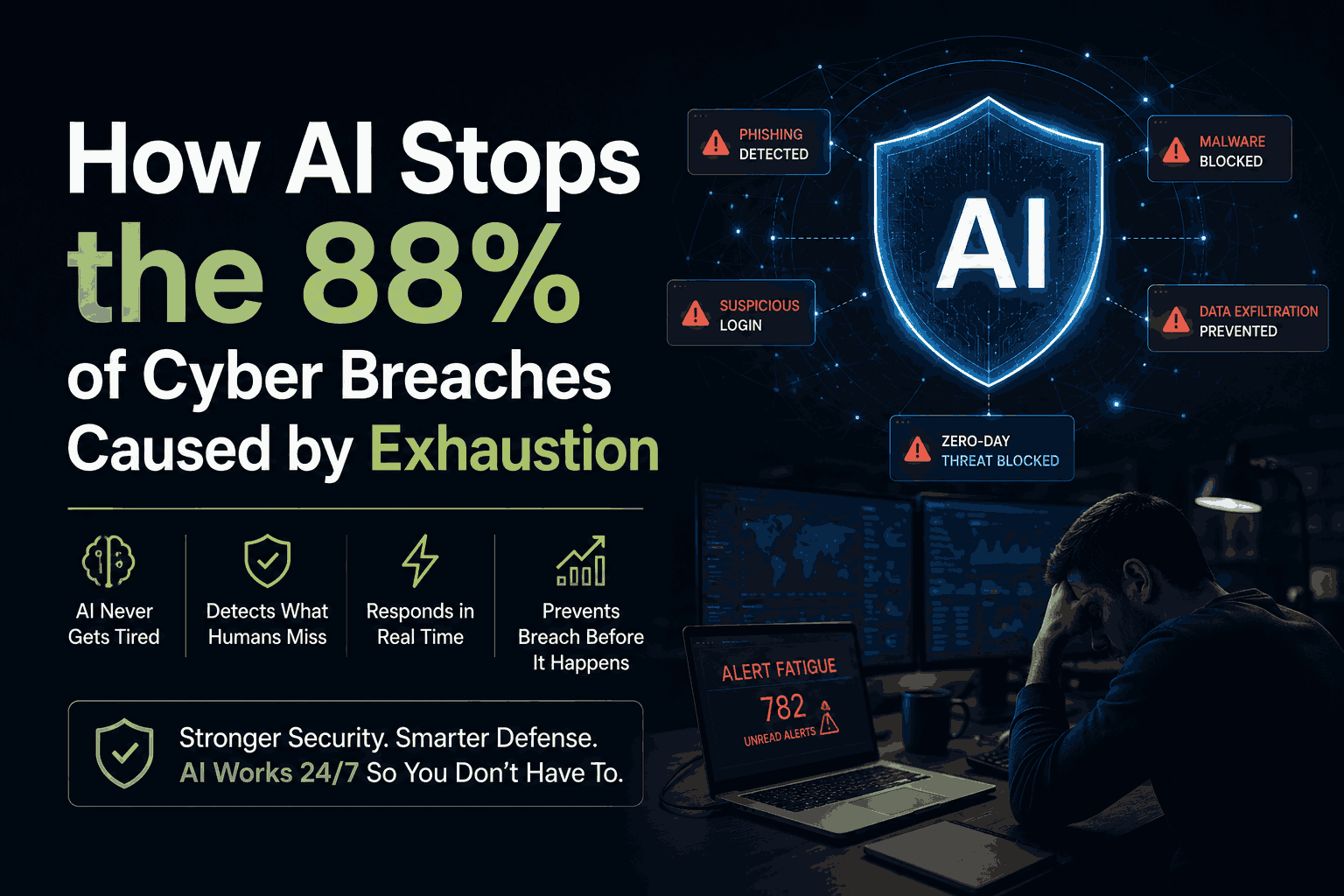
It was 4:45 PM on a Friday, and I was completely running on fumes. I had been staring at my screen for hours, digging through the Downloads folder on my PC to locate a specific project file I needed to finish a WordPress automation script for ProfitShieldAI.com. My brain was fried, and I just wanted to close my laptop for the weekend.
Right at that moment, an email popped up.
“Urgent: Please review the attached server infrastructure invoice before the bank closes at 5:00.”
It had the exact name of my hosting provider. It had the correct logo. Because I was exhausted, I didn’t think critically. I just moved my mouse to click the attached PDF to get it over with.
Before my finger could press down, a bright yellow banner flashed across my screen: “Warning: This sender is attempting to impersonate a known vendor. The domain does not match our historical relationship records.”
I froze. I looked closer at the sender’s address. It wasn’t from my host. It was a highly targeted, perfectly crafted phishing payload. If that AI safety net hadn’t caught me, I would have handed the keys to my entire digital infrastructure over to a ransomware syndicate.
That cold, sinking pit in your stomach when you realize you almost lost everything? That is the sound of human error.
We love to imagine hackers as hooded geniuses typing furiously in dark rooms, breaking through firewalls with complex code. The reality is much simpler, and much scarier. Hackers don’t “hack” into systems anymore. They log in. They log in using passwords we hand them because we are tired, stressed, or just trying to be helpful.
If you want to protect your digital assets, your traffic, and your revenue, you have to stop blaming people for being human. Here is how modern operations use AI to build a “Human Firewall” that catches us when we fall, and how you can lock down your own business against the silent threat of exhaustion.
Phase 1: The “88% Reality” (Why Smart People Mess Up)
Let’s get the math out of the way. Researchers at Stanford University ran a massive study and found that roughly 88% of all data breaches are caused by human error. IBM released a similar report putting the number closer to 95%.
If you manage a business, those numbers should completely change how you allocate your resources. It means that out of ten catastrophic hacks, nine of them didn’t happen because your enterprise firewall was weak.
They happened because an employee or founder:
- Clicked a malicious link out of sheer curiosity or panic (exploiting “System 1” rapid thinking).
- Re-used a weak password across multiple platforms because of password fatigue.
- Misconfigured a cloud storage bucket because they were rushing to meet a Friday deadline.
To truly understand the operational risk your business faces every day, you have to look at the mathematical probability of a successful breach over time. Even if your team is 99% accurate at identifying phishing emails, the sheer volume of attacks ensures an eventual failure:
Breach Probability (%) = ( 1 – (1 – P_e)^N ) x 100
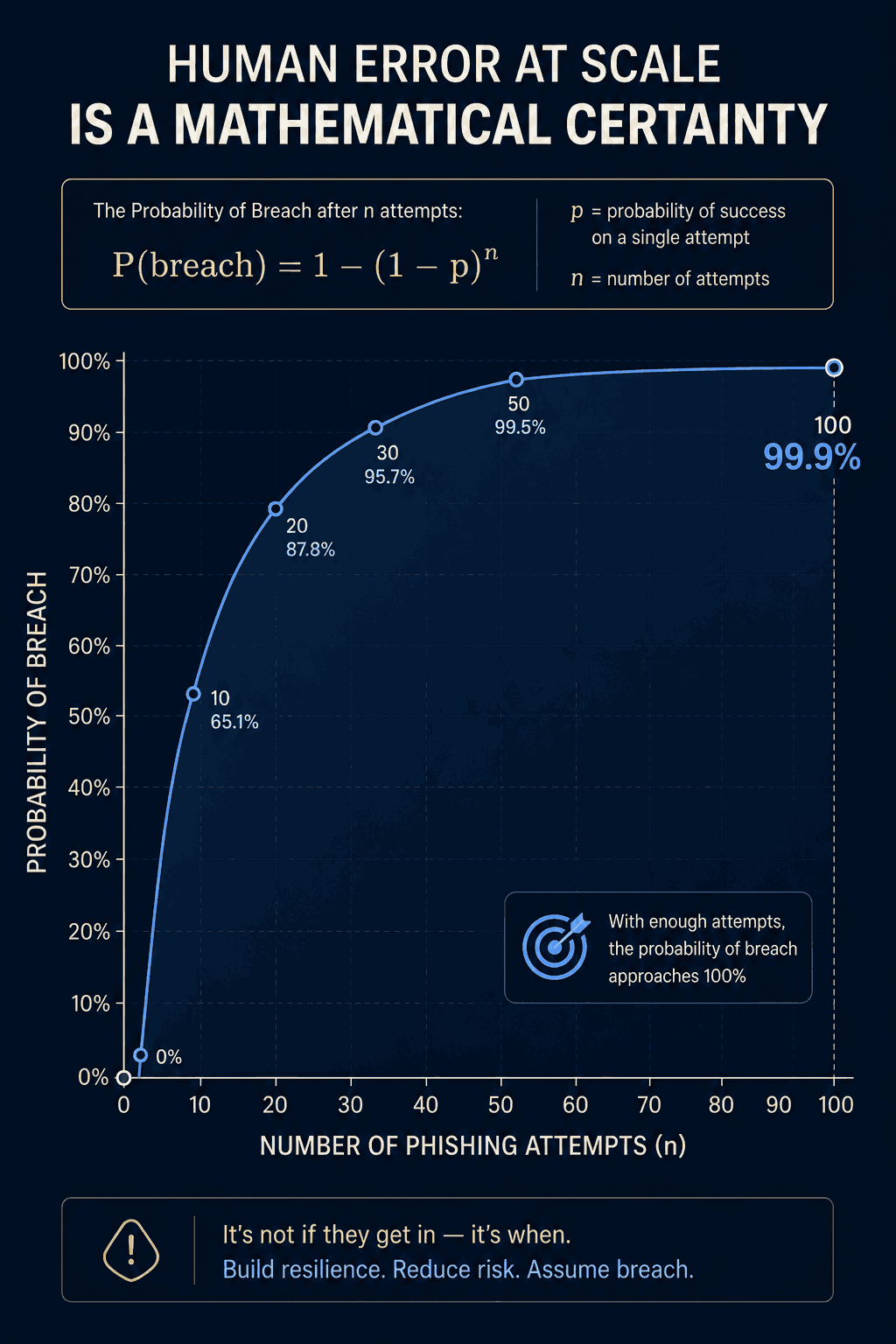
(Where P_e is the probability of a human making an error on a single email, and N is the total number of phishing attempts received.)
You cannot “patch” a human being the way you patch a server. We get tired. We have bad days. Punishing people for making mistakes under pressure doesn’t make them smarter; it just makes them hide their mistakes, which gives hackers more time to steal your data.
To actually protect our workflows, we have to lean into empathy and use artificial intelligence to bridge the gap between human fatigue and digital security.
Phase 2: The Anatomy of an Accidental Breach
To stop the bleeding, you have to know exactly how the wounds happen. There are three specific types of “Insider Threats” that absolutely destroy businesses—and none of them are malicious.
| Threat Type | How It Happens | Why Traditional Security Fails |
| The “Fat Finger” Leak | You type “Sa…” into your email client, hit enter on auto-complete, attach an unencrypted financial file, and hit send. You just sent a confidential asset to Sarah the Vendor instead of Sarah the Accountant. | Antivirus software cannot read your mind to know you selected the wrong contact from your address book. |
| The “People Pleaser” | A scammer calls your newest virtual assistant, pretending to be IT. They say, “I just sent a 6-digit code to your phone, can you read it back so I can fix your server error?” The VA complies to be helpful. | Firewalls cannot stop an employee from voluntarily reading a 2FA code out loud over a phone call. |
| Alert Fatigue | Your computer constantly pops up with warnings (“Update Java,” “Scan Completed”). You stop reading them and click “Ignore” out of habit. When a real ransomware payload triggers a warning, you blindly click “Allow.” | Security tools that create too much “noise” condition humans to bypass security protocols entirely. |
If you want to understand exactly how hackers exploit human empathy to bypass enterprise firewalls, watch this fascinating 18-minute TEDx breakdown by Cyber Psychology Profiler Mark T. Hofmann. It provides the essential context on why we must stop blaming humans for mistakes and start building AI ‘Human Firewalls
Phase 3: How AI Becomes Your Empathetic Safety Net
Modern security operations no longer rely on humans to be perfect. They rely on Artificial Intelligence to learn human behavior and quietly watch our backs.
Here is exactly how AI stops the 88% of errors before they become a headline:
1. Inbound Protection: Contextual Intent Analysis
Legacy spam filters are fundamentally outdated. They look for “bad words” like Wire Transfer or known bad IP addresses. Modern AI security tools look for Intent and Context.
- How it works: The AI analyzes your entire organization’s historical communication patterns. It knows that your CEO has never asked an employee to buy Apple gift cards at 3:00 AM. It maps out your usual working hours, tone of voice, and standard vendor domains.
- The Save: If a hacker spoofs an executive’s name, the AI catches the behavioral mismatch instantly. It pulls the email out of the inbox before your team even wakes up, removing the temptation to click entirely.
2. Outbound Protection: Data Loss Prevention (DLP)
This is the most “human” fix in the entire cybersecurity playbook.
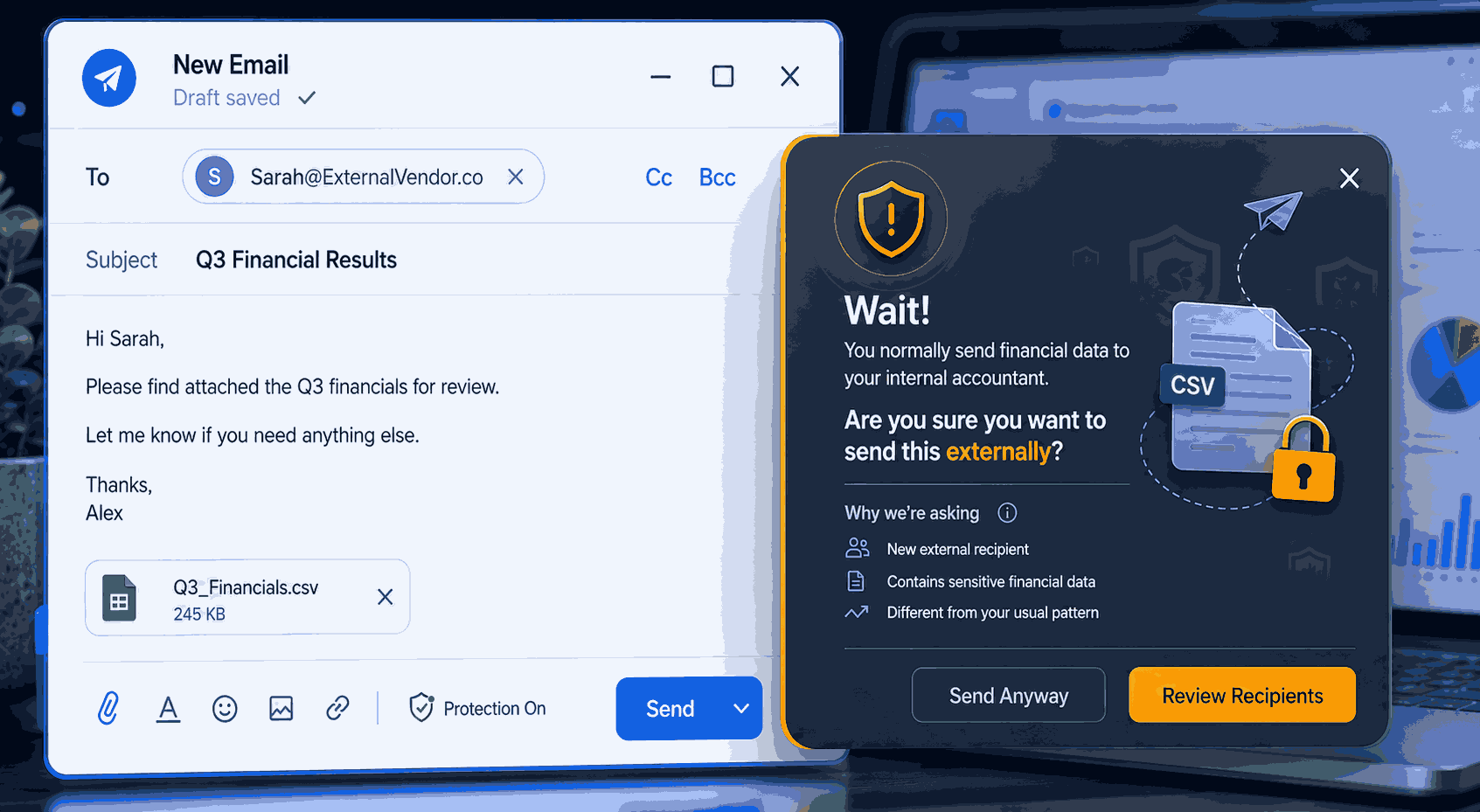
- How it works: Let’s go back to the “Fat Finger” scenario. As you type “Sarah” and attach a financial spreadsheet, the AI scans your historical Relationship Graph. It sees that you communicate with the vendor Sarah frequently, but you have never sent her a file containing financial keywords.
- The Save: Before the email leaves your outbox, a gentle, non-punitive pop-up appears: “Hold on! You usually send financial files to Sarah (Accountant). Are you sure you want to send this to an external vendor?” It allows you to correct the mistake in real-time, saving your reputation in one second.
3. Behavioral Biometrics: Stopping Account Takeovers
If a hacker successfully steals your password and logs into your cloud dashboard, they look exactly like you to the system. But they don’t act like you.
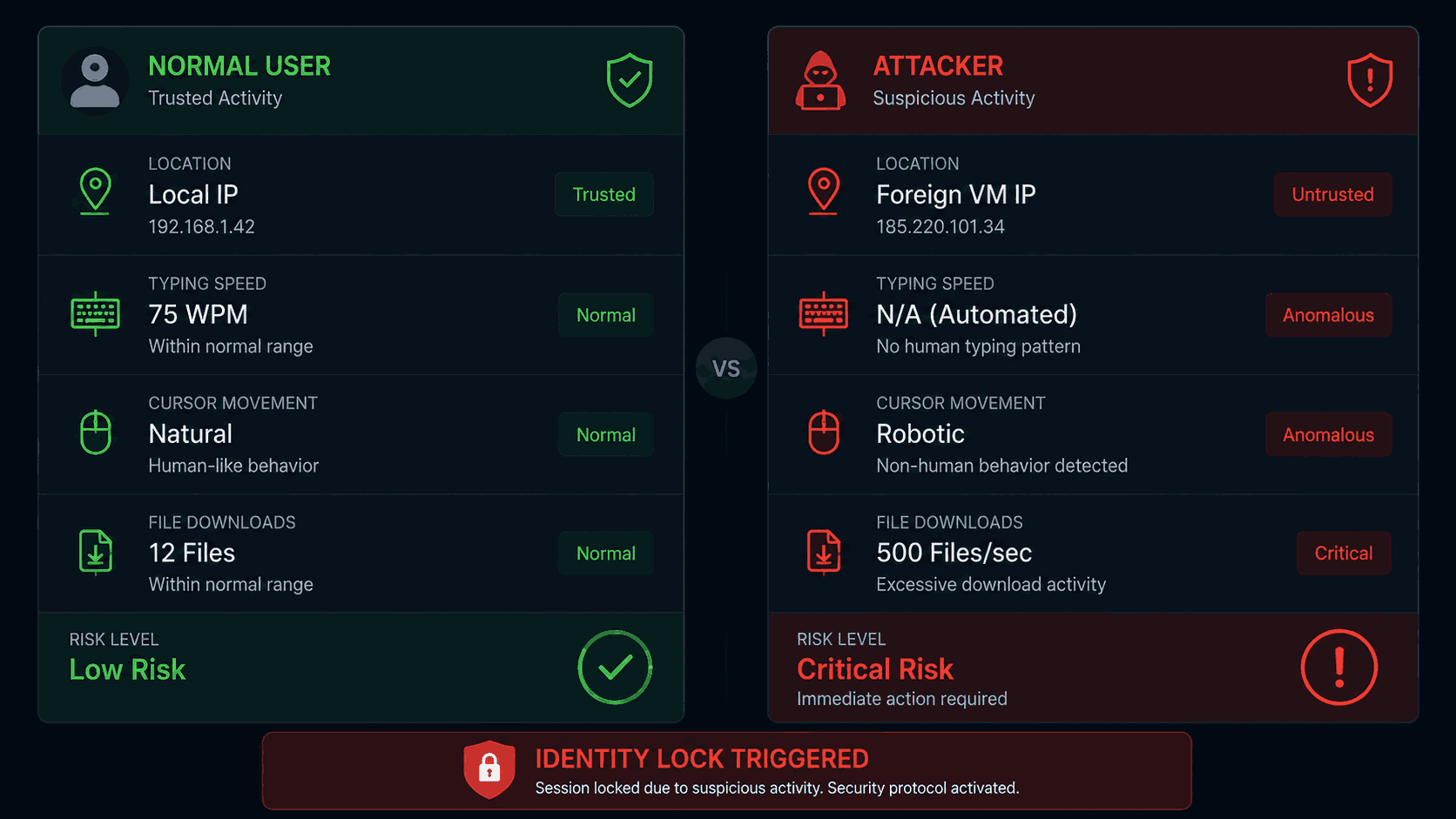
- How it works: Next-generation AI learns your digital fingerprint. It knows that you type at roughly 75 words per minute. It knows you use a specific mouse acceleration speed, and you always access your administrative dashboards from your local IP address.
- The Save: Suddenly, “your” account logs in from a virtual machine in another country, the mouse moves with robotic precision, and it attempts to download 5,000 files in ten seconds. The AI knows instantly that the person behind the keyboard is an imposter. It triggers an Identity Lock, freezing the account and demanding a hardware security key to proceed.
Phase 4: Build Your Own Firewall (High-Value Actions for Teams)
You do not need an enterprise budget to protect your digital real estate. Here are three advanced, highly actionable steps you can take today to build a human firewall around your business operations:
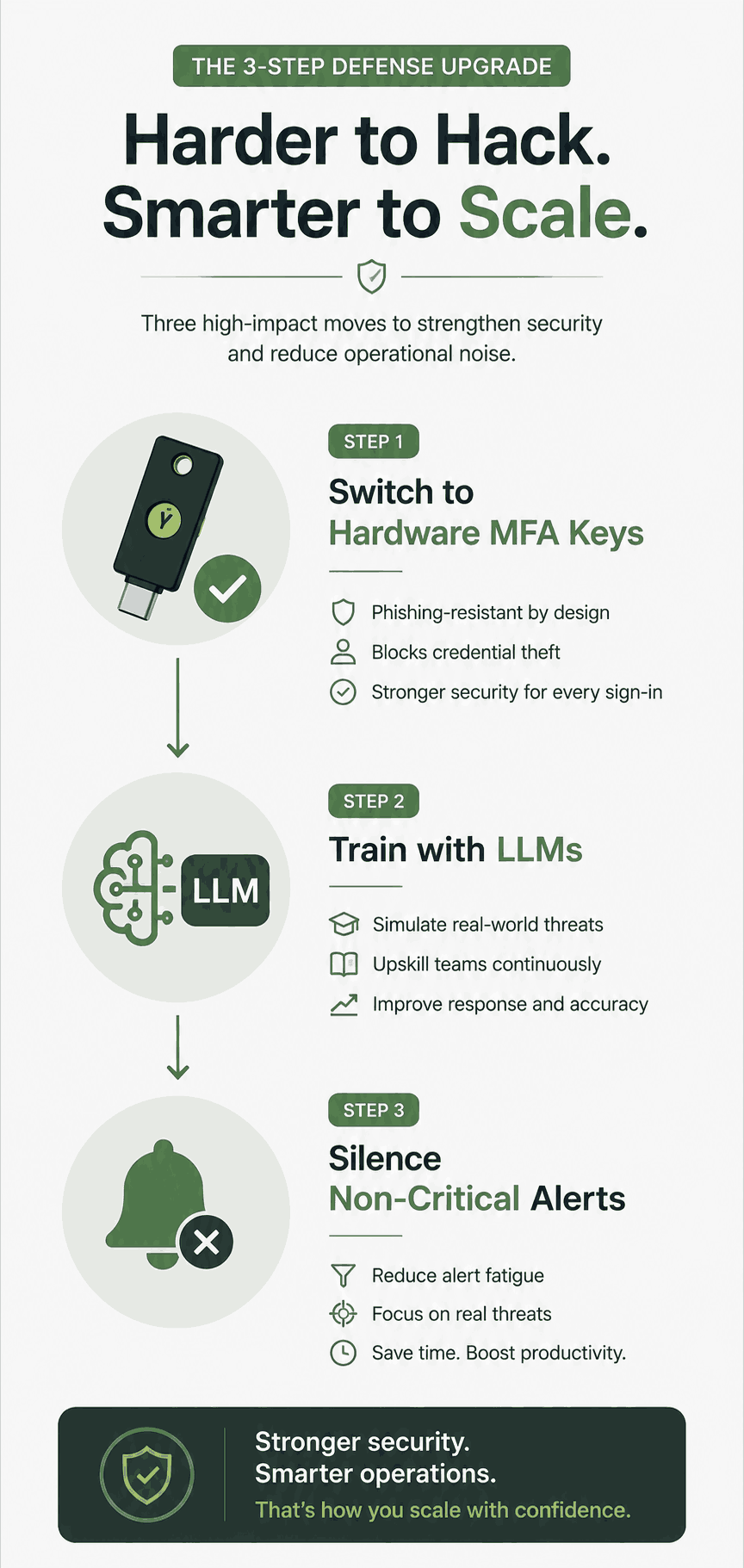
1. Upgrade to “Phishing-Resistant” MFA
Standard SMS text messages are no longer safe (they can be easily intercepted via SIM-swapping). You need to move your entire operation to hardware keys (like YubiKeys) or strict Authenticator apps.
Action Step: Go into your workspace admin panel today and enable Context-Aware Access. Set a rule that entirely blocks logins from countries where you do not have employees, even if the password is 100% correct.
2. Train Yourself with LLMs
I use my Google AI Pro plan to actively train myself against new threats. When I get a highly suspicious email that slips past the filters, I copy the raw email headers (stripping out any personal data) and feed it directly into the LLM.
Action Step: Ask the AI: “Analyze these email headers and tell me exactly how the sender attempted to spoof the domain, and what technical red flags I should look for next time.” It turns a scary, stressful moment into a high-level masterclass in cybersecurity.
3. Silence the Useless Noise
Protect your team from Alert Fatigue. Go into your antivirus and firewall settings and turn off all the routine “Success” or “Scan Complete” notifications. Your team should only ever see a popup when something is actually on fire. If alerts are rare, they will actually stop and read them.
The Bottom Line: Empathy is the Ultimate Security Policy
We have to stop treating our own people as the enemy. The 88% statistic isn’t a sign that humans are incompetent; it’s a sign that our digital lives are overwhelmingly complex, and our brains were not built to process thousands of deceptive data points a day.
Artificial intelligence doesn’t replace your people—it empowers them. It acts as an invisible guardian that taps you on the shoulder when you are tired and says, “Take a breath. Are you sure about this?”
That one second of hesitation—that tiny digital safety net—is the exact difference between a normal Friday evening and a devastating company-wide crisis. Protect your peace, protect your data, and give yourself the digital backup you deserve.