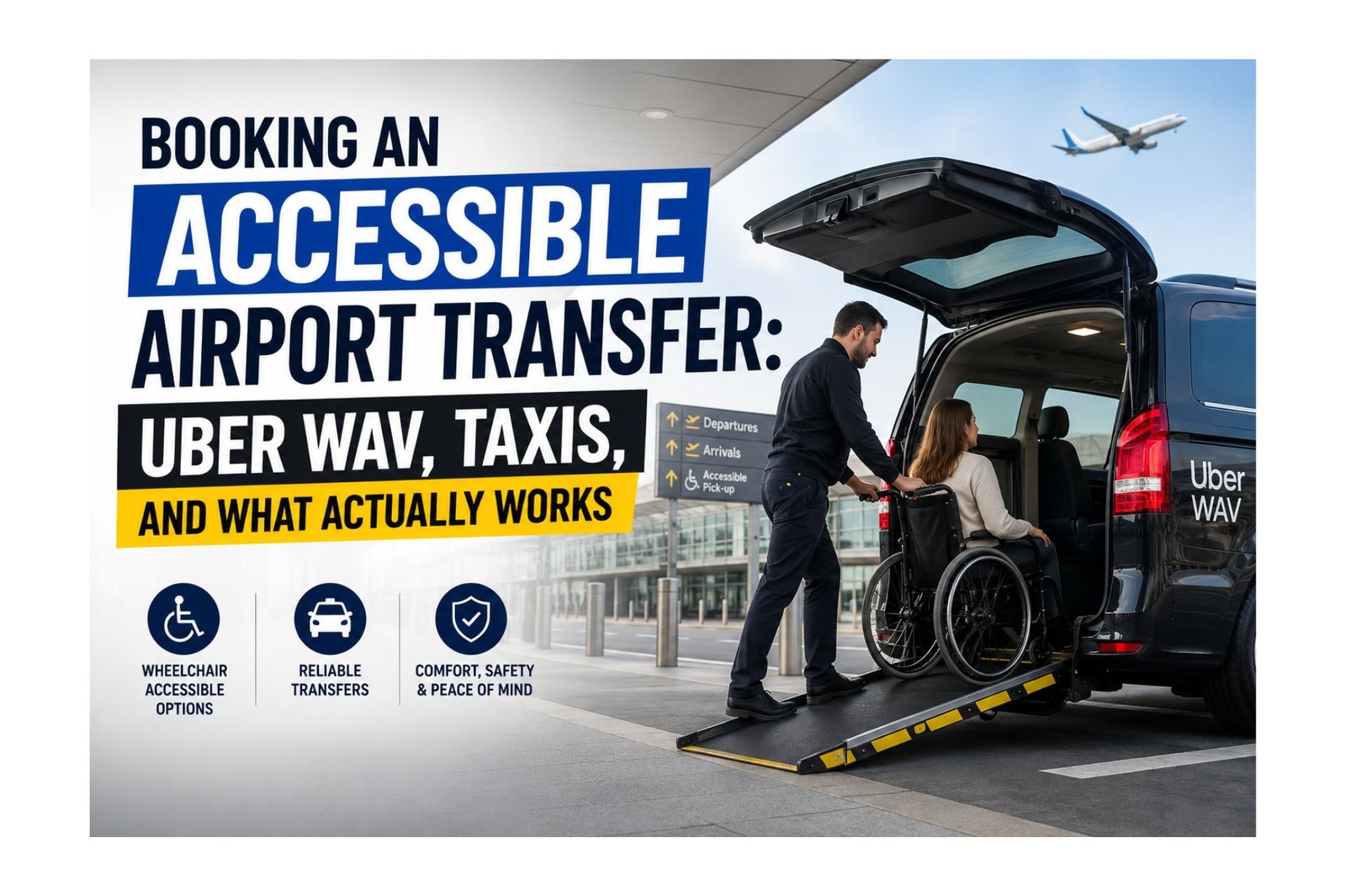
Booking an Accessible Airport Transfer: Uber WAV, Taxis, and What Actually Works
Your flight lands at a fixed time. Your accessible ride doesn’t always show up on one. Here’s how to close that gap before it costs you.
There’s a moment at baggage claim that non-wheelchair users never have to think about.
Everyone else steps outside, opens an app, and a car shows up in six minutes. For a wheelchair user, that same request can take twenty, forty, sometimes an hour — or come back with nothing available at all.
It’s not because you did anything wrong. The accessible vehicle fleet is simply much smaller than the standard one, in every city, on every platform. But knowing that in advance changes how you plan, and that’s the entire point of this guide.
Wheelchair-accessible rides on Uber WAV and Lyft cost the same as standard rides, but can take 20–45 minutes or longer to arrive. Check both apps before you land, know your city’s accessible taxi dispatch number as backup, and schedule ahead whenever your flight time is fixed.
01Why This Is Harder Than It Should Be
A standard rideshare pulls from a huge pool of ordinary cars. An accessible ride pulls from a much smaller pool of vehicles actually equipped with a ramp or lift.
That imbalance is the whole problem. It’s not a bug in the app — it’s a real shortage of accessible vehicles on the road, and it shows up hardest exactly when you need it most: right after a flight, on a fixed schedule, often exhausted.
The fix isn’t one app. It’s a plan with a backup.
No single service guarantees a fast accessible ride everywhere. Treating that as fact, rather than a surprise, is what actually prevents a missed connection.
02Your Real Options, Compared
Tap each one to see the honest tradeoff.
Accessible Transfer Options
Wait time and cost vary by city — this reflects typical patterns, not a guarantee.
Uber WAV
On-demand or scheduled ramp/lift-equipped vehicle, priced the same as standard UberX. Available in select major cities only — not universal.
Lyft Accessible
Similar model to Uber WAV — book on-demand or schedule ahead. Checking both platforms at once meaningfully improves your odds of a faster match.
Accessible Taxi Dispatch
Many cities run dedicated dispatch programs for wheelchair-accessible taxis — same fare as a standard cab, often bookable by phone or a dedicated app. Worth saving the number before you travel, not after you need it.
Paratransit
The cheapest option by far, required under the ADA in any area with public transit. Requires advance booking and runs on a more fixed schedule — better for planned trips than last-minute airport pickups.
03The Backup-Plan Habit That Actually Helps
- Check both Uber and Lyft before landing. Whichever shows a shorter wait, book that one.
- Save your destination city’s accessible taxi dispatch number before you fly, not while standing at baggage claim.
- Schedule ahead whenever possible — a pre-booked ride the night before gives the platform far more time to match you with an available vehicle.
- Confirm the pickup location with your driver directly once matched, especially if you need a curb cut or level entry point.
04What To Say To Your Driver
“Hi, I use a power wheelchair and will need the ramp. I’m at [specific location] — there’s a curb cut/level entry right at [landmark] that’s easiest for pickup.”
“I’ll need a few extra minutes to load — thank you for your patience.”
05What Real Travelers Are Saying
Frequent wheelchair travelers tend to land on the same handful of habits, learned the hard way.
Themes From the Accessible Rideshare Community
Common patterns reported across accessible-travel forums and rideshare communities — shared experience, not individual endorsements.
Experienced riders describe checking both Uber and Lyft as a near-automatic habit, not an extra step, since it roughly doubles the chance of a fast match.
Travelers consistently mention keeping a taxi dispatch number or paratransit booking as backup specifically for time-sensitive trips like flights.
A quick message to the driver about the exact pickup spot is repeatedly described as preventing the most common mix-ups at busy terminals.
06Frequently Asked Questions
Standard rideshare rides typically arrive within minutes, but wheelchair-accessible vehicles can take 20 to 45 minutes or longer, and in some markets none may be available at certain times, since the accessible fleet is much smaller.
No. Wheelchair-accessible rides are generally priced the same as the standard equivalent ride on the same platform, with no extra charge for the accessible vehicle.
Paratransit is a shared-ride service required under the ADA in areas with public transit, typically costing $1 to $5 per ride. It requires advance booking and runs on a more fixed schedule than on-demand rideshare.
Many frequent riders check both apps before a trip and choose whichever shows a shorter wait or better availability, since checking both roughly doubles the chance of finding an accessible vehicle quickly.
A note on accuracy: accessible rideshare availability, taxi dispatch programs, and paratransit rules vary significantly by city and change over time. Confirm current options for your specific destination before you travel.

10 thoughts on “Booking an Accessible Airport Transfer: Uber WAV, Taxis, and What Actually Works”