Tokyo Wheelchair Accessibility Guide: Why the Staff, Not Just the Elevators, Make It Work
Tokyo’s subway map looks like it was designed to overwhelm a first-time visitor. For a wheelchair user, it turns out to be one of the more manageable big cities in the world — for a reason most guides don’t explain clearly.
Most cities solve accessibility with infrastructure alone — elevators, ramps, curb cuts, and not much else.
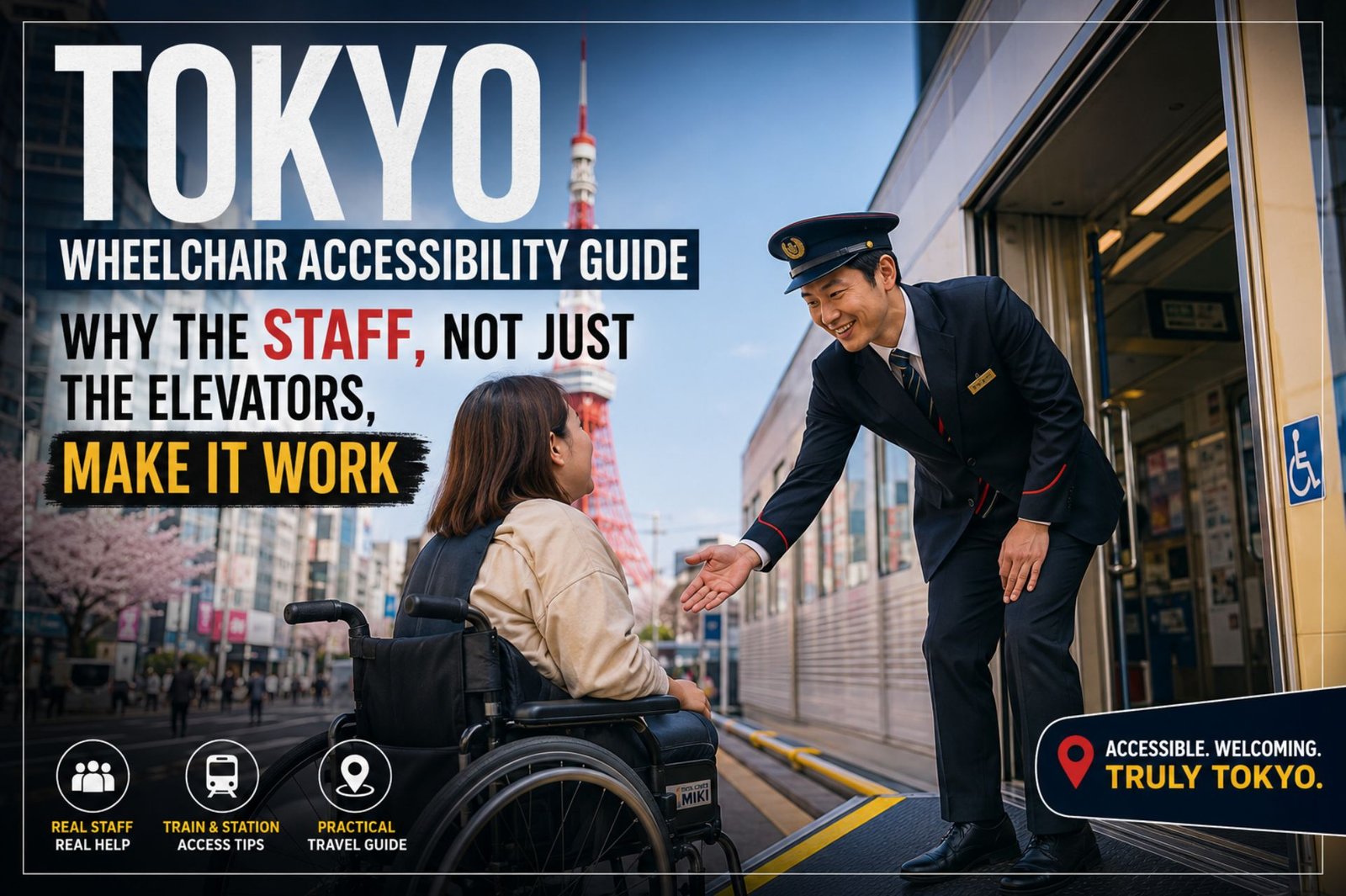
Tokyo does something different. The infrastructure is genuinely excellent, but the thing that actually makes the system work day to day is people: station staff who place boarding ramps by hand, call ahead to the next station, and personally walk you through transfers most cities leave you to figure out alone.
That distinction matters, because it changes how you should approach the city. This isn’t a “find the elevator and go” kind of place. It’s a “talk to the staff first” kind of place, and once that clicks, Tokyo becomes remarkably manageable.
Tokyo’s transit system is genuinely wheelchair accessible — nearly every station has an elevator, and staff personally assist with boarding ramps and platform gaps. Approach staff at the ticket gate before boarding. Avoid rush hour (7:30–9am, 5:30–7:30pm), when crowd density can make maneuvering genuinely difficult.
01How the Staff-Assisted System Actually Works
This is the part first-time visitors don’t expect: you’re meant to ask for help, and the system is built around it happening smoothly.
Approach staff at the ticket gate
Before heading to the platform, let staff know you need assistance. This is routine, not a special favor.
They guide you to the platform
Some stations use dedicated staff-only elevators for this, separate from the public ones.
A portable ramp bridges the platform gap
Staff place a ramp at the door nearest the wheelchair-designated area before you board.
They call ahead to your transfer or destination station
This is the detail that surprises most visitors — staff will be waiting for you at the other end, already informed.
Build in a little extra time, not less
Staff assistance is dependable, but it isn’t instant. A few extra minutes at each station keeps the system working for you rather than against your schedule.
02The Timing Detail Most Guides Skip
Tokyo’s rush hour isn’t just busy. It’s a level of density that genuinely changes what’s possible for a wheelchair user.
Outside these windows, the same stations that feel impossibly crowded in a photo are often calm and easy to navigate. Planning sightseeing around these two blocks, rather than through them, changes the entire experience.
03The One Navigation Trap Worth Knowing
Large terminal stations like Shinjuku or Tokyo Station can have dozens of separate street-level entrances. The one closest to where you’re standing isn’t guaranteed to have elevator access.
Both Tokyo Metro and Toei publish station-by-station accessibility search tools online — worth checking before you arrive at an unfamiliar station, rather than circling the building looking for the right door.
04What Real Travelers Are Saying
Wheelchair users who’ve spent real time in Tokyo tend to describe the same pleasant recalibration.
Themes From the Accessible Travel Community
Common patterns reported across accessible-travel blogs and Japan-focused accessibility resources — shared experience, not individual endorsements.
Travelers repeatedly describe initial intimidation at the size of Tokyo’s rail map giving way to real ease once they understood the staff-assisted routine.
Visitors consistently note that a more compact wheelchair navigates narrower older stations and sidewalks more comfortably than a larger device.
Many describe the personal, coordinated assistance across stations as one of the most reassuring parts of the trip, once expectations were set correctly.
05Frequently Asked Questions
Yes, considerably. Nearly all train and subway stations have elevators or ramps, buses are largely non-step, and station staff routinely assist wheelchair users with boarding, platform gaps, and transfers.
Generally yes, and it’s built into the system. Approaching staff at the ticket gate lets them place a boarding ramp, help with the platform gap, and call ahead to your transfer or destination station.
Morning rush hour, roughly 7:30 to 9:00 a.m., and evening rush hour, roughly 5:30 to 7:30 p.m., involve extremely dense crowding that can make maneuvering genuinely difficult.
Not always from street level. Large terminal stations often have many entrances, and the nearest one may not have elevator access, so locating the correct accessible entrance in advance is worth doing.
A note on accuracy: station accessibility continues to improve as ongoing infrastructure projects are completed. Always check Tokyo Metro’s or Toei’s official station accessibility search tools before your visit, since specific station details can change.

3 thoughts on “Tokyo Wheelchair Accessibility Guide: Why the Staff, Not Just the Elevators, Make It Work”