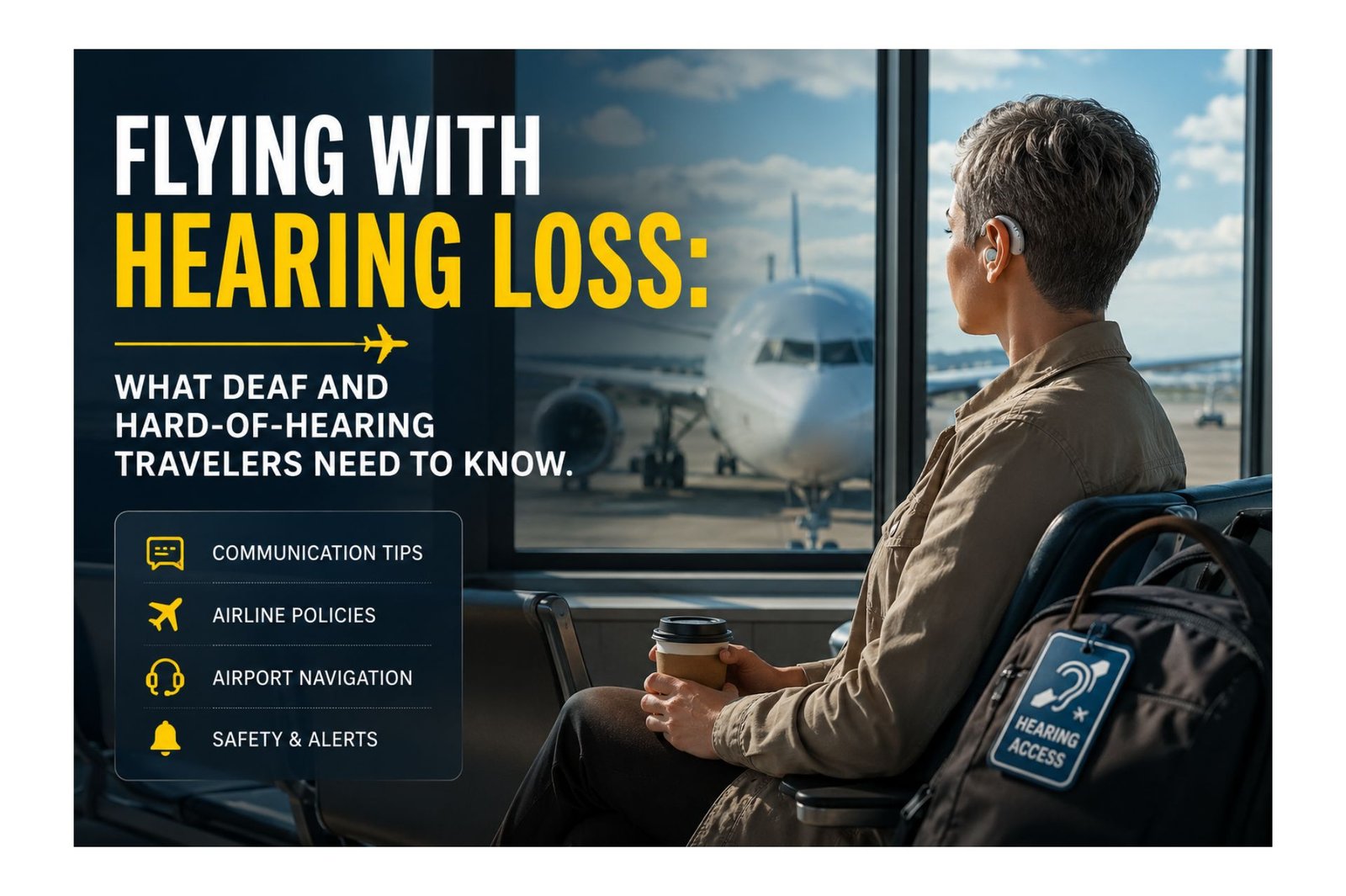
Flying With Hearing Loss: What Deaf and Hard-of-Hearing Travelers Need to Know
You shouldn’t have to guess what the gate agent just said. Here’s how to make sure you never have to.
There’s a specific kind of loneliness in sitting at a gate, watching other passengers suddenly stand up and move, and realizing something changed that you were never told.
Maybe it was a gate change. Maybe it was final boarding. Whatever it was, you missed it, and now you’re the one running.
This isn’t a small, occasional inconvenience. In 2026, HLAA reported on a 71-year-old woman with hearing loss who missed a connecting flight in Austin because a gate change was only ever announced over the loudspeaker — a story that resonated with a lot of readers because most people with hearing loss have a version of it.
It doesn’t have to keep happening. There are real, enforceable rights that exist for exactly this situation, and a handful of small habits that make airports feel far less like a gamble.
Self-identify to gate staff as deaf or hard of hearing so you get personal updates, not just loudspeaker ones. Ask for a Sunflower Lanyard at the airport info desk. Safety videos must legally be captioned, and you can request an adjoining seat for an interpreter or companion.
01Why This Keeps Happening
Airports are built around sound. Gate changes, boarding calls, delay notices — almost all of it defaults to a loudspeaker.
That’s not malice. It’s just a system designed around an assumption that doesn’t hold for everyone. And because so few people file complaints about it, the problem quietly persists.
The National Association of the Deaf has noted that airlines received around 14,000 disability-related complaints in a single year, but only a small fraction came from deaf or hard-of-hearing travelers — not because the problems are rare, but because most people don’t realize there’s somewhere to report them.
It’s not a favor. It’s a right.
Everything in this guide isn’t a courtesy some airlines choose to offer. It’s required under federal law. That distinction matters when you’re asking for it at a gate.
02Your Rights, In Plain English
The Air Carrier Access Act covers most of what you need. Here’s the short version.
Captioned safety videos
Safety and informational videos must be high-contrast captioned, and airport televisions must show captions at all times.
Personal updates from staff
Once you self-identify, staff must give you the same trip information as everyone else, delivered in a way you can actually receive.
Adjoining seat for a companion
If you’re traveling with an interpreter or someone assisting you, you can generally request a seat next to them.
Priority boarding
You’re entitled to board early if extra time helps you settle in, hear a personal safety briefing, or manage your equipment.
03The Sunflower Lanyard
This one is small, and it changes more than you’d expect.
What it is, and why it works
The Sunflower Lanyard is a simple green lanyard with a sunflower pattern, worn to quietly signal a non-visible disability — hearing loss, in this case — without needing to explain anything out loud. Many major airports provide them free at information desks, and staff trained to recognize them will often offer help before you have to ask.
04Before You Fly: A Short Checklist
Tap each item as you complete it.
Pre-Flight Prep
05What To Say At The Gate
You don’t owe anyone a long explanation. A short, direct sentence is enough.
“I’m deaf / hard of hearing. Please let me know directly about any gate changes, delays, or boarding calls — I won’t hear them over the speaker.”
“I’d like early boarding so I have time to settle in and get a personal safety briefing.”
06What Real Travelers Are Saying
The theme that comes up again and again isn’t about the technology. It’s about the habit of speaking up.
Themes From the Hard-of-Hearing Travel Community
Common patterns reported across hearing loss advocacy groups and traveler communities — shared experience, not individual endorsements.
Travelers consistently describe smoother trips when they mention their hearing loss at booking and again at the gate, rather than waiting until something goes wrong.
Telling both the gate agent and a seatmate is repeatedly described as more reliable than trusting any single system to catch every announcement.
Advocacy groups consistently encourage reporting inaccessible announcements through the DOT’s complaint system, since low reporting numbers are part of why the gaps persist.
07Frequently Asked Questions
You’re never required to disclose it, but self-identifying to gate agents and flight attendants is the only way to guarantee personal updates when announcements are made over a loudspeaker you can’t hear.
It’s a discreet lanyard that signals a non-visible disability, including hearing loss, without needing to explain it verbally. Many major airports provide them free at information desks.
Yes. Under the Air Carrier Access Act, safety videos and informational displays must be high-contrast captioned, and airport televisions must display captions at all times.
Yes. Airlines are generally required to provide an adjoining seat for a companion, such as a sign language interpreter, assisting a deaf or hard-of-hearing passenger.
A note on accuracy: airline policies and accessibility programs can vary by carrier and airport, and some requirements are still being phased in through 2028. Confirm current specifics directly with your airline before you fly.

2 thoughts on “Flying With Hearing Loss: What Deaf and Hard-of-Hearing Travelers Need to Know.”