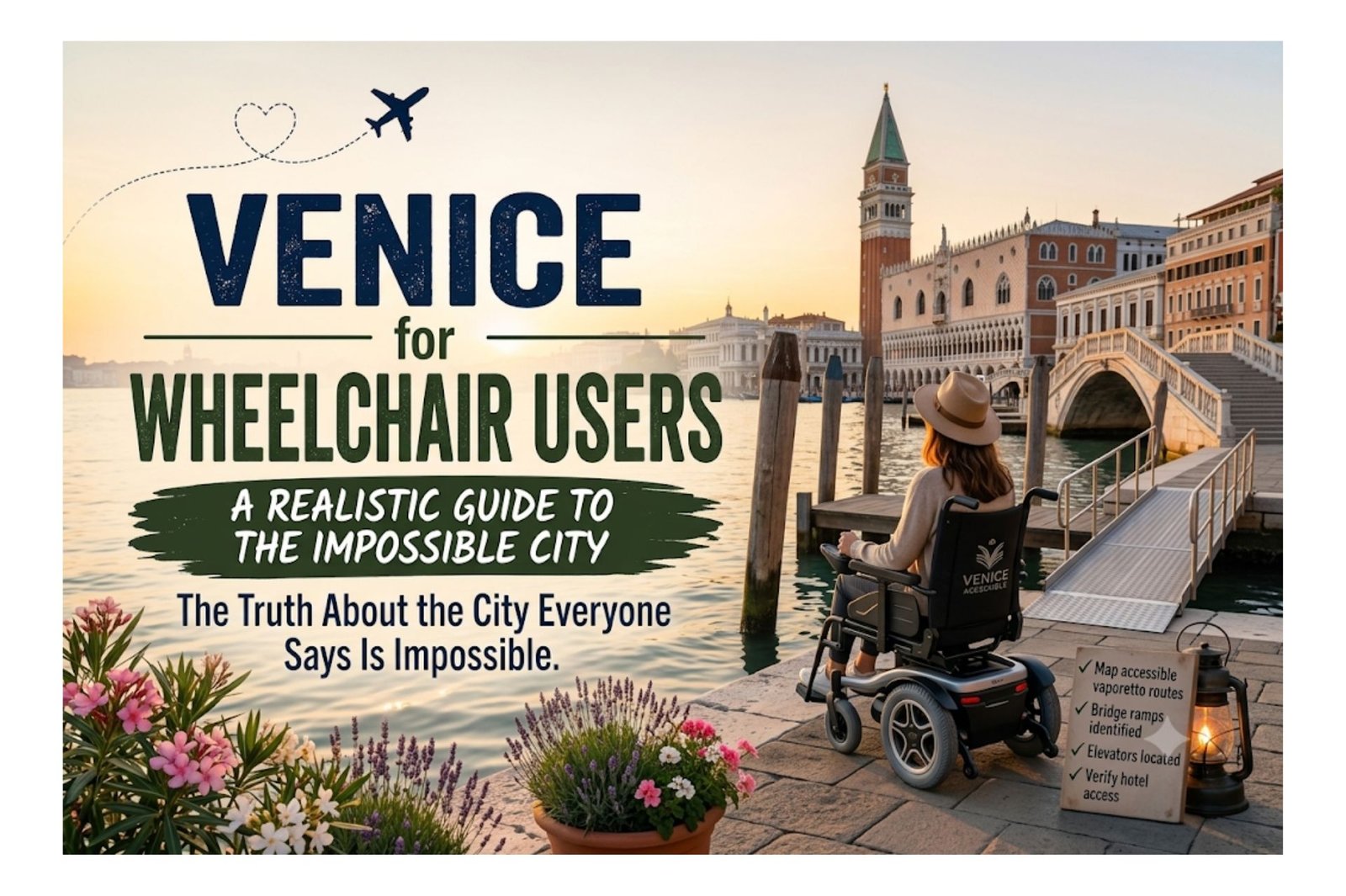
Venice for Wheelchair Users: The Truth About the City Everyone Says Is Impossible
Everyone will tell you Venice is impossible in a wheelchair. Most of them have never actually checked.
Venice has a reputation problem, and if you use a wheelchair, you’ve probably already heard it.
A city built on water. Hundreds of bridges, most of them old stone steps. No cars, no ramps, no way through.
It’s the kind of reputation that makes people quietly cross a bucket-list destination off their list without ever actually checking whether it’s true.
Here’s the part that doesn’t get said enough: it isn’t. Not entirely. Roughly 70% of Venice’s historic center is considered wheelchair accessible today, not because the bridges changed, but because the city stopped routing people over them.
Venice is more accessible than its reputation suggests — an estimated 70% of the historic center is navigable using bridge-free walking routes and the accessible vaporetto network (Lines 1, 2, and 12). Most crossings happen by boat, not by bridge, and wheelchair users typically pay a reduced fare with a free companion ticket.
01Why the “Impossible” Reputation Exists
The reputation isn’t made up. Venice genuinely has hundreds of small stone bridges, and the vast majority of them still have steps.
Out of all of them, only a small handful — the Calatrava Bridge near Piazzale Roma and the Ponte degli Scalzi near the train station among them — have ramps or lifts built in.
So the instinct to assume the whole city is off-limits is understandable. It’s also based on the wrong question.
The right question isn’t “can I cross the bridges?”
It’s “can I get where I’m going without crossing them?” In Venice, thanks to the vaporetto network, the answer is usually yes.
02How People Actually Get Around
The vaporetto is the real answer to Venice’s bridge problem. Think of it less like a boat tour and more like a bus system that happens to float.
Line 1 runs the full length of the Grand Canal and stops often. Line 2 covers similar ground faster, skipping the smaller stops. Line 12 heads out to Murano and Burano, if you want to see the islands.
All of them run wheelchair-accessible boats, with ramps that deploy at the dock and crew trained to help you board. Wheelchair users typically pay a reduced single fare, and a companion travels free.
The one honest catch: tide levels. During Acqua Alta, high water can shift the gap between the dock and the boat, and crew may need to lay a metal plate to bridge it. It’s manageable, but worth knowing about before you’re standing there.
03Site-by-Site: What’s Actually There
St. Mark’s Basilica
There’s a dedicated accessible entrance off Piazzetta dei Leoncini, with ramps and staff to guide you in. The floor inside is a little uneven in places, but manageable. The main nave is fully viewable, even if a few side chapels aren’t reachable.
Doge’s Palace
The main palace rooms and courtyards are wheelchair accessible, and an alternative ground-floor route through the old prisons lets you experience most of what the famous “secret itineraries” tour covers, minus the stairs. The Bridge of Sighs itself, however, is not wheelchair accessible — it’s a narrow stone crossing with no adapted route.
Accademia Gallery
A barrier-free entrance and elevators between floors make this one of the more comfortable major museums in the city. Staff are used to helping visitors find the smoothest route through the collection.
Peggy Guggenheim Collection
This modern art museum, set in a former canal-side palace, has accessible entrances and is one of the more consistently praised stops for wheelchair users in the city.
04Where Should I Actually Go?
Tap a scenario to see the route that tends to work best.
Venice Route Planner
A quick way to decide between walking and the vaporetto for common situations.
05Before You Go
- Register for the access fee exemption in advance. Visitors with mobility disabilities and their companions are generally exempt from Venice’s entry fee, but you typically need to register through the city’s official portal beforehand to get the exemption code.
- Choose Cannaregio or Castello for your stay. These neighborhoods tend to have flatter terrain and easier access to accessible vaporetto stops than the deeper historic core.
- Check tide forecasts. Acqua Alta season can mean temporary platforms and altered routes — worth checking before you plan a specific day around a specific site.
- Get the city’s official accessible map. Venice’s mobility office publishes a route map marking bridge-free paths, ramped bridges, and accessible toilets — genuinely worth having before you land.
06What Real Travelers Are Saying
The most common reaction from wheelchair users who’ve actually been isn’t relief that Venice was “fine.” It’s surprise at how much further they got than they expected.
Themes From the Accessible Travel Community
Common patterns reported across accessible-travel blogs and traveler communities — shared experience, not individual endorsements.
Travelers repeatedly describe going in expecting to see very little, then discovering entire neighborhoods were reachable once they stopped trying to cross every bridge on the map.
What feels intimidating on paper — boarding a boat in a wheelchair — is consistently described as routine by the second or third ride, once the rhythm of it clicks.
Frequent visitors mention checking the Acqua Alta forecast the way other travelers check the weather, since it affects boarding more than it affects most sightseeing.
07Frequently Asked Questions
More than most people expect. An estimated 70% of Venice’s central historic area is considered wheelchair accessible thanks to bridge-free walking routes and an accessible vaporetto network, even though many historic bridges remain stepped.
Most crossings happen via the accessible vaporetto network rather than bridges. A small number of major bridges, including the Calatrava Bridge and Ponte degli Scalzi, also have ramps or lifts.
Yes. Lines 1 and 2 along the Grand Canal, plus several outer-island lines, operate wheelchair-accessible boats with ramps, and wheelchair users typically pay a reduced fare with a free companion ticket.
Visitors with mobility disabilities and their companions are generally exempt, but typically need to register in advance through the city’s official portal to receive an exemption code.
A note on accuracy: accessibility infrastructure, fees, and exemption procedures can change, and tide conditions vary seasonally. Confirm current details through Venice’s official accessibility resources before your trip.

2 thoughts on “Venice for Wheelchair Users: The Truth About the City Everyone Says Is Impossible.”