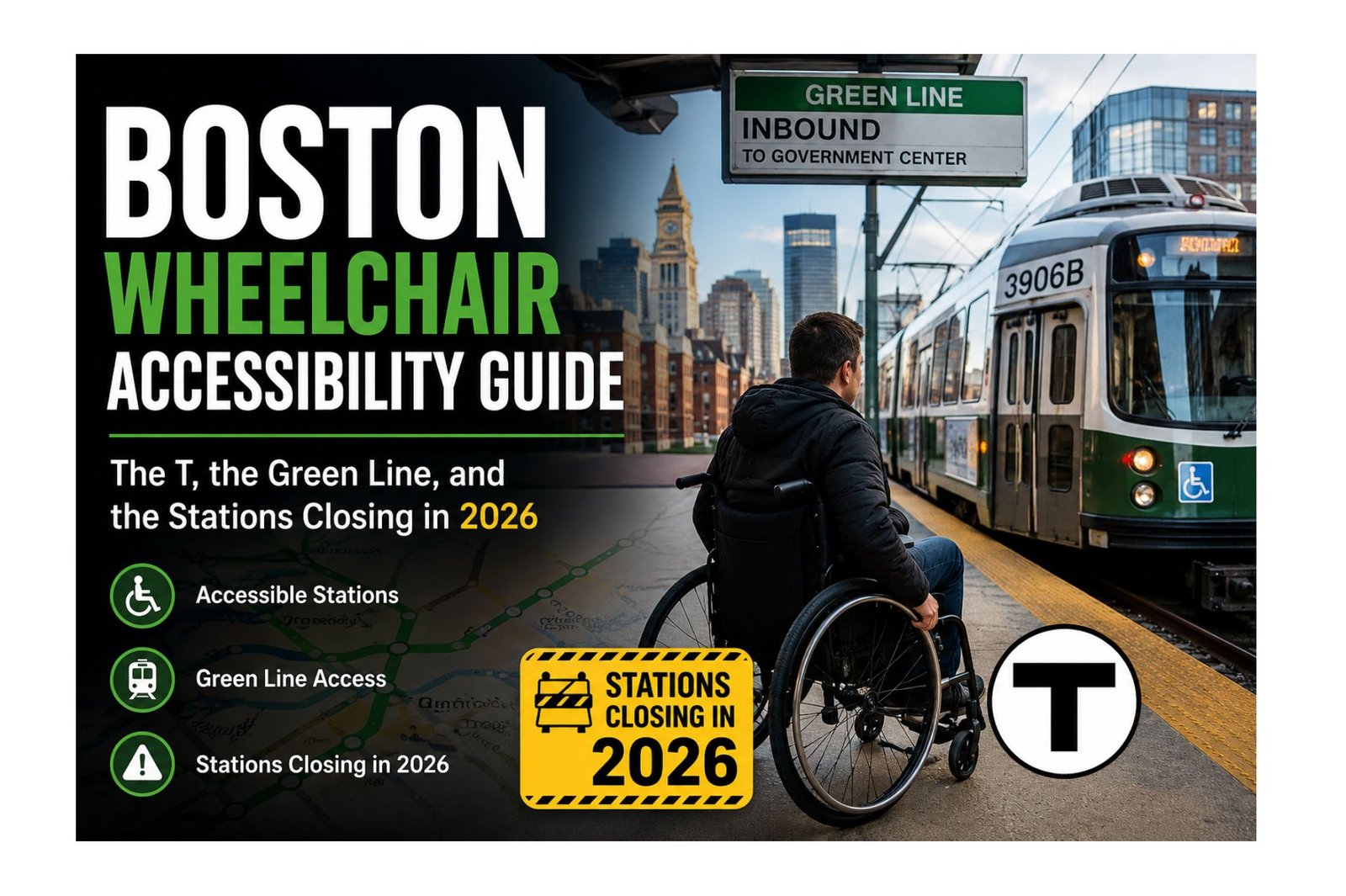
Boston Wheelchair Accessibility Guide: The T, the Green Line, and the Stations Closing in 2026
If you’re planning a trip to Boston and searching for wheelchair accessibility information, most of what you’ll find online treats the MBTA as one system. It isn’t. Right now, in 2026, the Red, Orange, Blue, and Silver lines are a completely different experience from the Green Line — and the Green Line itself is in the middle of the biggest accessibility construction project in the T’s history.
Stations are closing. Stops are being merged. A historic station near Symphony Hall is shut for three full years. None of this is secret — the MBTA publishes it all — but almost nobody has pulled it together into one place a visitor can actually use before booking a trip. This guide does.
Boston’s subway is 83% wheelchair accessible system-wide, but that number hides a real split: the Red, Orange, Blue, and Silver lines are almost entirely accessible, while the historic Green Line is only 64% accessible today. The MBTA is mid-construction on a plan to bring 68 of 70 Green Line stops up to standard by 2031, which means several stops are closed or consolidating right now, in 2026. Subway fare is $2.40; The RIDE paratransit costs $3.35 per ADA one-way trip.
01Why the Green Line Is the Outlier, Not the Whole System
Boston’s subway isn’t really one network — it’s four heavy-rail lines and one much older light-rail line sharing a single brand. The Red, Orange, Blue, and Silver lines run modern, high-platform trains, and the overwhelming majority of their stations already meet accessibility standards.
The Green Line is different by design. Large stretches of it run as a streetcar at ground level, in the median of city streets like Commonwealth Avenue and Beacon Street, boarding directly from the sidewalk rather than from a raised platform. Those surface stops were never built to accessible height, and retrofitting a street-level boarding platform is a far bigger job than adding an elevator to an underground station.
As of the MBTA’s own May 2026 reporting, only 45 of the Green Line’s 70 stops — 64% — currently meet accessibility standards. The agency’s plan is to bring that to 68 of 70 by 2031, and the work is happening branch by branch, right now.
Green Line construction is active and changes month to month. Stops close for days or years depending on the project. The MBTA posts current detours, fare-free shuttle bus routes, and accessible van service at mbta.com — check the day of your trip, not just when you book it.
02Green Line Stops Closing, Closed, or Under Construction Right Now
This is the part almost no accessibility guide covers, because it changes constantly. As of 2026, the following stops are affected by active accessibility construction — some are temporarily out of service, and a few are being permanently closed and merged with a neighboring stop.
| Branch | What’s happening |
|---|---|
| Green Line E | Symphony station is fully closed for a major accessibility rebuild, expected to last approximately three years, with completion targeted for fall 2030. Riders should use Prudential or Northeastern instead. CLOSED |
| Green Line B | Nine stops — Blandford Street, Packard’s Corner, Griggs Street, Allston Street, Warren Street, South Street, Sutherland Road, Chiswick Road, and Chestnut Hill Avenue — are scheduled for accessibility upgrades. Allston Street and Warren Street are being consolidated into one stop; South Street and Chestnut Hill Avenue are also being merged. IN PROGRESS |
| Green Line C | Fairbanks Street and Brandon Hall are being consolidated into a single accessible stop, and Kent Street is closing outright. Construction on the C Branch began in spring 2026 and is projected to finish spring 2027. IN PROGRESS |
Because stops are being permanently merged, not just renovated, a station name that worked for your last trip to Boston may not exist anymore. Check the current MBTA system map before you plan a route.
During Green Line construction, the MBTA has been running fare-free shuttle buses parallel to the affected branches, plus accessible van service directly between the stations on either side of a closure. Both are announced on the MBTA’s Green Line alerts page for the specific dates you’re traveling.
03Getting Around: Your Real Options
Tap each one to see the honest tradeoff.
Boston Transit Options
Red, Orange & Blue Lines
These are your most reliable option. Nearly every station is accessible, trains run on high-level platforms with a minimal gap, and fare is $2.40 with transfers to bus included at no extra charge. If your route can be planned on these three lines instead of the Green Line, do it.
Bus
Every MBTA bus is wheelchair accessible with a ramp, and the fare is $1.70 one-way. Buses are also the official detour route around Green Line construction zones — several routes are running fare-free specifically because of the ongoing accessibility work.
The RIDE (Paratransit)
$3.35 per one-way ADA trip, with a Personal Care Assistant riding free. Trips generally need to be booked by 5 PM the day before — same-day changes or trips outside the standard service area count as “premium” and cost $5.60 instead. Registration requires an eligibility interview with the Mobility Center, so this isn’t a same-day, walk-up option.
Green Line
Usable, but plan carefully. Underground Green Line stations in Boston proper are generally accessible; it’s the surface stops further out on the B, C, and E branches where accessibility is inconsistent and actively under construction through at least 2027. Check the current stop-by-stop status before relying on it.
04What’s Actually Accessible: The Highlights
Boston Public Garden & Freedom Trail (Downtown Section)
Fully accessibleThe Public Garden’s paved paths are flat and wide, and the downtown stretch of the Freedom Trail — from the State House area through Faneuil Hall — runs on paved sidewalks with curb cuts at every crossing.
Faneuil Hall Marketplace
AccessibleGround-level entrances, wide aisles between the food stalls at Quincy Market, and accessible restrooms make this one of the easiest stops for a first afternoon in the city.
New England Aquarium
AccessibleStep-free entry and elevator access to every exhibit level, with wheelchairs available to borrow at the front desk if you need one on the day.
Freedom Trail (Charlestown Section)
Partly accessibleThe route north across the Charlestown Bridge and up to the Bunker Hill Monument includes some narrow, uneven brick sidewalks. The monument itself is not accessible inside. Fine for the walk; skip the climb.
05What Real Travelers Are Saying
Wheelchair users who travel through Boston regularly tend to describe the same three things, almost word for word.
06Frequently Asked Questions
Is the Boston subway wheelchair accessible?
Why are so many Green Line stations closed right now?
How much does The RIDE paratransit cost in Boston?
Are MBTA buses wheelchair accessible?
Sources
- Massachusetts Bay Transportation Authority (MBTA) — Accessibility, Green Line Projects, Fares, and The RIDE pages, mbta.com
- WBUR News — “MBTA plans to close accessibility gaps on nearly all Green Line stops”
- Streetsblog Massachusetts — MBTA Green Line B Branch accessibility coverage

1 thought on “Boston Wheelchair Accessibility Guide”