
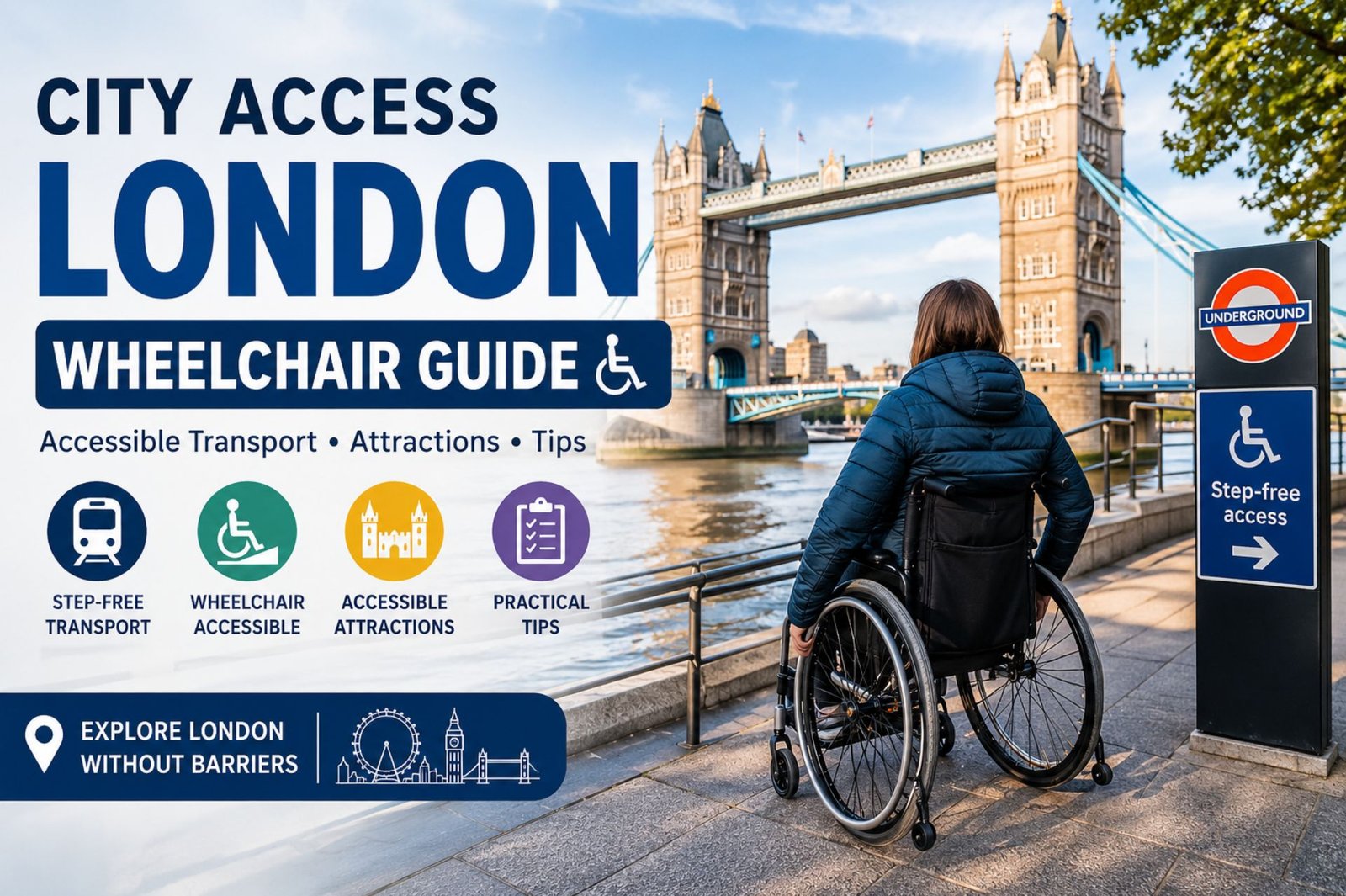
London Wheelchair Accessibility Guide: The Truth About the Tube (And What Actually Works Instead)
Most London guides quietly skip past this. We’re not going to. Here’s the honest number, and the plan that gets you around the city anyway.
A lot of travel content treats London’s Tube as basically figured out. It isn’t, and pretending otherwise doesn’t help anyone actually planning a trip.
Only about a third of Underground stations have step-free access. That means roughly two out of every three Tube stations you might want to use simply aren’t an option if you use a wheelchair.
That’s a real, structural limitation of a network first built more than 160 years ago, long before accessibility was part of the conversation. It deserves to be said plainly rather than glossed over with a hopeful tone.
The good news, and there is real good news here, is that London has other ways to move that work far better — and once you build your trip around them instead of the Tube, the city opens back up.
Only about a third of Tube stations are step-free. Skip the Tube as your default and lean on buses (nearly 100% accessible), the fully step-free Elizabeth line and DLR, and London Overground, which has step-free access at over 60 stations. Always check live lift status before relying on a specific Tube station.
01The Number Worth Knowing Before You Plan Anything
As of 2026, roughly 93 of London’s 272 Underground stations have step-free access — a little over a third. Transport for London has committed to reaching half the network by 2041, which tells you plainly this isn’t a problem solving itself quickly.
Emma Vogelmann, head of policy at the disability-led charity Transport for All, has pointed out that a large share of disabled Tube users also report ongoing issues with the lifts that do exist — outages, lifts too small for larger wheelchairs, and simply not enough of them during busy periods.
The Tube isn’t your primary transit option here — treat it as a bonus
Build your route around buses, the Elizabeth line, DLR, and Overground first. If a step-free Tube station happens to be convenient, that’s a plus, not the plan.
02Your Real Transit Options, Ranked by Reliability
Tap each one to see how it actually performs.
London Transit Comparison
Based on Transport for London’s published accessibility data as of 2026.
Buses — Your Most Reliable Default
Nearly the entire fleet is wheelchair accessible with ramps and kneeling capability, and over 94% of stops are accessible too. This is genuinely the backbone of accessible travel in London, not a backup plan.
Elizabeth Line & DLR — Fully Step-Free
Every single station on both lines is step-free, with level boarding. If a route can be built around these lines, it’s the smoothest ride in the network.
London Overground
More than 60 stations offer step-free access — a genuinely strong showing, though not universal, so it’s worth checking your specific stations before relying on a route.
The Tube — Check Before You Commit
Only around a third of stations are step-free, and lift reliability varies. Treat any Tube-based route as something to verify station by station, not assume.
03Building a Route That Actually Works
- Check TfL’s step-free Tube map before planning any route — it’s the single source of truth, and it updates as new stations convert.
- Default to buses for short-to-medium hops rather than treating the Tube as the obvious first choice.
- Prioritize the Elizabeth line and DLR whenever a route can realistically use them — they’re the most dependable rail options in the city.
- Check live lift status at any Tube station you do plan to use, since outages are common enough to plan around.
- Build in extra time for longer, more convoluted routes that avoiding inaccessible stations sometimes requires.
04What Real Travelers Are Saying
Wheelchair users who live in or frequently visit London tend to describe the same recalibration.
Themes From the Accessible Travel Community
Common patterns reported across accessible-travel blogs, disability advocacy groups, and London residents — shared experience, not individual endorsements.
Regular travelers consistently describe planning routes around the bus network first, rather than defaulting to the Tube and hoping for the best.
Frequent Tube users describe checking live lift status the same way others check the weather, since outages are common enough to genuinely disrupt a route.
Travelers repeatedly point to the fully step-free Elizabeth line as a genuine improvement to cross-city trips since it opened, in contrast to the older Tube network.
05Frequently Asked Questions
Only partially. Roughly a third of Tube stations have step-free access, meaning about two-thirds still require stairs or escalators, with no elevator alternative.
London’s bus network is the most consistently accessible option, with nearly all buses wheelchair accessible and over 94% of bus stops accessible. The Elizabeth line, DLR, and all tram stops are also fully step-free.
Not always. Outages, undersized lifts for larger wheelchairs, and insufficient lift capacity during busy periods have been reported by a significant share of disabled Tube users.
The Elizabeth line, the DLR, and all London tram stops are entirely step-free. London Overground has step-free access at more than 60 of its stations.
A note on accuracy: TfL is actively converting more stations to step-free access, so these figures will continue to improve over time. Always check TfL’s official step-free Tube map for the current status before your trip.

5 thoughts on “London Wheelchair Access Guide: Navigating the City”