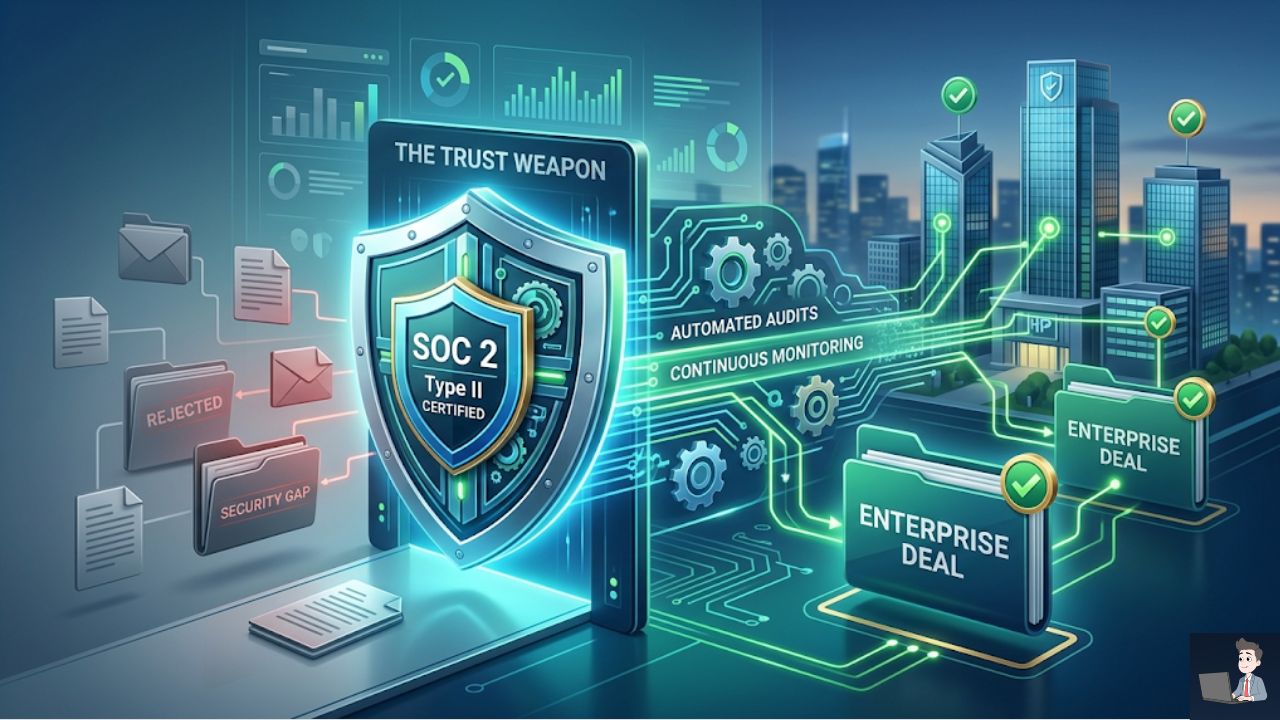
I remember the exact email that made my stomach drop.
We had been courting a massive enterprise client for three months.
The demos went perfectly. The pricing was approved. The champion on their end was literally asking for the contract.
Then, he looped in their IT Procurement team.
The Procurement manager sent a one-line email: “Looks great. Please send over your latest SOC 2 Type II report and a link to your most recent penetration test, and we’ll get this signed today.”
I just stared at the screen. We didn’t have a SOC 2 report.
We didn’t even have an official “Access Control Policy.” Our security strategy at the time consisted of strong passwords and hoping for the best.
When I told the procurement manager we didn’t have the report, the deal didn’t just stall. It froze solid.
They told us to come back when we took our data security “seriously.”
Losing a five-figure contract over a missing PDF is a gut punch you don’t easily forget.
When I looked into what it took to actually get a SOC 2 report, I nearly had a panic attack.
The traditional process involves hiring a consultant for $500 an hour. You spend six months taking hundreds of screenshots of laptop settings. You constantly nag your developers to prove they use two-factor authentication.
I refused to do it the old way.
I went down the rabbit hole of compliance automation, and it completely changed how I run my operations.
If you are losing deals because you can’t pass a security review, you don’t need to hire a massive consulting firm. You need an “Autopilot.”
Here is my hands-on, realistic guide to using AI-driven compliance platforms to turn a 6-month auditing nightmare into a streamlined, background process.
Phase 1: Decoding the “Alphabet Soup”
Before we automate it, let’s clear up the massive confusion around what SOC 2 actually is.
Founders constantly say, “I need a SOC 2 Certificate.”
First lesson: There is no such thing as a SOC 2 Certificate. You do not get a diploma to hang on your wall.
SOC 2 (System and Organization Controls) is an Attestation Report.
An independent, third-party auditor (a CPA firm) looks at your company’s infrastructure, reads your policies, and writes a highly detailed legal report saying, “Yes, we checked their homework, and their data is safe.”
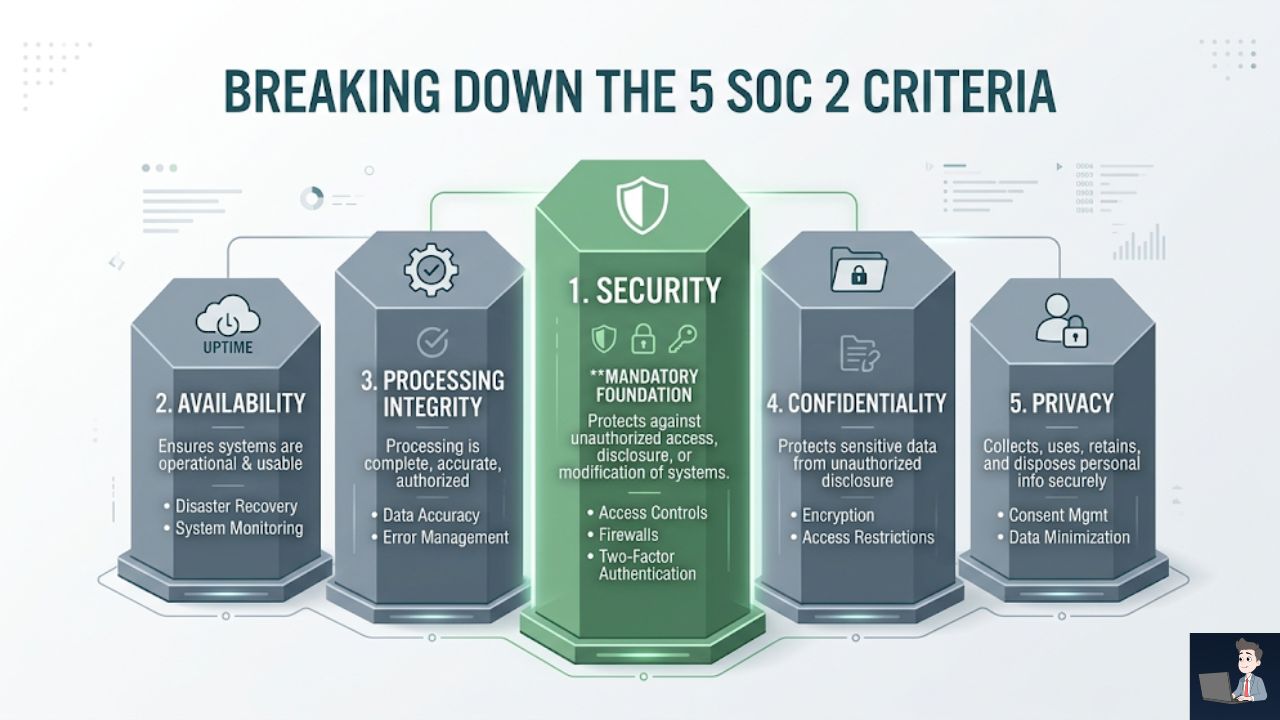
To get this report, you have to prove you meet the Trust Services Criteria (TSC).
There are five of them:
- Security (The Mandatory One): Do you have firewalls, MFA, and endpoint protection?
- Availability: If AWS goes down, do you have backups and a Disaster Recovery plan?
- Confidentiality: Is restricted client data encrypted at rest and in transit?
- Processing Integrity: Does your software actually do what it’s supposed to do without dropping data?
- Privacy: Are you handling personal info (PII) according to strict privacy laws?
If you want to understand exactly how an auditor legally defines these five criteria, watch this CPA Exam masterclass by Professor Farhat. It breaks down the exact Information Systems and Controls standards that auditors use to judge your infrastructure.
The Biggest Rookie Mistake
When I first started, I thought I had to audit for all five criteria. Do not do this.
Unless you are a massive healthcare or financial data processor, only audit for Security (and maybe Confidentiality) in your first year.
Adding the other criteria will double the cost of your audit and add months to your timeline. Keep your scope incredibly tight.
Phase 2: The End of “Screenshot Hell”
In 2019, passing a SOC 2 audit meant “Screenshot Hell.”
If your policy said, “All employee laptops must have encrypted hard drives,” the auditor would ask you to prove it.
You would literally have to ask 30 employees to take a screenshot of their Mac’s “FileVault” settings and drop it into a Google Drive folder. By the time the auditor looked at it, the data was already outdated.
This is where Compliance Automation platforms completely shifted the industry.
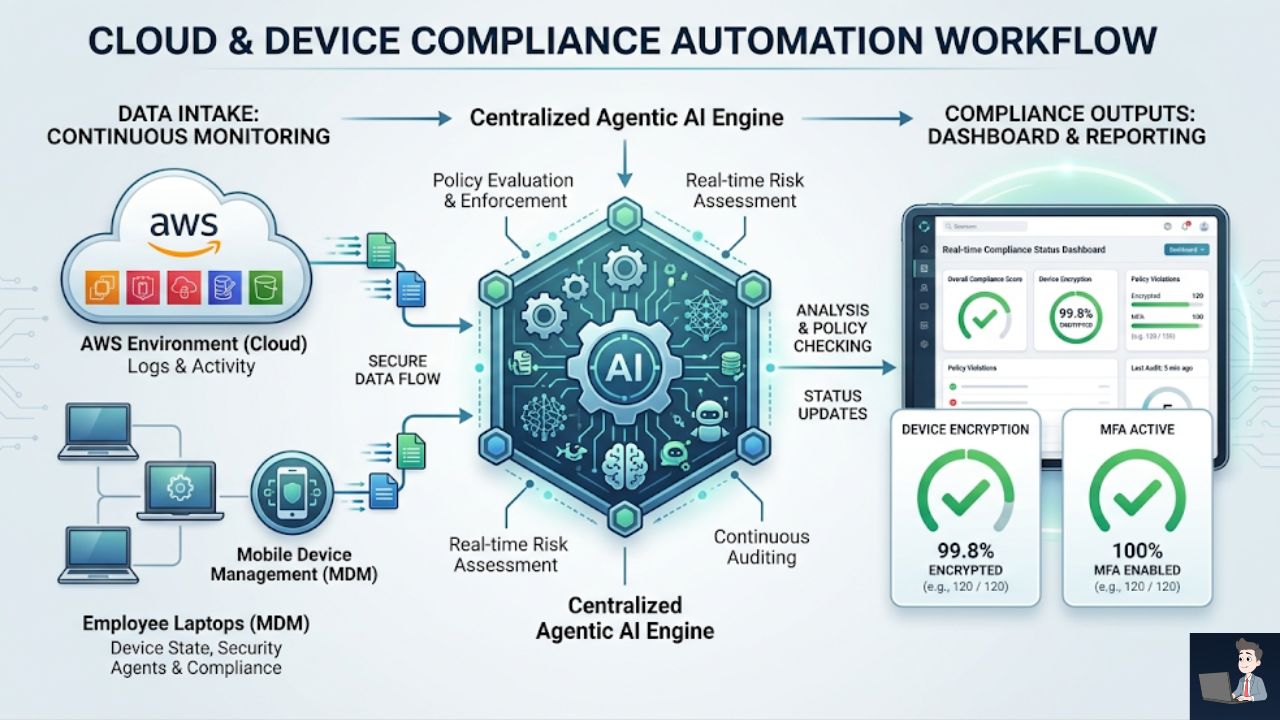
They use API connections and agentic monitoring to do the work in the background.
1. The Cloud API Hookup
Instead of taking screenshots of your Amazon Web Services (AWS) or Google Cloud settings, you grant the automation tool a “Read-Only” API key.
The software scans your cloud infrastructure 24/7.
If a junior developer accidentally leaves an S3 bucket publicly accessible on a Tuesday afternoon, the platform instantly fires off a Slack alert: “Compliance Violation: Public S3 Bucket detected. Fix immediately.”
2. The Endpoint Agents (MDM)
You deploy a tiny, silent app onto your employees’ laptops, or you hook the platform into your Mobile Device Management (MDM) software.
The AI constantly checks: Is the hard drive encrypted? Is the screen saver set to lock after 5 minutes? Is the antivirus running?
If an employee turns off their firewall to play a video game, the system logs it.
When the auditor asks for proof that laptops are secure, you just hand them the dashboard. The evidence is continuously collected.
3. AI Policy Generation
You need about 20 massive legal documents to pass SOC 2. Lawyers charge a fortune to write these.
Modern platforms have AI templates built-in. You fill out a quick wizard.
The system generates 50 pages of perfectly formatted, auditor-approved policies. You just read them, click approve, and have your team sign them digitally inside the app.
Phase 3: The 2026 Tool Battle (Vanta vs. Drata vs. Scytale)
I spent weeks demoing these platforms.
If you are trying to decide which “Robot Auditor” to hire, here is the unvarnished truth based on my experience and recent 2026 data.
| Platform | Best For | Core Strength | Core Weakness |
| Vanta | Speed & Simplicity | Massive integration library (375+) and the largest network of partner auditors. | Can feel rigid. Custom, obscure tech stacks are hard to map. |
| Drata | Technical Developers | Deep automation. Granular control over evidence and infrastructure mapping. | Requires more technical setup time due to its advanced customization. |
| Scytale / Secureframe | Non-Technical Founders | Heavy focus on customer success. They assign dedicated compliance experts to hold your hand. | Often carries a slightly higher price tag for the consulting layer. |
Phase 4: The Hidden Traps
The marketing around these tools implies that you just “plug it in and get your SOC 2.”
That is a dangerous illusion. Here are the three traps I almost fell into:
Trap 1: The “Policy Lie”
The AI will generate a beautiful “Background Check Policy” for you. You click approve.
But here is the catch. If your policy says you do background checks on all new hires, but your HR team forgets to run one on the new marketing intern, you fail the audit.
The software writes the rule, but you have to follow it.
It is better to have a slightly weaker, honest policy than a draconian one you break every week.
Trap 2: You Still Have to Pay a Human Auditor
Vanta and Drata do not issue SOC 2 reports. They just organize the evidence.
You still have to hire an independent CPA firm to log into the software, review the data, and write the legal attestation.
Total Cost Math: You will pay ~$10,000 for the software, and another ~$15,000 to the human auditor. Budget $25k to $30k for your first year.
SOC 2 Compliance ROI Calculator
Calculate the true cost of delaying compliance by comparing your annual lost revenue against the fixed cost of an automated SOC 2 audit.
Total Revenue Lost
Net ROI of Compliance
Trap 3: The Penetration Test
No automated tool can replace a human hacker.
Every SOC 2 auditor will require a manual Penetration Test of your web application performed by a certified ethical hacker.
This is an additional $3,000 to $6,000 expense that you must complete before the audit finishes.
Phase 5: The "Type I" vs. "Type II" Timeline
This is the most common question I get from panicked founders.
- SOC 2 Type I (The Photograph): This evaluates your security at a specific moment in time. The auditor says, "On October 1st, 2026, their systems were secure." You can achieve a Type I in about 4 weeks. It’s a great stop-gap to show clients you are serious.
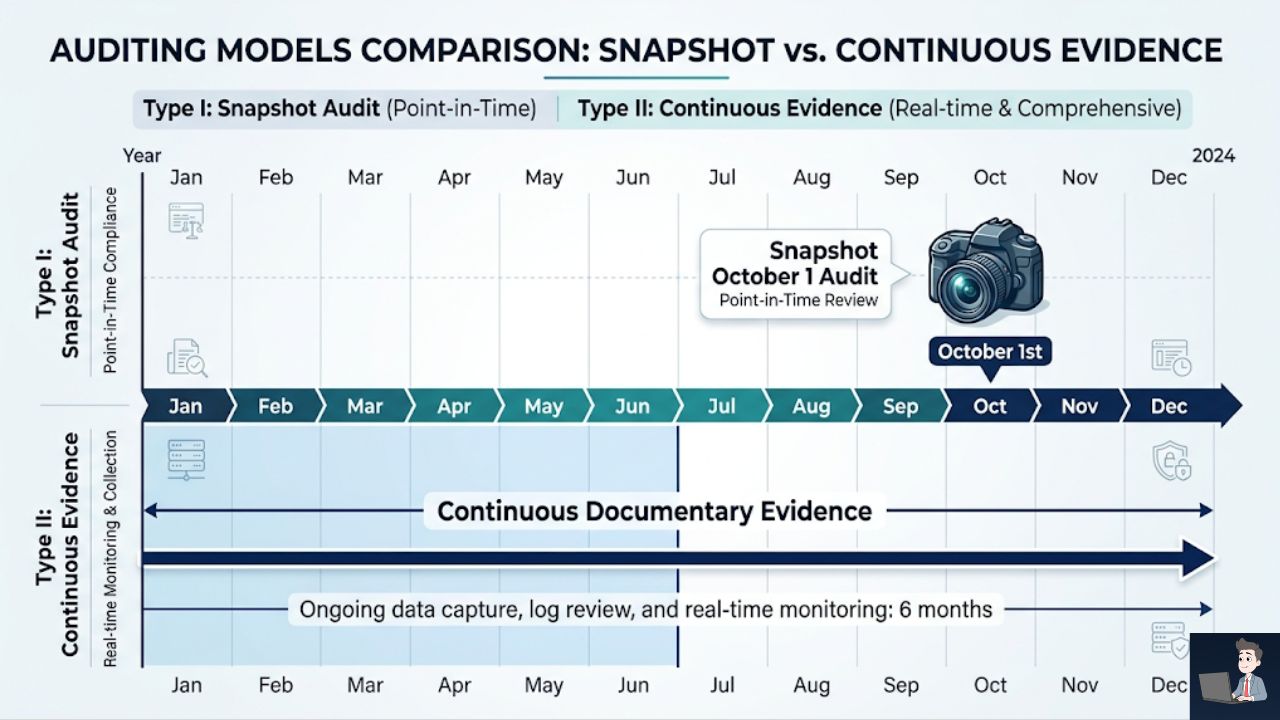
- SOC 2 Type II (The Documentary): This evaluates your security over a period of time (usually 3, 6, or 12 months). The auditor says, "From January to June, their systems were secure every single day." This is the gold standard that enterprise companies actually demand.
You cannot "rush" a Type II. It requires time to pass. You must start your observation window immediately.
Phase 6: Turning an Expense into a Revenue Weapon
Spending $30,000 on compliance feels painful until you realize how to use it to close deals.
When we finally got our SOC 2 Type II, I didn't just lock the PDF in a drawer.
I used our compliance platform to build a live, public-facing security dashboard.
I put a "Security & Trust" link in the footer of our website.
When a prospect clicks it, they don't see a boring PDF. They see a live dashboard showing real-time metrics.
- Data Encryption: 100% Active
- MFA Enforced: 100% of Staff
- Last Pen Test: Passed (Download Summary)
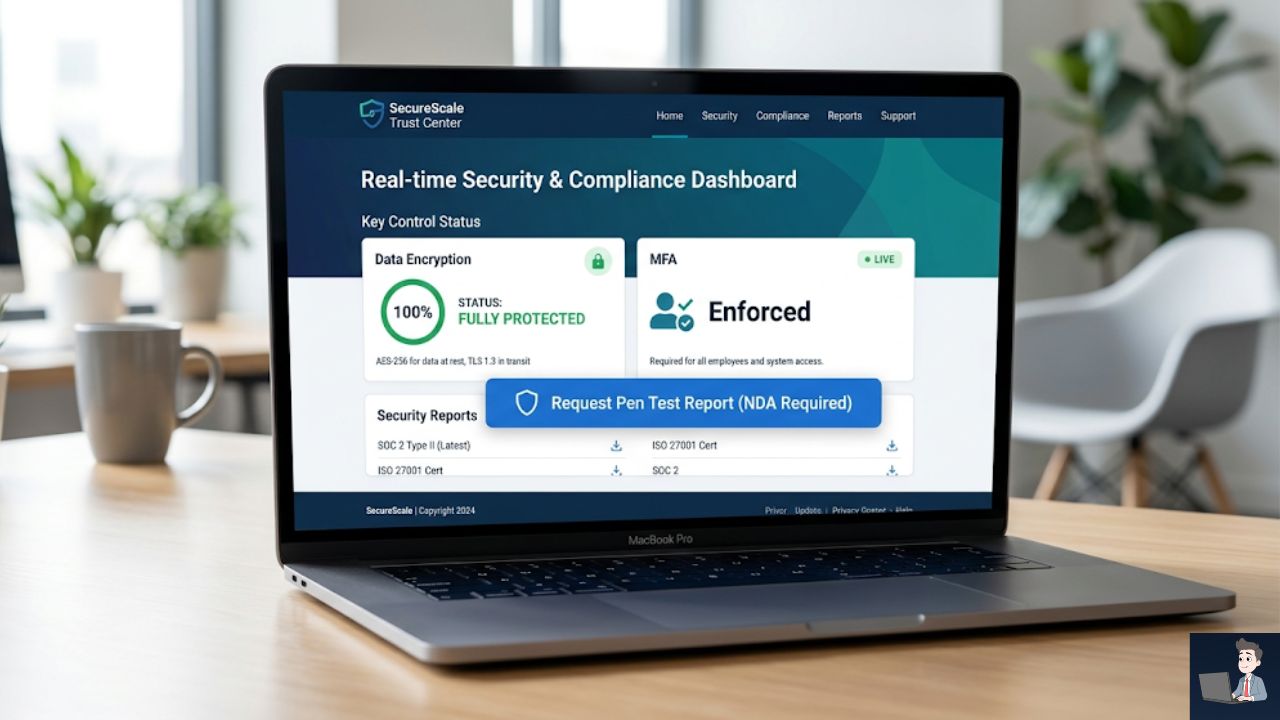
Instead of answering 300-row Excel security questionnaires from procurement teams, I just send them the link to our Trust Center.
It forces them to agree to a Non-Disclosure Agreement (NDA) automatically before downloading our sensitive docs. It completely bypasses the manual Q&A process.
Our sales cycle for enterprise clients dropped from 4 weeks to 5 days.
The $30,000 audit paid for itself on the very first contract we closed.
The Bottom Line
When you are a growing business, compliance feels like a massive, terrifying speedbump.
But in the modern B2B landscape, security is a feature.
In 2026, data breaches cost businesses an average of $4.6 million. Procurement teams are not taking chances on unsecured vendors.
If you and a competitor offer the exact same software at the exact same price, but you have a SOC 2 Trust Center and they don't, you win the contract 100% of the time.
The procurement department will literally force the buyer to choose you.
Don't let the anxiety of an audit cost you a massive deal.
Stop taking screenshots, automate the busy work, and turn your security posture into your biggest competitive advantage.
Operational & Security Disclaimer: This article is for educational and informational purposes only. Achieving SOC 2 compliance does not guarantee immunity from cyberattacks. Always consult with a certified CPA firm and a dedicated cybersecurity professional when designing your internal security controls and selecting a compliance automation vendor.