Traveling with prescription medications takes a little extra planning, but none of it is complicated. A few habits — the right bag, the right paperwork, and knowing what security will ask — cover almost every situation.
The golden rules
- Carry-on only. Never put essential medication in checked luggage. Bags get delayed; your health can’t wait.
- Bring extra. Pack at least 2–3 days more than your trip length to cover delays.
- Keep original labels. Labeled pharmacy containers are your proof of legitimacy everywhere.
- Split the risk. If traveling with a companion, divide critical meds between two bags.
Build your medication travel kit
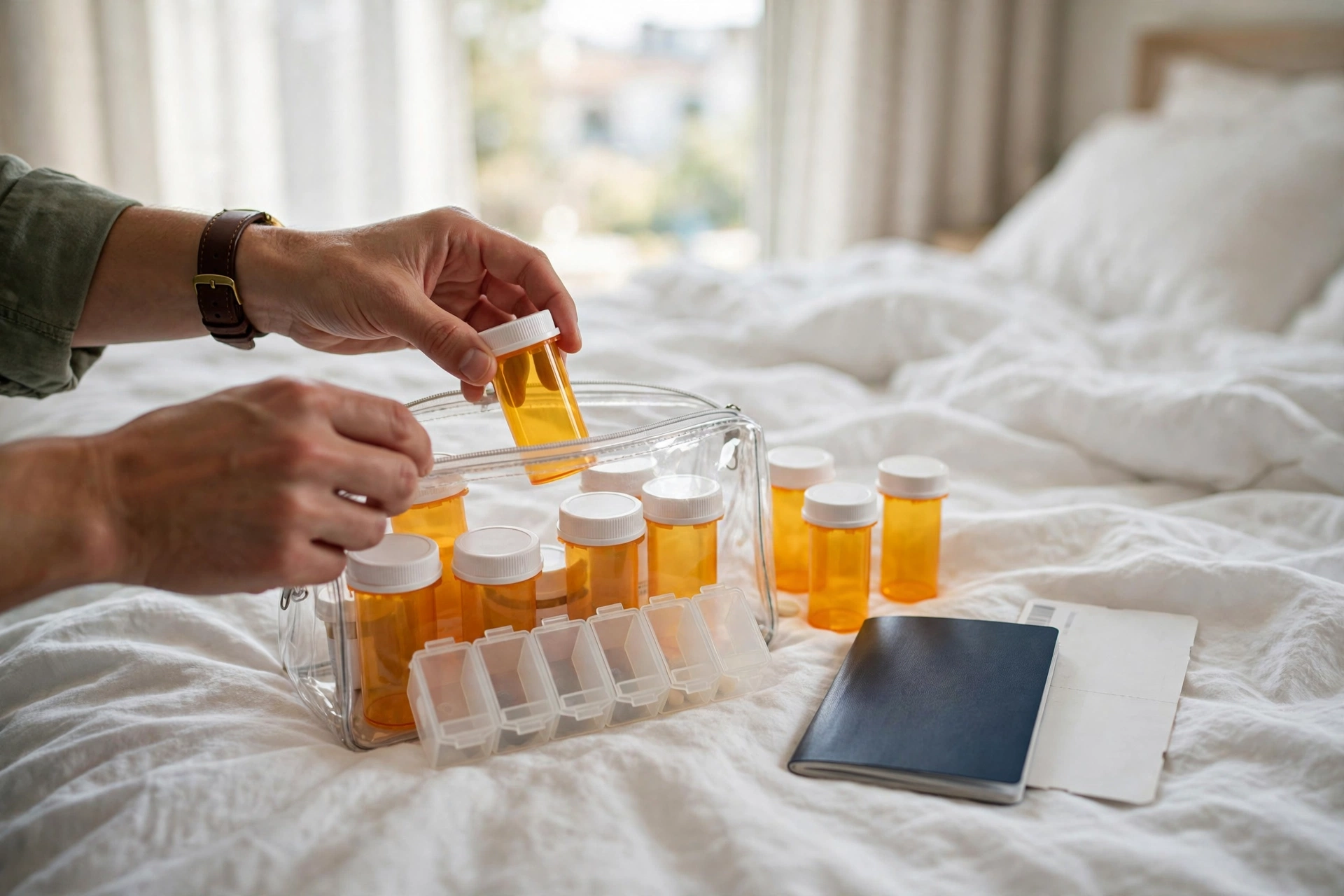
Put together a small dedicated pouch so everything is in one place at security and in an emergency:
- A printed list of every medication: generic name, dosage, and schedule
- A doctor’s letter on letterhead describing your prescriptions
- A weekly pill organizer plus the original labeled bottles
- A copy of your prescriptions stored in your phone and email
Airport security: what to expect
In the U.S., TSA allows medically necessary liquids, gels, and aerosols over the standard 3.4oz limit — but you must declare them. Tell the screening officer about medically necessary liquids and supplies before your items go through the X-ray; declaring them upfront keeps the process smooth.
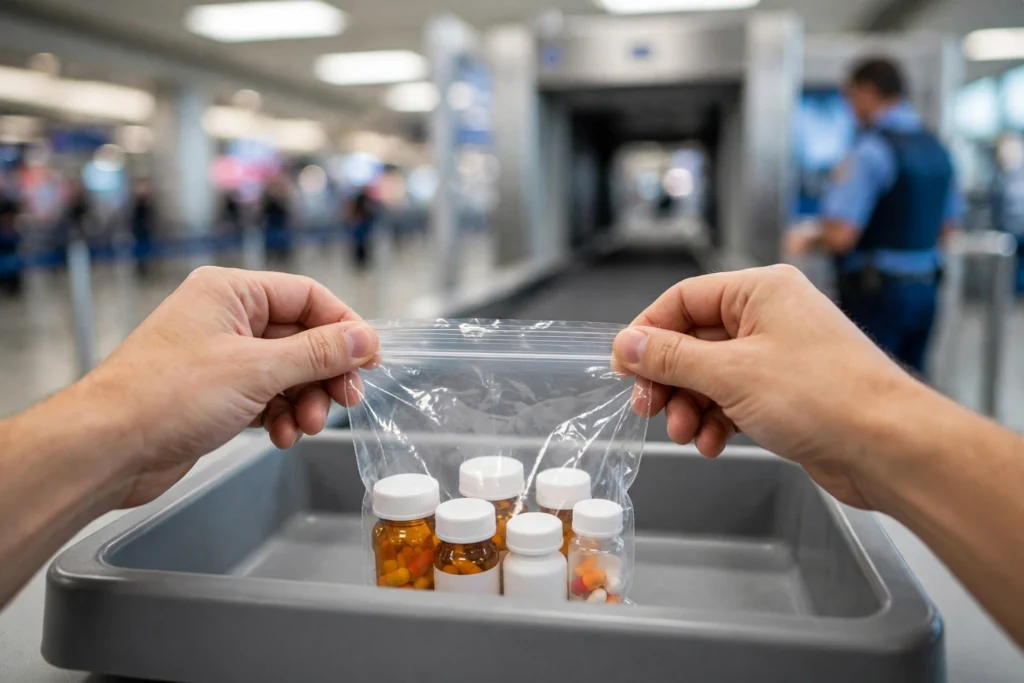
Syringes, EpiPens, and ice packs for medication are permitted. Ice packs must be frozen solid at screening or they fall under liquid rules. You can request that medication not go through the X-ray, though officers may use alternative screening instead.
International travel: where it gets tricky
The same pill can be perfectly legal at home and a controlled substance abroad. Travelers commonly trip over ADHD stimulants, codeine-based painkillers, and even pseudoephedrine, which is restricted in Japan. Before any international trip, check the destination country’s rules through its embassy or health ministry website — not a travel forum.
- Carry your prescription and a doctor’s letter; get the letter translated for non-English-speaking destinations.
- Keep everything in original labeled packaging.
- Plan for time zones: shift your dosing schedule gradually a few days before departure, and set phone alarms on the new schedule.
If something goes wrong
- Lost medication: travel insurance with medical coverage can help you replace prescriptions; a local pharmacy plus your digital prescription copy often solves it the same day.
- Questioned at a border: stay calm, show your paperwork, and ask for a supervisor — most issues resolve with documentation.
- Ran out: contact your travel insurer or your home pharmacy about an emergency transfer.
Refrigerated medications and medical devices
Some medications — insulin, certain biologics, and some eye drops — need to stay cool. A small insulated pouch with frozen gel packs works for most journeys; the packs must be frozen solid at security or they count as liquids. If you need refrigeration at your destination, email the hotel ahead and ask for a room fridge, or ask the airline about onboard options well before you fly. Never check refrigerated medication — hold baggage can freeze or overheat.
Medical devices need their own plan. CPAP machines, nebulisers and TENS units should travel in your carry-on, with batteries and chargers in an accessible pocket. Security may swab or X-ray devices separately, which is routine — allow a few extra minutes. If your device has a lithium battery, check the airline’s watt-hour limits before you book, since spare batteries usually must travel in the cabin rather than in checked luggage.
Related guides
- TSA PreCheck with medical devices: your screening rights
- Flying with diabetes: TSA rules for insulin, pumps and CGMs
- Flying with a feeding tube
Frequently asked questions
Can I fly with syringes?
Yes, when they’re for medication — bring the medication with its pharmacy label.
Do pills have to stay in original bottles?
In the U.S., no — but internationally, original packaging is strongly recommended.
What about medical marijuana?
Don’t fly with it. It’s illegal under U.S. federal law and in most destinations, regardless of your home state’s rules.
Should I tell the airline?
Only if you need something specific, like refrigeration — request it well ahead of time.
The bottom line
Pack meds in your carry-on, bring extra, keep the labels, and carry a doctor’s letter. Do that and medications become the easiest part of your trip.
Medical note: this guide covers travel logistics only and is not medical advice. Talk to your clinician or pharmacist about your personal medical needs.
Sources & verification
Key details in this guide were checked against official sources on 18 October 2026.
- TSA Cares — the TSA’s programme for passengers with disabilities, medical conditions and anyone needing additional assistance at security, describing what support is available.
- TSA’s guidance for disabilities and medical conditions — the official TSA page including a dedicated section on travelling with medications.

8 thoughts on “Traveling With Medications: Packing, Paperwork, and Airport Security”